What Is a Bed Shaker Alarm and Do I Need One?

A bed shaker alarm is a vibrating pad placed under your pillow or mattress that wakes you through physical movement instead of sound. If you've ever slept through an alarm, have hearing loss, or share a room with someone whose sleep you can't disturb - this guide tells you exactly what it is, how it works, and whether it's the right solution for your situation.
The Short Answer First
A bed shaker alarm - sometimes called a vibrating alarm clock, a bed shaker alarm clock, or a pillow shaker alarm - is a device with a built-in vibration motor that activates at your set alarm time and physically shakes the surface you are sleeping on. Unlike a regular alarm clock, it does not rely on sound to wake you up. The signal goes through your body instead.
The long version - covering who actually needs one, what the different types are, how to choose the right model, and where common misconceptions lead buyers astray - is what the rest of this guide is for.
A bed shaker alarm is a vibrating pad or disc - powered either by a wall-connected clock unit or by its own rechargeable battery - that is placed under a pillow or mattress. When the set alarm time arrives, a small electric motor in the pad spins an off-center weight at high speed, generating rhythmic vibration that travels through the sleeping surface into the body. The body's mechanoreceptors - sensory cells in the skin that detect touch and movement - register the vibration and produce arousal from sleep, independently of the auditory system.
How a Bed Shaker Alarm Actually Works
The mechanism is simpler than most people expect. Inside the shaker pad is a small electric motor with an unbalanced - or "eccentric" - weight attached to its shaft. When the motor spins, the off-center weight creates a wobbling force that vibrates the entire pad. That vibration travels through whatever surface the pad is resting on and produces a physical movement you can feel through your body.
This is exactly the same principle behind the "vibrate" function on your phone - just significantly more powerful, and designed to travel through a mattress rather than sit in a pocket. The intensity of the vibration depends on the motor's output, the mass of the weight, and how directly the pad is in contact with the sleeping surface. All of these factors vary meaningfully between a cheap consumer device and a purpose-built product like those in the Bellman lineup.
The reason vibration wakes people - including people who sleep through loud sound alarms - is that it reaches the brain through a different sensory pathway entirely. Sound travels through the ear canal, across delicate cochlear hair cells, and up the auditory nerve. Vibration is detected by Pacinian corpuscles in the skin and travels up through separate somatosensory nerve pathways. A sleeping brain that has learned to suppress a familiar alarm sound cannot suppress a physical shaking signal it is not habituated to. For deeper reading on neuroscience: How Does a Bed Shaker Alarm Clock Actually Work?
The Three Types of Bed Shaker Alarms
Not all bed shakers are the same product, and the category divides meaningfully into three types. Understanding which type you are looking at is the first step to choosing correctly.
Do I Need a Bed Shaker Alarm? An Honest Answer for Each Situation
The answer depends entirely on your specific situation. Here is an honest assessment for each common profile - not a sales pitch, but a direct answer based on what the technology actually solves.
This is the clearest yes. When hearing aids or cochlear implant processors are out, you are functionally deaf during the hours when your alarm needs to work. A sound-based alarm - at any volume - is either inaudible or severely reduced. A bed shaker is not a supplement to your alarm; it is the alarm. The Bellman Alarm Clock Pro, with its bed shaker, four flashing LEDs, and battery backup, is the most complete single-unit solution for this situation.
If you have tried multiple alarm clocks, multiple smartphones, and multiple volume levels and still sleep through them consistently, you are not simply a "heavy sleeper." You likely have either a sleep architecture that deeply suppresses auditory signals, some degree of undiagnosed high-frequency hearing loss (extremely common and frequently unrecognized), or both. A bed shaker reaches the body through a non-auditory pathway that is harder for the sleeping brain to suppress. The Alarm Clock Pro's three simultaneous channels - vibration, lights, and 100dB sound - give the highest probability of breaking through.
Even partial hearing loss - particularly in the high-frequency range most affected by age-related and noise-induced loss - makes standard alarm tones functionally unreliable. The 2,000–4,000 Hz range that most alarms use is precisely where presbycusis and noise-induced loss hit first. A bed shaker bypasses the frequency problem entirely. The Alarm Clock Classic is the straightforward starting point for this profile: a wired bed shaker, a 100dB multi-frequency ascending alarm, and a simple two-dial interface.
Hotel alarm clocks are unreliable in a specific way: they retain other guests' settings, may have dead batteries, and sit at the other end of an unfamiliar room. For travelers with hearing loss or heavy sleeping habits, the Bellman Vibio is a portable Bluetooth bed shaker that stores your alarm settings locally, fires even if your phone dies, and fits in any bag. You bring your own alarm every time. Most people who buy the Vibio for travel quickly decide they won't travel without it.
One of the most practical and least-discussed uses for a bed shaker. The Vibio produces no sound at all - it is silent by design. Under-pillow placement contains the vibration closely. You wake up; your partner does not. The alternative - a sound alarm turned low enough not to disturb others - is almost always turned low enough not to wake you reliably either. The Vibio removes that tradeoff entirely.
Age-related high-frequency hearing loss (presbycusis) affects 1 in 3 adults over 65 and begins in most people in their 40s and 50s - often before any clinical diagnosis. Standard alarm tones in the 2,000–4,000 Hz range may be gradually becoming harder to detect, and the effect compounds when hearing aids are removed for sleep. If alarms that used to work reliably have become unreliable with no obvious change in sleep habits, the auditory explanation is the most common one. A bed shaker eliminates the frequency-range variable.
When missing an alarm has genuine professional or health consequences - medication schedules, dialysis, overnight shifts - reliability becomes a safety consideration. The Alarm Clock Pro's three-channel approach and battery backup means there is no single point of failure in your morning routine. Sound alone, even at 100dB, is a single-channel system. Three simultaneous independent channels are meaningfully harder to sleep through.
If your current alarm works every morning without fail and you have no reason to believe your hearing is affected, a bed shaker is not a necessary upgrade. That said, many people in this category find the Vibio useful for travel, or appreciate the Alarm Clock Pro's silent-mode vibration for early-morning alarms in shared sleeping situations. But the core question - do you need one? - Is your current setup is genuinely working.
A bed shaker alarm doesn't ask your ears to do anything. It moves your body directly. That's why it works when everything else has failed - it operates on a completely different sensory pathway from the one that failed.
Bellman & Symfon - Design PrinciplesFive Misconceptions About Bed Shaker Alarms
"It's only for completely deaf people."
Bed shakers are used by deaf adults, hard-of-hearing adults at every level of loss, heavy sleepers with typical hearing, travelers, light-sleeping couples, shift workers, and anyone whose regular alarm has become unreliable. The technology is not diagnostic - it serves anyone for whom an auditory-only alarm is insufficient.
"I just need a louder alarm, not a shaker."
Volume alone doesn't solve the problem when the issue is high-frequency hearing loss. Standard alarm tones cluster in the 2,000–4,000 Hz range - the range most damaged by presbycusis and noise-induced loss. A louder alarm at the wrong frequency remains inaudible at any volume. Multi-frequency ascending alarms like those in Bellman clock units help, but adding vibration removes the frequency dependency entirely.
"The vibration will disturb my partner too."
Under-pillow placement with a compact shaker like the Vibio on soft intensity is unlikely to be felt on the other side of a standard mattress. Under-mattress placement near the torso produces stronger vibration for the user but some detectable movement for a co-sleeper. Most couples find under-pillow placement on soft-to-medium completely non-disruptive. It is far less intrusive than an audible alarm.
"A phone alarm is the same thing."
A smartphone on vibrate produces vibration through its own chassis - a weak, localized signal designed to be noticed in a pocket during waking hours. It is not designed to travel through a mattress and wake a deeply sleeping person. A dedicated bed shaker motor is an order of magnitude more powerful and specifically designed for under-surface placement. The comparison is similar to saying a desk fan and an industrial fan are the same because both move air.
"Placement doesn't matter much."
Placement is one of the most important variables in bed shaker effectiveness - more so than motor strength for most users. Under the torso near the chest, it produces the strongest and most distributed signal. Under a thick memory foam topper (rather than between topper and mattress) dramatically reduces vibration transmission. Near the feet produces little useful signal. The same device, placed correctly vs. incorrectly, can feel completely different in terms of waking reliability. See How Does a Bed Shaker Work? for the full placement guide.
"They're bulky and complicated to set up."
The Vibio is 3.7 × 3.7 × 1.1 inches - smaller than most TV remotes - with a quilted fabric cover that blends into any bed. The wired Alarm Clock Classic sets up with two push-rotate dials in under a minute. Neither requires technical knowledge or complicated installation. The Vibio requires a one-time Bluetooth pairing with the free app; after that, it operates independently every morning.
What to Look for When Buying a Bed Shaker Alarm
If you have reached the conclusion that a bed shaker is right for your situation, the next question is which one. Here are the factors that actually affect performance - beyond the marketing descriptions.
Motor Strength - The Most Overlooked Spec
The vibration motor is the entire product. A weak motor may produce perceptible vibration when you hold the pad in the air but fail to transmit sufficient force through a mattress to a deeply sleeping person. Look for products with established track records among deaf and hard-of-hearing users, not consumer gadgets repurposed as alarm accessories. All wired Bellman models - the Alarm Clock Pro, Classic, and Alarm Clock Receiver - use motors selected specifically for reliable through-mattress transmission.
Wired vs. Wireless - Match to Your Use Case
Wired shakers (connected to a bedside clock unit) offer zero latency, no battery to manage in the shaker itself, and no Bluetooth pairing - they are the more dependable primary home alarm. Wireless shakers like the Vibio offer portability and complete silence but require periodic charging. The right choice depends on whether your priority is home reliability or portable flexibility.
Additional Alert Channels - Especially for Deaf Users
A single-channel vibration-only alarm is better than a sound-only alarm for deaf users, but a multi-channel alarm - vibration plus flashing lights - is more reliable than either alone. The Alarm Clock Pro's four high-intensity LEDs activate simultaneously with the bed shaker, giving the sleeping brain two independent non-auditory signals to process at once. If one morning the vibration alone doesn't achieve immediate arousal, the LED flash often does.
Battery Backup - Not Just for the Display
Many alarm clocks advertise battery backup, but power only the display on backup. For a bed shaker alarm to be genuinely reliable, backup power must keep all alert functions - vibration, lights, and sound - running through a power outage. The Alarm Clock Pro includes pre-installed rechargeable NiMH batteries that maintain all three channels. Confirm this specifically before purchasing any model based on a battery backup claim.
Smart Snooze vs. Fixed Snooze
A fixed 9-minute snooze allows repeated return to deep sleep between alarm cycles, which compounds the original waking problem. The Smart Snooze on the Bellman Alarm Clock Pro and Classic progressively shortens the snooze interval from 9 minutes down to 2 minutes in 2-minute steps. By the time the interval is at 2 minutes, the repeated physical activation cycles have usually produced full arousal. This is a behavioral design decision that matters in practice.
The Bellman Bed Shaker Lineup
Bellman & Symfon has been designing assistive alerting products for deaf and hard-of-hearing users since 1989. Every alarm clock in the US lineup includes a bed shaker component as a primary - not supplementary - alert channel. Here is where each model fits.

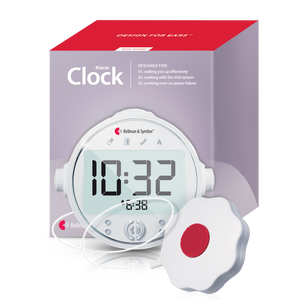
The most complete bed shaker alarm Bellman makes. Wired shaker (pillow or mattress) + four flashing LEDs + 100dB multi-frequency ascending sound, all activating simultaneously. Pre-installed rechargeable battery backup powers all channels during power outages. Smart Snooze reduces from 9 to 2 minutes. Sound toggle lets you disable audio entirely, leaving vibration and lights active. Recommended starting point for most deaf and hard-of-hearing adults and for heavy sleepers who want maximum wake-up reliability at home.
View Alarm Clock Pro →
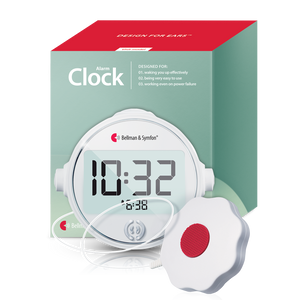
The Pro's core reliability in a streamlined package: wired bed shaker, 100dB multi-frequency ascending alarm, Smart Snooze, battery backup, and sound-off mode. Two dedicated push-rotate dials for time and alarm - no shared-button menus, no audio feedback required to set correctly. The right choice for users who want vibration and loud sound together without flashing lights, and for anyone who prefers a familiar physical clock interface over digital controls.
View Alarm Clock Classic →
A wireless, rechargeable, completely silent bed shaker pad controlled by a free app (iOS and Android). Stores up to 10 alarms locally on the device - fires even if the phone is off or out of battery. Three adjustable vibration intensities (soft/medium/strong). Up to 10 days of battery life per charge. Also vibrates for incoming calls and text messages. Compact at 3.7 × 3.7 × 1.1 inches - designed to go where you go, not to stay on a nightstand. The natural choice for travelers, couples with different wake times, students, and anyone who needs silence as a non-negotiable.
View Vibio →
A bedside alarm unit and home alerting receiver in one. Functions as part of the Bellman Alerting System - receives wireless signals from compatible transmitters placed around the home, including smoke alarm and CO detector transmitters (certified UL217, UL2034, ULC-S531, CSA 6.19). Color-coded LEDs identify which type of alert triggered the shaker and lights. Covers up to 260 ft from any transmitter. For deaf adults living alone who need overnight safety coverage beyond the morning alarm, this is the appropriate product - not just a louder clock, but a connected overnight safety system.
View Alarm Clock Receiver →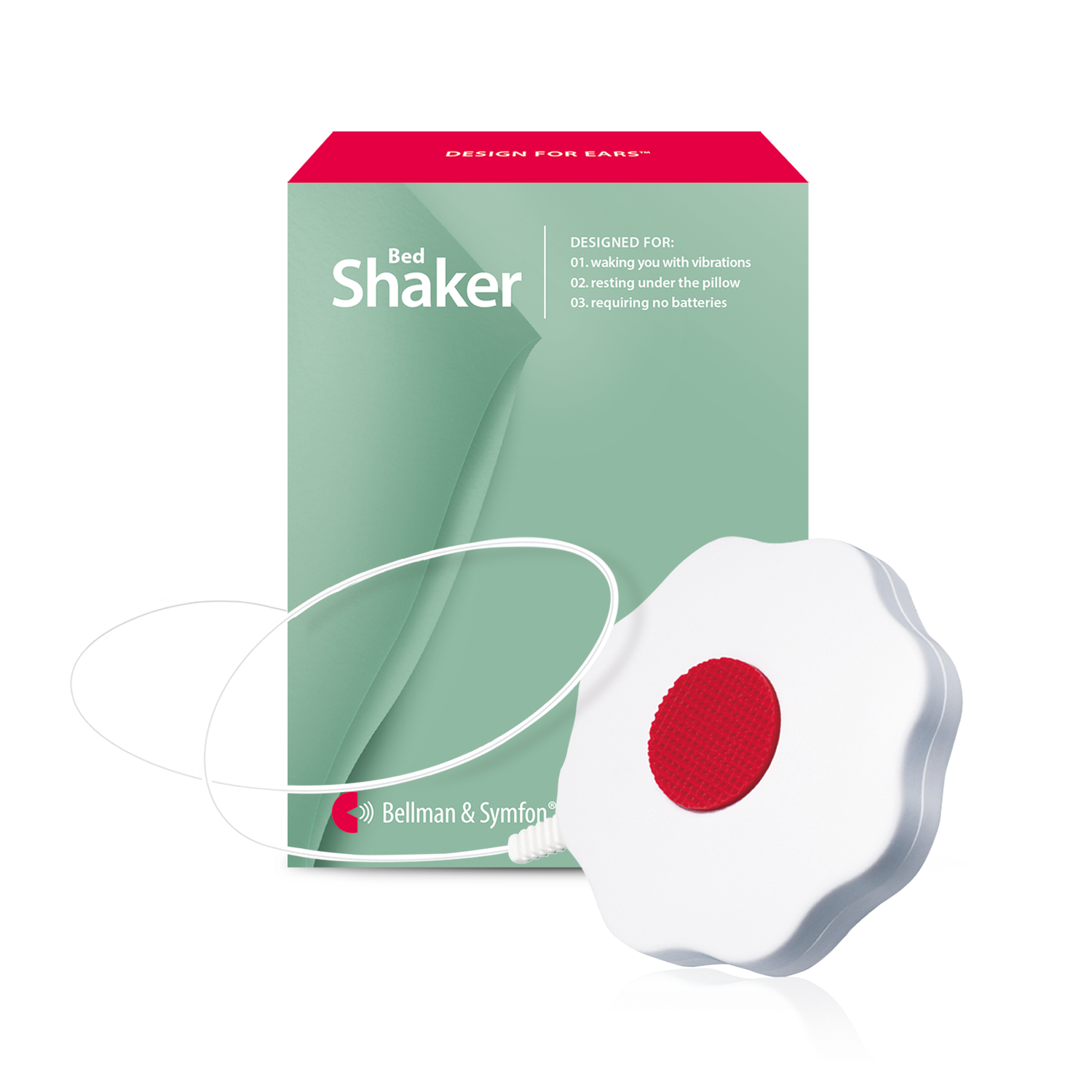
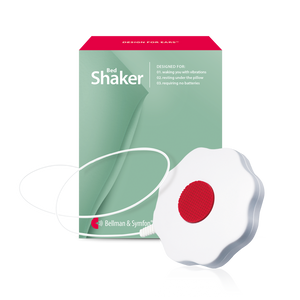
The wired vibration component is sold separately, compatible with Bellman Alerting System receivers, including the Alarm Clock Receiver. The same motor and pad design is used in the integrated models. The right option if you already have a compatible Bellman receiver and need to add or replace the bed shaker without replacing the entire unit. Connects via the standard 3.5mm port on compatible receivers.
View Bed Shaker →Quick Placement Guide: Getting It Right the First Time
The most common reason a bed shaker doesn't perform as expected is placement, not product quality. Before concluding a device isn't strong enough, run through these:
- Place under the torso (chest/shoulder area), not near the feet
- If using a memory foam topper: place shaker between topper and mattress, not beneath both
- Anti-slip surface face-down to prevent overnight shifting
- Give the cable enough slack - tension on the connector reduces vibration transmission
- Test in your actual sleeping position before relying on it for real
- For the Vibio: sync alarms to the device before turning your phone off
- Under-pillow placement works well for lighter sleepers and pillow shakers
- Under-mattress placement near torso is stronger and more reliable for deep sleepers
Read down - the more that apply, the clearer the yes
Any single item in the first group is sufficient on its own. The second group is cumulative.
- I'm deaf or profoundly hard of hearing
- I remove hearing aids / cochlear implants for sleep
- I regularly sleep through sound alarms
- I travel and can't rely on hotel clocks
- I need to wake without disturbing my partner
- I have high-frequency hearing loss (diagnosed or suspected)
- I work shifts or have medically critical wake times
- I'm over 50 and alarms feel less reliable than they used to
- I need overnight home safety alerts too (smoke, CO, doorbell)
- I've tried louder alarms and they haven't solved the problem
Common Questions
Can a Bed Shaker Alarm Work Under a Thick Mattress?
Yes, but placement matters more with a denser mattress. Standard innerspring and medium-foam mattresses transmit vibration well with the shaker placed directly underneath the sleeping area. Thick memory foam mattresses can dampen vibration - if you use a memory foam topper, place the shaker between the topper and the base mattress rather than under both layers to keep it as close to the sleeping surface as possible.
Will It Wake Me If I'm a Very Deep Sleeper?
For most deep sleepers, yes - particularly with the wired shakers in the Alarm Clock Pro or Classic, which use motors rated for through-mattress performance. If vibration alone is uncertain, the Pro's simultaneous LED flash adds a second independent non-auditory channel that significantly improves arousal reliability. Placement under the torso (not the feet) and directly on the mattress (not on a thick topper) are the two adjustments that resolve most "it isn't strong enough" complaints before attributing the issue to the product itself.
Can I Use It Without the Sound Alarm?
Yes. The Alarm Clock Pro and Classic both have a sound toggle that disables audio while keeping vibration and lights, on the Pro, fully active. This is the standard configuration for most deaf users and for anyone waking in a shared room. The Vibio produces no sound at all by design - it is always vibration-only and needs no configuration for silent operation.
What's the Difference Between a Bed Shaker and a Vibrating Alarm Clock?
They refer to the same category of product. "Vibrating alarm clock" is the broader term for any clock that uses vibration as an alert method. A "bed shaker" specifically refers to the vibrating pad component - the part that goes under the pillow or mattress. Some products are sold as complete systems (clock + shaker), others as standalone shaker accessories. All Bellman alarm clocks except the Vibio include both components; the Bed Shaker is the standalone pad for users who already have a compatible receiver.
Is a Bed Shaker Alarm Right for My Elderly Parent?
Very likely yes. Age-related hearing loss (presbycusis) affects around 1 in 3 adults over 65, frequently in the high-frequency range that alarm tones use, and often goes undiagnosed for years. An older adult who has "started sleeping through their alarm" may be experiencing gradual hearing deterioration rather than a change in sleep patterns. The Alarm Clock Classic's large dials, simple two-control interface, and battery backup make it specifically well-suited for older adults who want a reliable alarm without complicated setup.
The Bottom Line
A bed shaker alarm is a vibrating pad that wakes you through physical movement rather than sound. It works by stimulating skin mechanoreceptors through a sensory pathway entirely separate from the auditory system - which is why it succeeds when sound-based alarms fail.
You need one if you are deaf or hard of hearing and remove hearing devices for sleep, if you regularly sleep through conventional alarms regardless of volume, if you travel and can't rely on hotel alarm clocks, or if you share a room where silent waking is a requirement. You may benefit from one if you have age-related or noise-induced high-frequency hearing loss, work shifts with critical wake times, or have gradually found standard alarms less reliable.
The right Bellman product depends on your situation: the Alarm Clock Pro for maximum home reliability, the Vibio for travel and shared rooms, the Alarm Clock Classic for the simplest interface, and the Alarm Clock Receiver for deaf adults who also need overnight home safety coverage. For the full breakdown across all four models, see the complete guide: Best Vibrating Alarm Clocks for Heavy Sleepers & Hearing Impaired (2026).
Ready to find the bed shaker alarm that's right for you?
Explore the full Bellman lineup - wired, wireless, and whole-home options for every sleeper and every situation.
Sources and references: National Institute on Deafness and Other Communication Disorders (NIDCD) - Quick Statistics About Hearing (2026); Age-Related Hearing Loss fact sheet; Noise-Induced Hearing Loss fact sheet · World Health Organization (WHO) - Deafness and Hearing Loss Fact Sheet (March 2026) · Hearing Loss Association of America (HLAA) - Hearing Loss Facts and Statistics (2026) · Bellman & Symfon - Alarm Clock Pro product specifications (us.bellman.com/products/heavy-sleeper-vibrating-alarm-clock-pro); Alarm Clock Classic specifications (us.bellman.com/collections/alarm-clocks); Vibio specifications (us.bellman.com/products/vibio); Alarm Clock Receiver specifications (us.bellman.com/products/alerting-signaling-device-alarm-clock-receiver); Bed Shaker specifications (us.bellman.com/products/bed-shaker) · UL Safety Certifications: UL217 (smoke alarms), UL2034 (CO alarms), ULC-S531, CSA 6.19 · Bolanowski SJ, Gescheider GA, Verrillo RT, Checkosky CM - Four channels mediate the mechanical aspects of touch. Journal of the Acoustical Society of America, 1988 (Pacinian corpuscle frequency sensitivity, 40–400 Hz range) · American Sleep Association - Sleep stages and sensory arousal thresholds during NREM and REM sleep · Eccentric rotating mass (ERM) vibration motor principles - general engineering references.
This article is for informational purposes only. Product specifications are based on current published listings at us.bellman.com; verify current specs on the product page before purchase. For clinical guidance on hearing loss, consult a licensed audiologist or qualified hearing health professional.
What Is a Bed Shaker Alarm and Do I Need One?
This guide breaks down the practical choices, features, and considerations behind this topic. Use it to identify a setup that fits the listener, the environment, and the everyday moments that matter most.
The featured products below are current Bellman options discussed in the article or closely matched to its use case.