The Complete Guide to Bluetooth Alerting Systems for Deaf & Hard of Hearing People (2026)

Everything you need to know about how Bluetooth alerting systems work, what they alert you to, who they're designed for, and how to build a complete whole-home notification setup - without Wi-Fi, subscriptions, or compromise.
- What a Bluetooth alerting system actually is
- Who needs a Bluetooth alerting system
- How the technology works - in plain English
- What a Bluetooth alerting system can alert you to
- Wrist receiver vs. smartphone app: understanding both notification channels
- Nighttime and sleep safety: closing the most dangerous gap
- Why is no Wi-Fi a feature, not a limitation
- Whole-home alerting: building a complete system
- How to choose the right starter system
- Frequently asked questions
What a Bluetooth Alerting System Actually Is
A Bluetooth alerting system for deaf and hard-of-hearing people is a home notification hub that converts sound-based alerts - doorbells, smoke alarms, baby cries, phone calls, and more - into silent vibrations and visual icons delivered to a wearable watch receiver and a free smartphone app. No Wi-Fi subscription required. No cloud dependency. No monthly fees.
The core concept is straightforward: the world's most important household alerts are almost entirely audio-based. Smoke detectors beep. Doorbells chime. Phones ring. Babies cry. For the more than 37.5 million Americans who have some degree of hearing loss - and for the millions who sleep without hearing aids - these sounds represent both a connection to daily life and, in some cases, a genuine safety lifeline. A Bluetooth alerting system bridges that gap.
At the center of every system is a Bluetooth Bridge - a small transceiver that sits in your home and communicates wirelessly with dedicated transmitters placed at each alert source. When a transmitter is triggered (the doorbell rings, the smoke alarm sounds), the Bridge picks up that signal and instantly relays it to your Bluetooth Watch Receiver on your wrist and to the free Bellman Assistant App on your smartphone - clearly labeled with an icon so you know exactly what's happening and where.
Who Needs a Bluetooth Alerting System
Bluetooth alerting systems are designed for a wide range of people, not only those with profound deafness. If any of the following situations resonate, a Bluetooth alerting system is worth understanding in detail.
Deaf and profoundly hard-of-hearing people
For people with severe to profound hearing loss, standard household audio alerts are simply inaudible. A Bluetooth alerting system replaces those missed audio cues with unmissable vibration and visual notification - reliably, every time.
Hearing aid users who remove devices at night
Most hearing aid wearers sleep without their devices. That gap - typically 7 to 9 hours - leaves them unable to hear fire alarms, CO detectors, or a baby crying. A Bluetooth alerting system with a bed shaker or alarm clock receiver closes that gap.
Deaf parents of young children
Parents need to respond quickly to their baby. A Bluetooth baby monitor system delivers instant wrist vibration and a clear visual icon the moment infant sounds are detected - whether a parent is in another room, in the yard, or asleep.
Older adults with age-related hearing loss
Age-related hearing loss (presbycusis) affects roughly one in three adults between 65 and 74. Many live independently but may miss important alerts. Bluetooth alerting systems provide a quiet, non-intrusive layer of safety without depending on caregivers.
Multi-level homes and large properties
Even people with mild hearing loss may miss a doorbell from a different floor, or a phone ringing from the basement. A whole-home alerting system ensures you're notified wherever you are in the house - on your wrist, in real time.
Families and caregivers of deaf or HoH individuals
Setting up a Bluetooth alerting system for a family member with hearing loss is one of the most practical and meaningful steps a caregiver or family can take - providing both safety and independence without constant check-ins.
How the Technology Works - In Plain English
The Bellman Bluetooth alerting system is built around three connected layers: transmitters that detect alerts at their source, a Bluetooth Bridge that acts as the central hub, and receivers that deliver the notification to you.
Layer 1 - Transmitters
Each transmitter is a small device placed at or near an alert source in your home. Depending on the specific transmitter type, it detects sound (such as a smoke alarm or baby monitor), contact (such as a doorbell button press), or phone ring signals from your landline. When triggered, it immediately sends a wireless signal to the Bridge.
Layer 2 - The Bluetooth Bridge
The Bluetooth Bridge is the brain of the system. It's a compact transceiver that plugs in at home and maintains a constant wireless connection both to your transmitters and to your receivers. When it receives a signal from any transmitter, it instantly identifies the source and relays a distinct, labeled alert - so your watch doesn't just vibrate, it tells you which alert was triggered. The Bridge communicates directly with the Watch Receiver via Bluetooth, with a range of up to 650 feet. It also communicates with the Bellman Assistant App on your smartphone via Bluetooth, requiring no Wi-Fi or internet connection after initial app setup.
Layer 3 - Receivers
Notifications arrive on two channels simultaneously: the Bluetooth Watch Receiver on your wrist, which vibrates and displays a clear icon identifying the alert source, and the free Bellman Assistant App on your iOS or Android smartphone, which delivers a visual and/or vibrating notification. At night, a dedicated Alarm Clock Receiver with a bed shaker and strobe flash ensures you're woken even when the watch is off your wrist. See the full section on nighttime safety below.
The Bellman Bridge communicates directly with the Watch Receiver over Bluetooth - with a range of up to 650 feet. This is a direct device-to-device connection, not a Wi-Fi network connection. That means it works even if your internet is down, your router is off, or you're in a rural area with no broadband coverage. The smartphone app uses the same direct Bluetooth connection to your Bridge - so cellular data is not required for in-home notifications after the app is first downloaded.
What a Bluetooth Alerting System Can Alert You To
One of the most important features of the Bellman Bluetooth system is that it's modular. You can start with the alerts most relevant to your situation and expand over time. Here's a comprehensive look at every alert category the system currently covers.
Doorbell
The Doorbell System with Bluetooth Bridge and Watch Receiver detects when someone presses your existing doorbell and sends an instant vibration and doorbell icon to your wrist. Whether you're upstairs, in the garden, or wearing headphones, you'll know someone's at the door. This is one of the most universally valued alerts in the system - and one of the simplest to add. For a deeper look at how this alert works, read our guide to Bluetooth doorbell alerts for deaf people.
Smoke and CO Safety
Smoke alarms and carbon monoxide detectors are among the most critical home alerts - and among the most dangerous to miss. The Bellman smoke alarm transmitter connects to your existing smoke or CO detector and, the moment an alarm sounds, sends an instant wrist vibration and smoke icon to the Watch Receiver and app. For nighttime coverage, a dedicated alarm clock receiver with bed shaker and strobe is the recommended solution - see the nighttime safety section below for the right bundle options.
Baby Monitor
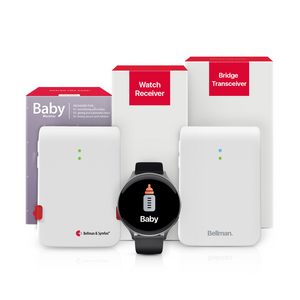
The Baby Monitor System with Bluetooth Bridge and Watch Receiver places a sound-sensitive transmitter in your baby's room. When infant sounds exceed the detection threshold, the system sends an immediate wrist vibration and baby icon - so deaf parents can respond quickly without needing to hear the baby cry. There's no audio to monitor and no screen to check. The alert simply arrives on your wrist. For a full breakdown, read our guide to baby monitors for deaf parents.
Phone Alerts
The Phone Alert System with Bluetooth Bridge and Watch Receiver connects to your landline and detects incoming calls. The moment your phone rings, the Bridge relays a phone icon and vibration to your wrist and app - so you never miss an important call regardless of where you are in the home. For more, see our full guide to phone alert systems for deaf and hard-of-hearing people.
Push Button / Personal Alert
The Push Button System with Bluetooth Bridge and Watch Receiver is a flexible wireless button that can be used for a range of signaling needs - a family member alerting you from another room, a caregiver call button, or a doorbell alternative. It's one of the simplest additions to an existing system and one of the most versatile.
Wrist Receiver vs. Smartphone App: Understanding Both Notification Channels
The Bellman Bluetooth alerting system delivers notifications through two independent channels - and understanding both is key to getting the most from your setup.
The Watch Receiver
The Bellman Bluetooth Watch Receiver is a discreet wrist wearable that connects directly to the Bridge without requiring a smartphone. When any alert is triggered, it vibrates and displays a clear icon identifying exactly which alert source was activated - doorbell, smoke, baby, phone, or push button. The Watch Receiver works up to 650 feet from the Bridge, covers multiple floors in most homes, and requires no internet connection whatsoever.
The watch is particularly valuable for anyone who doesn't always have their smartphone on their person, or for users who prefer a dedicated, always-on alerting device that doesn't depend on a phone battery or notification settings. It can also be added as an additional receiver for a family member who shares the home.
The Bellman Assistant App
The free Bellman Assistant App, available on iOS and Android, pairs with the Bridge via Bluetooth and delivers alert notifications directly to your smartphone. Because it uses a direct Bluetooth connection to the Bridge - not a Wi-Fi or cloud connection - it works reliably in your home without internet access after initial setup. This means you get labeled, visual alerts on the phone you already carry, in addition to (or instead of) the Watch Receiver.
The system is designed so that you're never dependent on a single device. The Watch Receiver and smartphone app work together - or independently - to ensure that a critical alert always reaches you, wherever you are in the home.
Bellman & Symfon Design PhilosophyFor most users, running both channels simultaneously provides the most complete coverage: the watch catches alerts when your phone is charging or in another room, and the app catches alerts when the watch is off your wrist. They are complementary, not competing.
Nighttime and Sleep Safety: Closing the Most Dangerous Gap
The hours you spend asleep represent the single largest alerting gap for anyone with hearing loss. Hearing aids come out. The phone may be silent or face-down. In those 7 to 9 hours, a smoke alarm, a CO detector, or a baby monitor alert could go completely undetected - with serious consequences.
The National Institute on Deafness and Other Communication Disorders (NIDCD) and the National Fire Protection Association both specifically highlight the risk of fire for people with hearing loss during sleep hours, noting that standard audio alarms may be inaudible without hearing devices. Closing this gap is not optional - it is essential.
During sleep, wrist-worn receivers may be removed, and smartphones may not be close enough or loud enough to wake you. The solution for nighttime alerting is a dedicated Alarm Clock Receiver with an integrated bed shaker - a vibrating pad placed under your mattress or pillow that physically wakes you - combined with a bright strobe flash that illuminates the room. This combination is the gold standard for nighttime smoke, CO, and other emergency alerts for deaf and hard of hearing people.
During the daytime, the Watch Receiver and smartphone app cover all your alert channels. For sleep, the right solution is one of the following bundles, each of which pairs a specific transmitter with the Bridge and an Alarm Clock Receiver for complete 24-hour coverage:
- Smoke & CO safety at night: Bridge + Smoke + Alarm Clock bundle - the smoke transmitter connects to your existing detector; the Alarm Clock Receiver wakes you with a bed shaker and strobe flash when it sounds. Add a Watch Receiver separately for daytime wrist notifications.
- Baby monitoring through the night: Bridge + Baby + Alarm Clock bundle - detects infant sounds overnight and wakes you via bed shaker and strobe. Add the Watch Receiver for daytime use when the alarm clock is not active.
- Doorbell alerts through the night: Bridge + Door + Alarm Clock bundle - ensures late-night or early-morning visitors or deliveries don't go unnoticed. Pair with the Watch Receiver for daytime coverage.
- Push button/caregiver alerts through the night: Bridge + Push + Alarm Clock bundle - ideal for family members or caregivers who need to signal you overnight. Add the Watch Receiver for daytime use.
Each bundle provides the essentials for round-the-clock coverage for that specific alert. For complete whole-home coverage across all alert types, see the section on building a complete system below.
Why No Wi-Fi Is a Feature, Not a Limitation
Many people ask whether a Bluetooth alerting system requires Wi-Fi. The answer - for the Bellman system - is no. And this distinction matters more than it might initially seem.
Wi-Fi-dependent smart home alert systems introduce a specific category of failure: when the internet goes out, the router reboots, or a cloud service has downtime, the alerts stop working. For most smart home applications, this is a minor inconvenience. For a smoke alarm alert system for someone who is deaf, it is a safety failure at precisely the moment reliability matters most.
- No internet outage can disable your smoke or CO alerts
- Works during power outages if the Bridge has battery backup
- No router reboot = no gap in coverage
- No cloud server going offline removes your alerting
- No cellular data required for in-home notifications after app setup
- Works in rural areas or homes with poor broadband
- No monthly subscription fee - ever
- Privacy: no alert data sent to external servers
The Bellman Bridge communicates directly with transmitters and receivers via Bluetooth - a point-to-point, local wireless connection. There is no cloud relay, no account required, and no dependency on any external network. This is a deliberate design choice rooted in the safety-critical nature of what the system does. For a full breakdown of why offline alerting matters, read our guide to no Wi-Fi hearing alert systems.
Whole-Home Alerting: Building a Complete System
The most important thing to understand about the Bellman Bluetooth system is that it is a platform, not a single product. Every component - every transmitter and every receiver - is designed to work together through a single Bridge. That means you can start with the most urgent alert for your situation and expand the system over time by adding transmitters and receivers without replacing what you already have.
The Modular Design Advantage
A single Bluetooth Bridge can manage multiple transmitters simultaneously. Your doorbell transmitter, smoke alarm transmitter, baby monitor transmitter, and phone transmitter all communicate with the same Bridge - and all alerts from any of them are delivered to your Watch Receiver and app, each clearly labeled with a distinct icon. You don't need one system for the doorbell and another for the smoke alarm. It all runs through one hub.
Similarly, multiple receivers can be paired to the same Bridge. A Watch Receiver on your wrist, the Bellman app on your smartphone, and an Alarm Clock Receiver in the bedroom can all receive alerts from the same set of transmitters. Different family members can carry their own Watch Receivers. Coverage extends wherever the receivers are within range.
Every alert source. Every receiver. One Bridge.
Build your system one transmitter at a time - everything works together.
- Bluetooth Bridge - the central hub (included in every starter bundle)
- Doorbell transmitter - front door coverage
- Smoke / CO transmitter - fire and gas safety
- Baby monitor transmitter - infant sound detection
- Phone transmitter - landline incoming call alerts
- Push button transmitter - personal or caregiver signaling
- Watch Receiver - daytime wrist notifications
- Bellman Assistant App (iOS / Android) - smartphone notifications
- Alarm Clock Receiver - nighttime bed shaker + strobe alerts
- Second Watch Receiver - for a partner or second user
Starting with a bundle that matches your highest-priority alert is the simplest path to setup. From there, each additional transmitter is a straightforward addition. There is no need to call a technician, configure a router, or set up a new account. The Bridge recognizes new transmitters automatically, and the Watch and app begin displaying the new alert icon immediately.
How to Choose the Right Starter System
The right entry point into the Bellman Bluetooth alerting system depends on your most pressing need. Here is a practical guide to the most common starting scenarios.
If Home Safety Is Your First Priority
Start with the Bridge + Smoke + Alarm Clock bundle for complete smoke and CO coverage day and night. The Alarm Clock Receiver's bed shaker will wake you during sleep; the Bridge is already in place to add further transmitters. Add the Watch Receiver for daytime wrist notifications, and the free Bellman Assistant App for smartphone coverage.
If You Are a Deaf or HoH Parent
The Baby Monitor System with Bridge and Watch Receiver gives you instant wrist notification the moment your baby makes sound. For nighttime coverage, the Bridge + Baby + Alarm Clock bundle adds bed shaker alerts for overnight monitoring. Add the Watch Receiver for daytime use.
If You're Focused on Daily Life Convenience
Start with the Doorbell System with Bluetooth Bridge and Watch Receiver - the most universally relevant alert for anyone who misses visitors or deliveries. Add the phone transmitter to cover landline calls. Expand from there based on your day-to-day priorities.
If You Want Complete Coverage From Day One
Start with the full Bluetooth Bridge collection to understand the complete range of transmitters and bundles available. Pairing the Bridge with the Watch Receiver, the Bellman Assistant App, and all relevant transmitters delivers whole-home alerting across every source. Add the Alarm Clock Receiver for nighttime coverage, and you have a complete 24-hour system.
Frequently Asked Questions
Does the system work without a smartphone?
Yes. The Bluetooth Watch Receiver connects directly to the Bridge and works entirely independently of a smartphone. You don't need to install an app or own a smartphone to receive wrist vibration and icon alerts from any transmitter in your system.
How far away can I be from the Bridge and still receive alerts?
The Bridge communicates with the Watch Receiver at a range of up to 650 feet in open air - sufficient to cover most homes including multiple floors and outdoor areas adjacent to the property. Range may be reduced by thick walls, metal structures, or other wireless interference.
Can more than one person in the home use the system?
Yes. Multiple Watch Receivers and multiple smartphones with the Bellman Assistant App can be paired to the same Bridge. Each receives the same alerts from all transmitters, making the system suitable for shared households where more than one person has hearing loss.
What happens to my alerts if the internet goes down?
Nothing changes. Because the Bellman system uses direct Bluetooth communication between the Bridge and your receivers - not Wi-Fi or a cloud server - internet outages have no effect on system operation. For in-home notifications, the system functions identically whether your broadband is up or down.
Will it work with my existing smoke alarm?
The Bellman smoke alarm transmitter is designed to connect with most standard household smoke and carbon monoxide detectors. It detects the audio output of your existing alarm, so you do not need to replace your detectors. Compatibility should be verified with your specific detector model before purchase.
How difficult is the setup?
Setup is designed to take under 10 minutes. The Bridge plugs in, transmitters are activated near their alert sources, and the Watch Receiver or app pairs with the Bridge. No Wi-Fi network configuration, no technician, and no ongoing account management required. For a step-by-step walkthrough, see our Bellman Bluetooth setup guide.
Can I add more alert types later?
Yes - this is one of the system's core advantages. Every additional transmitter connects to the same Bridge you already have. Add a phone transmitter, a push button, or a baby monitor at any time, and it immediately becomes part of your existing setup. Your Watch Receiver and app begin showing the new alert icon automatically.
Build your whole-home alerting system - without Wi-Fi or subscriptions.
Explore the complete Bellman Bluetooth range: Bridge, Watch Receiver, and transmitters for every alert source in your home.
More Guides in This Series
How does the Bellman Bluetooth Bridge work? A plain-English explainer
A detailed technical walkthrough of how the Bridge receives, processes, and relays alerts to your Watch and app.
Bluetooth doorbell alert for deaf people: what to look for in 2026
How vibrating doorbell alerts work, what to look for, and why Bluetooth outperforms Wi-Fi for this use case.
Baby monitor for deaf parents: how vibrating wrist alerts change everything
Everything deaf and hard-of-hearing parents need to know about staying connected to their baby overnight and during the day.
Bluetooth smoke alarm for hearing impaired: visual & vibrating safety explained
Why standard smoke alarms are dangerous for people with hearing loss, and how a Bluetooth alerting system closes the gap.
No Wi-Fi hearing alert systems: why offline Bluetooth beats smart home devices
The reliability case for direct Bluetooth over Wi-Fi and cloud-dependent alert systems for the deaf and hard of hearing.
Bluetooth watch receiver for hearing loss: what it does and who needs one
A complete guide to the Bellman Watch Receiver - how it works, what it displays, and how it fits into a whole-home alerting setup.
Sources: National Institute on Deafness and Other Communication Disorders (NIDCD) - Quick Statistics About Hearing; Age-Related Hearing Loss · World Health Organization (WHO) - Deafness and Hearing Loss Fact Sheet (2026) · National Institute on Aging (NIA) - Hearing Loss: A Common Problem for Older Adults; Assistive Devices for People with Hearing, Voice, Speech, or Language Disorders · Hearing Loss Association of America (HLAA) - Hearing Loss Facts and Statistics; Assistive Technology · National Fire Protection Association (NFPA) - Smoke Alarms for People Who Are Deaf or Hard of Hearing · Americans with Disabilities Act (ADA) - Effective Communication; Assistive Listening Systems · Federal Communications Commission (FCC) - Telecommunications Relay Services; Captioned Telephone Service · Centers for Disease Control and Prevention (CDC) - Noise-Induced Hearing Loss · American Speech-Language-Hearing Association (ASHA) - Hearing Assistive Technology Systems · Bellman & Symfon product documentation and system specifications.
This article is for informational purposes only and does not constitute medical advice. Consult a licensed audiologist or healthcare provider for a personalised hearing evaluation and treatment recommendations.
The Complete Guide to Bluetooth Alerting Systems for Deaf & Hard of Hearing People (2026)
This guide breaks down the practical choices, features, and considerations behind this topic. Use it to identify a setup that fits the listener, the environment, and the everyday moments that matter most.
The featured products below are current Bellman options discussed in the article or closely matched to its use case.