Smoke Alarm for Seniors with Hearing Loss: Visual and Vibrating Options Explained

A standard smoke alarm at 85 decibels may be completely inaudible to a senior sleeping without hearing devices. This guide explains every option - from flashing strobe alarms to vibrating wrist systems - how each works, what its limitations are, and what combination actually provides reliable overnight protection.
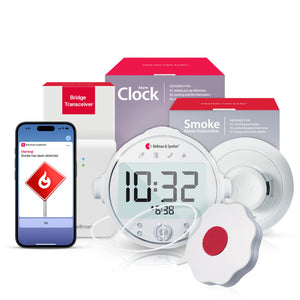
Smoke alarms for seniors with hearing loss connect to a Bluetooth bridge that sends instant wrist vibrations and a flame icon alert the moment smoke or CO is detected - providing life-saving notification even during deep sleep when audible alarms are ineffective. The Bellman smoke and CO transmitter pairs with the Bluetooth Bridge to deliver a strong wrist vibration and flame icon to the Watch Receiver - working offline, without internet, the moment any connected detector activates.
Why a Standard Smoke Alarm Is Not Enough for Seniors with Hearing Loss
A smoke alarm emitting 85 decibels at 10 feet is loud enough to wake most hearing adults from sleep. For a senior with moderate to severe hearing loss who has removed their hearing aids for the night, that same alarm may produce no perceptible sound at all. The auditory gap between a working smoke alarm and a sleeping senior without hearing devices is not a small gap - in many cases, it is total.
This is not a rare situation. The NIDCD estimates that approximately one in three adults between 65 and 74 has measurable hearing loss, and by age 75 and older, that figure rises to roughly one in two. Age-related hearing loss - presbycusis - preferentially affects high-frequency sounds first. Standard smoke alarm tones, which typically operate in the 3,000–4,000 Hz range, fall precisely in the frequency band that deteriorates earliest and most severely with age. A senior who can hold a normal conversation may still be genuinely unable to hear their smoke alarm from the bedroom with the door closed.
The NFPA reports that three in five home fire deaths occur in homes where a smoke alarm was present but failed to alert occupants. For seniors with hearing loss, this statistic is not abstract - it describes a real and preventable vulnerability that exists in a very large number of homes right now.
This guide covers every available option for addressing this gap - flashing strobe alarms, bed shakers, low-frequency alarms, and wrist vibration systems - with an honest assessment of what each approach can and cannot do, and how to combine them for complete day and night protection.
The Science: Why Standard Smoke Alarms Fail Sleeping Seniors with Hearing Loss
To understand why purpose-built alerting systems are necessary - rather than simply turning the smoke alarm up louder - it helps to understand what is actually happening audiologically when a senior with hearing loss sleeps.
High-Frequency Loss and Alarm Tone Frequencies
Presbycusis - the gradual sensorineural hearing loss that accompanies aging - does not affect all frequencies equally. It begins at the high end of the audible spectrum and progresses downward over time. The cochlear hair cells responsible for detecting frequencies above 2,000 Hz are typically the first to deteriorate. This means a senior may hear conversational speech, which sits primarily between 250 and 2,000 Hz, while being unable to detect the 3,150 Hz T3 tone that the National Fire Alarm and Signaling Code (NFPA 72) mandates for sleeping area smoke alarms.
In plain terms: the smoke alarm is specifically tuned to a frequency that hearing loss takes away first. For many seniors, this means the alarm cannot be heard even at full volume from the same room, let alone through a closed bedroom door.
Hearing Aids Are Removed at Night
Even a senior whose hearing loss is well-managed during the day removes their hearing aids at night. Extended wear causes skin irritation, promotes bacterial growth in the ear canal, and depletes batteries. Most audiologists recommend nightly removal. The result is a predictable nightly window - typically 7–9 hours - during which the senior's only auditory access is whatever their unaided ears can detect. For a person with moderate to severe loss, that may be sounds below 60–80 dB at low frequencies only.
The Door-Closed Problem
A standard smoke alarm at 85 dB produces approximately 65 dB behind a closed interior door - a reduction of roughly 20 dB. For a senior whose hearing threshold at 3 kHz is already 60–70 dB (moderate to moderately severe loss), closing the bedroom door at night may push the effective alarm volume below their detection threshold entirely. This is a structural vulnerability in every home where a senior with hearing loss sleeps with the bedroom door closed.
Carbon monoxide has no smell, no visible presence, and causes progressive neurological impairment that begins before any physical sensation of alarm. By the time CO levels are high enough for a sleeping person to experience symptoms, cognitive function may already be impaired enough that they cannot wake and respond effectively. For a senior sleeping without hearing devices, the CO detector's audible alarm is the only standard alert mechanism - and it is the same mechanism that may not reach them through a closed bedroom door at night.
This is why CO transmitter coverage through a wrist alert system is not optional for seniors with hearing loss. It is the only reliable overnight CO warning for this population.
The Three Main Approaches: What Each One Does and Where It Falls Short
When families and caregivers begin researching smoke alarm solutions for seniors with hearing loss, they typically encounter three distinct approaches. Each has genuine value - and each has specific limitations that make standalone use insufficient for overnight protection.
Approach 1: Flashing Strobe Smoke Alarms
Strobe-equipped smoke alarms replace or supplement the audible alarm with a rapid, high-intensity flashing light - typically at 177 candela or greater, as specified by NFPA 72 for sleeping areas. These units are widely available and are designed specifically to alert people who cannot hear audible alarms.
Requires direct line-of-sight to be effective. A senior sleeping facing away from the unit, or with their eyes closed, may not be alerted. Closed bedroom doors significantly reduce light transmission. Effectiveness varies with room layout, curtains, and whether the senior is a light or heavy sleeper. Does not alert in other rooms. Provides no tactile component for deep sleepers.
Provides visual alert that does not depend on hearing at all. Widely available and relatively affordable. Works immediately without pairing or setup. Can cover an open-plan room effectively for light sleepers. Meets NFPA 72 requirements for hearing-impaired sleeping area protection when properly placed. Good supplementary layer.
Approach 2: Low-Frequency (520 Hz) Smoke Alarms
Research by the Fire Protection Research Foundation demonstrated that a square-wave 520 Hz tone wakes sleeping adults with hearing loss significantly more effectively than the standard 3,150 Hz T3 tone. NFPA 72 was subsequently updated to permit 520 Hz alarms as an alternative alerting method for sleeping areas where people with hearing loss are present. Several manufacturers now produce smoke alarms specifically using this lower frequency.
A 2009 National Institute of Standards and Technology (NIST) study found that a 520 Hz square-wave signal awakened 100% of sleeping subjects with mild to severe hearing loss, compared to far lower awakening rates for the standard T3 tone. Lower frequencies penetrate building materials more effectively and align better with the residual hearing that many people with age-related hearing loss retain at lower frequencies.
This is a meaningful improvement over standard alarms - but it still depends on the senior's residual hearing at lower frequencies, which varies by individual, and still does not provide a tactile component for those with profound loss or those who are simply deep sleepers.
Approach 3: Vibrating Wrist Alert Systems
Vibrating alert systems - like the Bellman smoke transmitter paired with the Bluetooth Bridge and Watch Receiver - convert the smoke alarm signal into a tactile alert delivered directly to the senior's wrist. The wrist vibration requires no hearing, no line-of-sight, and no assumption about the senior's remaining auditory function. It works regardless of whether the bedroom door is open or closed, whether the senior faces toward or away from the unit, and whether they are a light or deep sleeper.
This approach addresses every limitation of strobe and low-frequency alarms. It also enables a secondary alert channel through the Bellman smartphone app - meaning a caregiver or family member with the app installed simultaneously receives an alert notification, even if they are in another part of the home or away from the property entirely.
Visual vs. Vibrating vs. Low-Frequency: Full Comparison
| Feature | Strobe / Visual Alarm | Bellman Vibrating Wrist System |
|---|---|---|
| Alert mechanism | High-intensity flashing light | Strong wrist vibration + flame icon on Watch face |
| Requires line-of-sight | Yes - ineffective if senior faces away or door is closed | No - vibration is direct skin contact on wrist |
| Works through closed bedroom door | Limited - light significantly reduced by closed doors | Yes - Bluetooth signal reaches through walls and doors |
| Wakes deep sleepers reliably | Variable - depends on light sensitivity of individual | Yes - vibration is intentionally strong, on the wrist where movement begins |
| Hearing ability required | None - purely visual | None - entirely tactile |
| Alerts in other rooms | No - fixed location device only | Yes - Watch travels with senior throughout the home |
| Remote caregiver notification | No | Yes - Bellman app alerts caregivers simultaneously |
| CO detector integration | Separate CO strobe required | Same transmitter handles both smoke and CO detection |
| Internet required for alerting | No | No - Bluetooth Bridge operates offline; no cloud dependency |
| Expandable to other alerts | No - standalone device only | Yes - same Bridge handles doorbell, phone, push button alerts on same Watch |
How the Bellman Smoke and CO Alert System Works
The Bellman smoke and CO transmitter works with your home's existing smoke and CO detectors - you do not need to replace them. Here is the complete signal path from detector activation to wrist alert.
- Your existing detector activates: Your standard smoke or CO alarm sounds - photoelectric, ionisation, or CO electrochemical sensor, any type. The Bellman transmitter is placed near or attached to the detector and listens for the alarm sound.
- The transmitter detects the alarm: When the detector activates, the Bellman smoke transmitter detects the alarm signal and immediately sends a 433 MHz wireless signal. This happens within seconds of detection and does not require the senior to hear anything.
- The Bridge receives and converts the signal: The Bluetooth Bridge, placed centrally in the home, receives the 433 MHz signal and identifies it as a smoke/CO alert. It converts this into a Bluetooth alert and relays it to all paired receivers simultaneously.
- The Watch Receiver vibrates on the wrist: The Watch Receiver worn on the senior's wrist vibrates strongly and displays a clear flame icon. This tactile alert does not require hearing, does not require line-of-sight, and works through any closed door or wall within Bluetooth range.
- The Bellman app alerts caregivers: Simultaneously, the Bellman app on a paired smartphone shows a smoke/CO alert notification. Any family member or caregiver with the app installed receives this alert - whether they are in another room or in another city.
The entire signal path - from detector activation to wrist vibration - operates locally over Bluetooth. No internet connection. No cloud server. No router. The alert reaches the wrist whether the Wi-Fi is working or not.
Bellman & Symfon EditorialDaytime vs. Nighttime Coverage: Different Risks, One System
Smoke and CO alerting for seniors with hearing loss presents different challenges at different times of day. The Bellman system is designed to handle both without requiring the senior to switch devices or change settings.
Daytime Coverage
During the day, the senior is typically awake and mobile - moving between rooms, gardening, watching television, cooking. The Watch Receiver worn on the wrist delivers an immediate flame icon vibration wherever they are in the home. Because the Bridge's Bluetooth range extends up to 650 feet in open field, the senior receives the alert in the garden, in the garage, in a back bedroom, or anywhere else within the property.
Daytime CO alerting is particularly important because CO impairs cognitive function gradually and insidiously - a senior who is sitting quietly in a room with rising CO levels may feel increasingly tired or headachy without connecting those symptoms to a gas emergency. The wrist alert from the Watch provides the external signal that prompts action before the cognitive impairment becomes incapacitating.
Nighttime Coverage
Nighttime is the highest-risk period. Most residential fire fatalities and the majority of fatal CO poisoning incidents occur during sleeping hours. For seniors without hearing devices, this window has historically been the most vulnerable.
The Watch Receiver worn to bed is the primary nighttime solution. Its vibration is specifically designed to be strong enough to wake a sleeping adult. The flame icon on the Watch face communicates the nature of the emergency clearly - even at 3 a.m. when the senior is groggy and disoriented.
For the most complete overnight setup, pairing the Bridge with a vibrating alarm clock and bed shaker provides a redundant physical alert. The Bridge + Smoke/CO + Alarm Clock bundle is purpose-built for exactly this scenario: it combines the Bluetooth Bridge, smoke transmitter, and a vibrating alarm clock with a bed shaker that goes under the mattress. When a smoke or CO alarm activates overnight, the Watch vibrates on the wrist, the bed shaker vibrates beneath the mattress, and the alarm clock unit flashes - three simultaneous physical alerts that together provide near-certain waking even for deep sleepers. Add a Watch Receiver separately to this bundle if daytime wrist alerts are also needed.
- Watch Receiver charged above 20% and worn to bed
- Smoke transmitter confirmed within acoustic range of detector
- CO transmitter near sleeping area or hallway detector
- Bridge placed on same floor as bedrooms for shortest signal path
- Test alert confirmed from sleeping position with bedroom door closed
- Existing smoke and CO detectors tested within last 30 days
- Bed shaker (Alarm Clock bundle) placed under mattress for redundant alert
- Caregiver app installed on family member's phone for remote awareness
Common Mistakes Seniors and Families Make - and How to Avoid Them
Most families who are trying to address this gap make at least one of the following errors. Each one either leaves a coverage hole or creates false confidence in a system that is not complete.
Where to Place Smoke and CO Detectors and Transmitters
The effectiveness of any smoke or CO alert system - audible, visual, or vibrating - depends entirely on detectors being in the right locations. The NFPA provides the foundational placement requirements, and the Bellman transmitters are positioned to reflect them.
Smoke Detector Placement (NFPA 72)
- At least one smoke alarm on every level of the home, including the basement
- In every sleeping room - including guest rooms used by the senior or by visitors overnight
- Outside every sleeping area, in the immediate vicinity of bedrooms (typically in the hallway)
- At the top of every stairway, where heat and smoke rise
- Not in kitchens (false alarm risk) - keep alarms at least 10 feet from cooking appliances
- Not in garages - combustion products from vehicles trigger nuisance alarms
CO Detector Placement (CPSC / NFPA 720)
- On every level of the home, including the basement
- Outside every sleeping area - CO exposure during sleep is the most dangerous scenario
- Near the primary source of CO risk: gas furnace, water heater, attached garage
- At approximately chest height - CO distributes relatively evenly in a room, unlike smoke
- Not directly above or beside fuel-burning appliances - this creates false alarm risk from normal combustion
Bellman Transmitter Placement
For each smoke or CO detector in the home, place a Bellman transmitter within close acoustic range - on the same ceiling mount, on the adjacent wall within a few feet, or using the mounting bracket to attach directly to the detector. The transmitter does not need a direct line-of-sight to the Bridge - the 433 MHz signal travels through walls - but it must be close enough to the detector's speaker to reliably detect the alarm sound when it activates. For multi-detector homes, a single transmitter covering the bedroom hallway detector is the minimum; additional transmitters on other floors or in other zones provide more comprehensive coverage.
Building the Complete System: Smoke, CO, and More on One Bridge
One of the most important advantages of the Bellman Bluetooth Bridge architecture is that smoke and CO alerting does not require a standalone system. The same Bridge that handles smoke and CO also handles doorbell alerts, phone call alerts, and push button alerts - all delivered to the same Watch Receiver, each identified by a distinct icon. For a senior living independently, or a senior cared for by a family member, this integration simplifies the entire home safety setup into one device worn on the wrist.
This means a senior with the Bellman system does not need to manage a strobe alarm receiver in the bedroom, a separate doorbell flasher in the hallway, and a phone ringer in the living room - all with separate batteries, separate maintenance, and separate devices to understand. Everything comes to the Watch. The smoke icon means fire. The doorbell icon means a visitor. The phone icon means a call. One device, one charging routine, complete coverage.
For families building out a comprehensive setup, the logical expansion path is:
- Foundation: Bridge + Smoke/CO + Alarm Clock bundle - covers the most critical overnight safety alert plus silent vibrating morning wake-up. Add the Watch Receiver separately for daytime wrist notifications.
- Add doorbell coverage: Add the Bellman doorbell transmitter to the same Bridge - visitors are announced on the wrist, no chime sounds through the house, no missed deliveries.
- Add phone coverage: Add the Bellman phone transmitter - incoming calls trigger a phone icon on the Watch, no missed calls from doctors or family. See our full guide: phone alert system for elderly with hearing loss.
- Add push button: A push button transmitter lets the senior silently alert a caregiver anywhere in the home. Full guide: push button call system for elderly.
The complete picture of why this integration matters beyond smoke alerting is covered in the pillar guide: Home safety alert systems for seniors with hearing loss: complete guide (2026).
Buyer Guidance: What to Look For When Choosing a Smoke Alert System for a Senior
If you are a caregiver, adult child, or senior evaluating smoke alert options, use these criteria to cut through the noise in a crowded market.
Tactile alert - not just visual
A strobe light alone is insufficient for a sleeping senior who may be facing away from the unit or whose door is closed. The primary alert mechanism must include vibration delivered directly to the body - either a bed shaker, a wrist vibrator, or both. Any system that relies solely on visual alerting for overnight protection should be supplemented.
No internet dependency for the core alert
If the smoke alert system routes through Wi-Fi or a cloud server, it can fail during the exact scenarios when fire risk is elevated - storms, power fluctuations, and outages. The core wrist-vibration alert must work offline. The Bellman Bridge's local Bluetooth path ensures the Watch Receiver vibrates during internet outages, router reboots, and ISP failures.
Works with existing detectors
Replacing all smoke detectors in a home is a significant undertaking and is rarely necessary. The Bellman smoke transmitter works with your existing detectors - it listens for the alarm sound and relays the signal wirelessly. No rewiring, no replacement, no electrician required.
Easy setup - no technician
A system that requires professional installation is a barrier for many seniors and families. The Bellman system requires no tools, no wiring, and no professional installer. Most people complete the full setup - Bridge, transmitter, Watch pairing - in under 15 minutes.
Expandable to other alert types
A smoke-only alerting device is a good start but leaves other safety gaps open. Choose a platform that can be expanded to cover doorbell, phone, and push button alerts through the same receiver - so the senior manages one device, not five.
Caregiver visibility through an app
When a smoke or CO alarm activates in a senior's home, family members should know immediately - even if they are not present. The Bellman app provides this remote visibility. When the transmitter fires, both the senior's Watch and every family member's app receive the alert simultaneously.
Frequently Asked Questions
-
Do I need to replace my existing smoke detectors? No. The Bellman smoke transmitter detects the sound from your existing smoke or CO detector and relays it wirelessly. Your detectors continue to function exactly as before - the transmitter simply adds a vibrating alert channel on top of the existing audible one.
-
Will the Watch Receiver really wake a deeply sleeping senior? The Watch Receiver's vibration motor is designed to be strong enough to wake sleeping adults, not merely to provide a gentle notification. Most users find it reliable for overnight waking. For additional redundancy - particularly for very deep sleepers - the bed shaker in the Bridge + Smoke/CO + Alarm Clock bundle adds a second simultaneous physical alert under the mattress.
-
Does it work during a power outage? The Bridge is mains-powered and requires electricity. The Watch Receiver and smoke transmitters are battery-powered and continue to function during power outages. Most home smoke detectors are also battery-backed and continue to function when mains power is interrupted. In a typical power outage scenario, the detectors continue working, the transmitters continue sending, and the Watch Receiver continues alerting - only the Bridge requires power. Keeping the Bridge on a UPS (uninterruptible power supply) extends coverage through power outages if this is a concern.
-
Does it alert for both smoke AND carbon monoxide? Yes. The Bellman smoke transmitter detects the alarm sound from both smoke detectors and CO detectors. You need both types of detector present and functioning in appropriate locations - the transmitter relays the alarm from whichever type activates. The Watch Receiver displays a distinct icon for each alert type.
-
How many transmitters do I need for a multi-story home? For minimum overnight protection, one transmitter covering the bedroom hallway detector is essential. For comprehensive whole-home coverage - including daytime alerting from kitchen or basement detectors - additional transmitters, one per key detector location, provide the most complete protection. Each transmitter pairs to the same Bridge and sends the same flame icon to the Watch.
-
Can family members receive alerts on their phones? Yes. Multiple people can install the Bellman app and receive simultaneous notifications whenever any transmitter fires. A family member across town receives the same smoke/CO alert at the same moment the senior feels it on their wrist. No additional hardware required - just the app on a smartphone.
-
How long does the Watch Receiver battery last? The Bellman Watch Receiver is designed for extended daily wear. Charge it daily - the same habit as a smartphone - and it will always be ready for overnight monitoring. Check the current specifications at us.bellman.com/products/bluetooth-watch-receiver for the most current battery life figures.
-
How do I test whether the system is working correctly? Use the test button on your smoke or CO detector. This activates the alarm sound, which the transmitter detects and relays through the Bridge to the Watch Receiver. Confirm the Watch vibrates and displays the flame icon within a few seconds. Test from your sleeping position with the bedroom door in its normal overnight position to confirm coverage from where it matters most.
Complete checklist for seniors with hearing loss
Run through every item before relying on the system for overnight protection.
- Smoke detector in every sleeping room and hallway
- CO detector near sleeping area and on every level
- All detectors tested - alarms activate on test button
- Bellman smoke transmitter within acoustic range of bedroom hallway detector
- CO transmitter near sleeping area detector
- Bluetooth Bridge placed centrally on bedroom floor
- Watch Receiver paired - flame icon confirmed on test
- Test confirmed from sleeping position, door closed
- Watch Receiver charged above 20% before bed
- Bed shaker (Alarm Clock bundle) under mattress for deep sleepers
- Bellman app installed on caregiver's or family member's phone
- Detectors scheduled for monthly test and annual battery check
Smoke and CO alerting that works while you sleep - no hearing required.
The Bellman smoke transmitter pairs with the Bluetooth Bridge and Watch Receiver to deliver an instant wrist vibration the moment any detector activates. Day and night. No internet required. Setup in under 15 minutes.
Sources and references: National Fire Protection Association (NFPA) - NFPA 72: National Fire Alarm and Signaling Code (2022 edition); Home Structure Fires report; Smoke Alarm Requirements · NFPA 720 - Standard for the Installation of Carbon Monoxide Detection and Warning Equipment · Centers for Disease Control and Prevention (CDC) - Carbon Monoxide Poisoning: Prevention; Unintentional Non-Fire-Related CO Poisoning statistics · National Institute on Deafness and Other Communication Disorders (NIDCD) - Quick Statistics About Hearing; Age-Related Hearing Loss (Presbycusis); Hearing Loss Prevalence by Age · National Institute on Aging (NIA) - Hearing Loss: A Common Problem for Older Adults · National Institute of Standards and Technology (NIST) - Effectiveness of Low Frequency vs. T3 Tone Smoke Alarms for Awakening Sleeping Individuals with Mild to Severe Hearing Loss (2009) · Fire Protection Research Foundation - Smoke Alarm Research: Low Frequency Alarms for People with Hearing Loss · Hearing Loss Association of America (HLAA) - Smoke Alarm Technology and Hearing Loss; Assistive Technology Resources · National Association of the Deaf (NAD) - Fire Safety for Deaf and Hard of Hearing Individuals · U.S. Consumer Product Safety Commission (CPSC) - CO Detector Placement Guidelines · Bellman & Symfon - Smoke Alert Transmitter specifications; Bluetooth Bridge Transceiver BE1521 documentation; Watch Receiver BE3330 specifications (us.bellman.com) · IEEE 802.15 - Bluetooth 5 specification: local peer-to-peer operation, no internet dependency · FCC - 433 MHz ISM band specification.
This article is for informational purposes only and does not constitute fire safety, medical, or legal advice. Smoke and CO detector installation should comply with local building codes. Test all detectors monthly and replace per manufacturer guidelines. Consult a licensed audiologist for personalised hearing health guidance.
Smoke Alarm for Seniors with Hearing Loss: Visual and Vibrating Options Explained
This guide breaks down the practical choices, features, and considerations behind this topic. Use it to identify a setup that fits the listener, the environment, and the everyday moments that matter most.
The featured products below are current Bellman options discussed in the article or closely matched to its use case.