Loudest Alarm Clocks on the Market: 2026 Rankings

Not all "extra loud" alarm clocks are actually loud where it counts. We ranked the leading models by real decibel output, frequency range, and how much of that volume survives real bedroom conditions - plus why raw loudness stops being the whole story once vibration enters the picture.
Ranked by verified decibel output and real-world effectiveness for heavy sleepers, the Bellman Alarm Clock Pro and Alarm Clock Classic tie for loudest at up to 100dB, both using a multi-frequency ascending tone rather than a single flat pitch. The Pro pulls ahead as the more complete pick because it adds flashing lights on top of the same sound and bed shaker. The Vibio wireless bed shaker ranks last on raw decibels - it produces no sound at all by design - but is included here because for many heavy sleepers, a silent vibration alarm is the more reliable choice than any amount of volume. Decibels are only half the story; how you use them matters just as much.
Before the Rankings: What "Loud" Actually Means for an Alarm Clock
"Extra loud" is one of the most overused phrases in alarm clock marketing, and it rarely comes with a number attached. Before ranking anything, it's worth being precise about what loudness actually measures and why a bigger number doesn't automatically mean a more effective alarm.
Sound is measured in decibels (dB), and the decibel scale is logarithmic rather than linear. That means a 10dB increase represents roughly a doubling in perceived loudness, not a 10% increase. An alarm at 90dB isn't marginally louder than one at 70dB - it's dramatically louder in terms of the actual sound pressure hitting your ear, closer to eight times the sound energy. This is the first thing most "loudest alarm clock" comparisons get wrong: they treat a 5dB or 10dB gap between two products as a minor spec difference, when in practice it can be the difference between an alarm that wakes a heavy sleeper and one that doesn't.
How We Ranked These Alarm Clocks
Rather than ranking on a single decibel figure, we weighed four criteria that determine whether an alarm's volume actually translates into a reliable wake-up for a heavy sleeper.
Peak Decibel Output
The maximum rated sound pressure level at close range - the headline number and the starting point for comparison, but not the finish line.
Frequency Range
Whether the alarm uses a single fixed tone or sweeps across multiple frequencies, which affects audibility for anyone with partial, frequency-specific hearing loss.
Backup Channels
Whether sound is the only way the alarm can wake you, or whether vibration and light are built in as redundant channels if sound alone isn't enough on a given morning.
Real-World Reliability
Battery backup, build quality, and whether the rated decibel figure is independently documented rather than a marketing claim with no measurement behind it.
A model that's marginally louder on paper but relies on a single frequency and has no vibration backup can rank below a slightly quieter model that covers more bases. That's the logic behind the order below.
The Rankings
Bellman Alarm Clock Pro
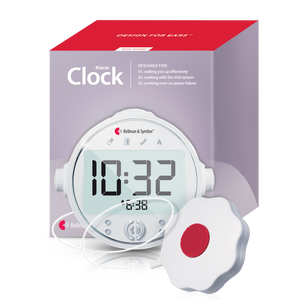
Up to 100dB · Multi-frequency ascending alarmThe Pro takes the top spot not because it's the only clock that reaches 100dB, but because it's the only one on this list that pairs that output with every other channel available: bright flashing lights and a wired bed shaker, all firing at the same moment as the sound. The alarm doesn't hit at full volume immediately - it starts softer and ascends, sweeping through multiple frequencies rather than a single pitch, which improves the odds of registering for anyone with partial, frequency-specific hearing loss. Pre-installed rechargeable batteries mean the alarm keeps working through a power outage without any setup required.
If you want the single most failure-resistant alarm clock available and don't mind a few extra features to configure, this is the one to buy first.
Bellman Alarm Clock Classic
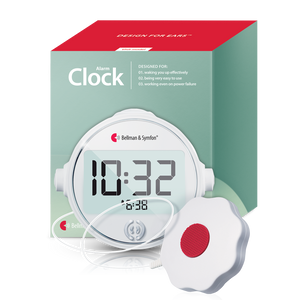
Up to 100dB · Multi-frequency ascending alarmThe Classic matches the Pro's 100dB, multi-frequency ascending alarm and wired bed shaker, but skips the flashing lights in favor of a simpler, two-dial interface. For anyone who wants the loudest sound and the strongest vibration without extra settings to manage, the Classic delivers exactly the same audio and vibration performance in a more streamlined package. It drops to #2 purely because it has one fewer sensory channel than the Pro, not because its sound or vibration output is any weaker.
The right pick for anyone - including many older adults - who wants the fewest possible buttons and menus between them and a reliable wake-up.
Bellman Alarm Clock Receiver
Up to 100dB · Multi-frequency ascending alarm + expandableThe Alarm Clock Receiver matches the Pro's sound, light, and bed shaker combination at the bedside, and ranks third only because its core function extends beyond a standalone alarm clock: it doubles as a receiver for other transmitters in the home - a smoke alarm, a doorbell, a phone line. If your only need is a morning alarm, the Pro is the simpler purchase. If you want that same 100dB, multi-sensory wake-up signal to also relay a smoke alarm or doorbell overnight, the Receiver is effectively the Pro's loudness with a bigger job description.
Vibio Wireless Bed Shaker
0dB by design · Vibration onlyVibio ranks last on decibels because it doesn't produce sound at all - it's a rechargeable, Bluetooth-connected bed shaker controlled entirely through a free smartphone app, with adjustable vibration strength and no audio component whatsoever. It's included in this ranking specifically to make a point: for a meaningful share of heavy sleepers, especially those with hearing loss or anyone sharing a room, the "loudest" alarm clock in the traditional sense is the wrong tool. Vibio's silent, app-controlled vibration solves the same core problem - waking a deep sleeper - through an entirely different channel, and does it without disturbing anyone else in the room.
Why Decibels Alone Don't Guarantee You'll Wake Up
A 100dB rating is a genuinely strong figure - for context, that's in the range of a motorcycle passing at close distance or a loud power tool. But three separate factors can quietly erode that number before it ever reaches a sleeping brain, and understanding them explains why two alarms with an identical decibel rating can perform very differently in practice.
| Factor | What Happens | What to Do About It |
|---|---|---|
| Distance | Sound intensity drops roughly 6dB every time distance from the source doubles. An alarm rated at 100dB on the nightstand can register closer to 88dB from across the room. | Keep the clock within arm's reach if sound is one of your alert channels - don't place it across the room "for willpower." |
| Frequency | Standard alarm tones often cluster in the 2,000–4,000 Hz range - precisely the range most affected by age-related and noise-induced hearing loss. A loud alarm at the wrong pitch can still be inaudible to someone with partial hearing loss. | Choose an alarm with a multi-frequency, ascending sweep rather than a single fixed tone. |
| Habituation | A brain exposed to the same alarm tone every morning for months becomes progressively better at filtering it out during sleep, regardless of how loud it is. | Add a bed shaker so the wake-up signal isn't entirely dependent on a sound channel the brain has learned to ignore. |
A louder alarm helps up to a point. Past that point, the more reliable fix isn't more decibels - it's a second channel, like vibration, that reaches the brain through a pathway habituation and hearing loss don't affect the same way.
Bellman & Symfon - Product Testing NotesThis is precisely why the highest-ranked clocks on this list all pair their decibel output with a bed shaker rather than relying on sound in isolation - and why Vibio, despite producing no sound at all, earns a place in this ranking rather than being dismissed for its 0dB rating. For the full explanation of why some people stop responding to loud alarms altogether, see our companion guide, why some people sleep through any alarm (and how to fix it).
- Buying the highest dB number without checking frequency range
- Placing a loud alarm across the room, undercutting its rated output
- Assuming a phone alarm app matches a purpose-built device's decibel rating
- Ignoring vibration entirely because sound "should be enough"
- Not checking whether the dB figure is independently documented
- Sticking with the same tone for years despite habituation setting in
- Skipping battery backup on a mains-powered clock
- Overlooking that a fully silent option may suit a shared room better than volume
Matching the Ranking to Your Situation
The #1 spot on this list isn't automatically the right purchase for everyone. Here's how the ranking translates into a real buying decision.
- Want the single loudest, most complete option: the Alarm Clock Pro combines the top decibel rating with every backup channel available.
- Want the same volume with a simpler interface: the Alarm Clock Classic matches the Pro's sound and vibration output with fewer settings to manage.
- Also need to hear a smoke alarm or doorbell overnight: the Alarm Clock Receiver delivers the same 100dB alarm while doubling as a whole-home safety receiver.
- Share a room, travel often, or want a fully silent option: the Vibio wireless bed shaker solves the same wake-up problem without any sound at all.
Confirm These Alongside the dB Rating
A high number on the box isn't the full picture. Check these too.
- Is the dB figure independently documented, not just a marketing claim?
- Does the alarm sweep multiple frequencies, or use one fixed tone?
- Is a bed shaker included, or available as an add-on?
- Can the sound be disabled while keeping vibration and light active?
- Does the unit include battery backup for power outages?
- Will you actually place it within arm's reach, or across the room?
- Do you share a bedroom, and would a silent option serve you better?
- Have you already habituated to your current alarm's tone?
Frequently Asked Questions
What is the loudest alarm clock currently available?
Among Bellman's range, the Alarm Clock Pro, Alarm Clock Classic, and Alarm Clock Receiver all reach up to 100dB with a multi-frequency ascending alarm. The Pro and Receiver add flashing lights on top of that same sound and vibration output.
Is a louder alarm clock always better for heavy sleepers?
Not necessarily. Distance from the clock, the frequency of the tone, and habituation over time can all erode the effective loudness of even a genuinely high-decibel alarm. A bed shaker adds a channel that isn't affected by any of those three factors.
Why is a silent alarm clock included in a "loudest" ranking?
Because raw volume isn't always the right metric. For heavy sleepers with hearing loss, or anyone sharing a room, a vibration-only device like Vibio can be more reliable than any amount of sound, since it bypasses hearing entirely.
Does a higher decibel rating help with hearing loss?
Only partially. If hearing loss affects specific frequencies, a louder alarm at the wrong pitch may still be difficult to hear. A multi-frequency, ascending alarm - or a bed shaker as backup - addresses this more directly than volume alone.
How loud does an alarm need to be for a heavy sleeper?
Sleep researchers generally consider 85–100dB the range where an alarm becomes reliably effective for heavy sleepers, though placement, frequency, and the presence of a backup vibration channel all affect real-world results at any decibel level.
Ready to find your loudest reliable wake-up?
Compare the full range of Bellman alarm clocks - from the 100dB Alarm Clock Pro to the completely silent Vibio.
Sources and references: National Institute on Deafness and Other Communication Disorders (NIDCD) - Hearing Loss Statistics; Age-Related and Noise-Induced Hearing Loss · National Institute for Occupational Safety and Health (NIOSH) - Noise and Decibel Exposure Reference · Sleep Foundation - Sleep Arousal Thresholds and Alarm Efficacy · Centers for Disease Control and Prevention (CDC) - Sleep and Sleep Disorders · American Academy of Otolaryngology–Head and Neck Surgery (AAO-HNS) - Hearing Loss guidance · Bellman & Symfon - Product specifications and testing: Alarm Clock Pro, Alarm Clock Classic, Alarm Clock Receiver, Vibio.
This article is for informational purposes only and does not constitute medical advice. Decibel figures reflect manufacturer specifications and internal product testing; consult a healthcare provider or audiologist for concerns about hearing loss.
Loudest Alarm Clocks on the Market: 2026 Rankings
This guide breaks down the practical choices, features, and considerations behind this topic. Use it to identify a setup that fits the listener, the environment, and the everyday moments that matter most.
The featured products below are current Bellman options discussed in the article or closely matched to its use case.