Home Safety Alert Systems for Seniors with Hearing Loss: Complete Guide (2026)

When a smoke alarm, a ringing doorbell, or a telephone call cannot be heard, the gap between safety and danger closes fast. This guide covers every home alert category seniors with hearing loss need - how each system works, what to look for, and how to build a complete, coordinated setup that works day and night without relying on sound.
- Why hearing loss creates specific home safety risks for seniors
- How vibrating and visual alert systems work
- Smoke and CO alert systems for seniors with hearing loss
- Doorbell alert systems for hearing-impaired seniors
- Phone call alert systems for seniors with hearing loss
- Push button call systems for seniors - help when they need it
- One Bridge, every alert: the integrated approach
- Day and night alerting - how the system adapts
- What caregivers and family members need to know
- Choosing and setting up the right system
Hearing loss is the third most common chronic condition in the United States, and its prevalence rises sharply with age. By age 65, roughly one in three adults has measurable hearing loss. By age 75 and older, that figure climbs to approximately one in two. For the growing population of seniors living independently - or with family members who are not always present - hearing loss is not just a communication challenge. It is a home safety issue that demands a deliberate, practical response.
Standard home safety devices - smoke alarms, carbon monoxide detectors, doorbells, telephones - were designed with hearing in mind. They alert through sound: loud tones, high-pitched beeps, ringing bells. For seniors with significant hearing loss, particularly those who remove their hearing aids at night, these audible alerts may not reach them at all during the hours when emergencies are most dangerous.
The solution is a category of technology specifically designed to replace sound with tactile and visual alerts: wrist vibrations, visual icons, flashing lights, and bed shakers that communicate every household event directly to the senior's body and field of vision - regardless of whether they are wearing their hearing devices. This guide explains how these systems work, which alert categories matter most, and how to build a complete, integrated home safety setup through the Bellman Bluetooth Bridge system.
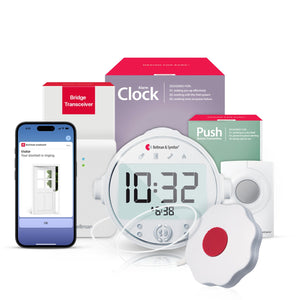
A home safety alert system for seniors with hearing loss replaces reliance on sound with wrist vibrations and visual icon notifications for smoke alarms, doorbells, phone calls, and door sensors - delivered through a connected bridge and wearable watch receiver. The Bellman Bluetooth Bridge serves as the central hub: it receives signals from all connected transmitters - smoke, doorbell, phone, push button - and delivers distinct icon-based alerts to the Bellman Watch Receiver worn on the wrist. No internet required for wrist alerts.
Why Hearing Loss Creates Specific Home Safety Risks for Seniors
The relationship between hearing loss and home safety is direct and well-documented. Sound is one of the primary channels through which humans detect danger - a crackling fire, a CO detector beeping, a visitor at the door, a family member calling for help. When that channel is degraded, every safety system that relies on it becomes less effective or entirely ineffective.
For seniors, several compounding factors make hearing loss a more acute home safety concern than it might be for younger adults with similar audiological profiles.
Hearing Devices Are Removed Overnight
Most seniors with hearing aids or cochlear implants remove them at night for comfort, skin health, and battery management. This is not a choice - it is a practical requirement of using these devices. The result is that the hours when fires, CO leaks, and medical emergencies are most dangerous are precisely the hours when the senior has the least audio awareness. An 85-decibel smoke alarm that is audible with hearing aids in may be completely inaudible to the same person when their devices are on the nightstand.
Age-Related Changes in Sound Sensitivity
Presbycusis - age-related sensorineural hearing loss - preferentially affects high-frequency sounds first. Smoke alarm tones, which are typically in the 3,000–4,000 Hz range, fall squarely in the frequency band that deteriorates earliest and most severely in age-related hearing loss. This means that a senior may still pass a basic conversational hearing test while being genuinely unable to hear their smoke alarm at adequate volume from their bedroom.
Reduced Awareness While Engaged or Distracted
A senior who is watching television, working in the garden, or simply absorbed in a task may not notice a doorbell, a ringing phone, or even a nearby alarm - even with hearing aids. This is not inattention; it is the practical reality of managing degraded auditory input in a busy environment. Purpose-built alert systems that deliver a physical wrist vibration cut through this engagement barrier in a way that audible alerts cannot.
The Independence Dimension
For seniors living independently or aging in place, the safety gap created by hearing loss has a direct bearing on their ability to remain in their own home. Family members and caregivers who worry about missed alarms, unanswered doors, or a senior unable to call for help drive the majority of conversations about alternative living arrangements - conversations that proper alerting technology can significantly delay or prevent. See our full guide on aging in place with hearing loss and the technology that supports it.
The right alerting technology doesn't just keep a senior safe - it gives them the confidence to remain in their own home, on their own terms, for longer.
Bellman & Symfon EditorialHow Vibrating and Visual Alert Systems Work
Purpose-built home alert systems for seniors with hearing loss operate on a fundamentally different principle from standard safety devices. Instead of amplifying sound, they convert sound-triggered or event-triggered signals into tactile and visual alerts - wrist vibrations, LED flashes, and icon-based displays that communicate meaning without requiring the recipient to hear anything.
The Bellman system uses a two-component architecture that delivers this conversion reliably across a whole home:
-
A transmitter detects the event at its source. Each alert type has a corresponding transmitter placed in the relevant location - a smoke transmitter near the smoke detector, a doorbell transmitter near the front door, a phone transmitter near the telephone. When the associated event occurs, the transmitter sends a 433 MHz radio frequency signal. This detection happens locally and does not depend on any internet connection.
-
The Bluetooth Bridge receives and identifies the signal. The Bellman Bluetooth Bridge, placed centrally in the home, receives the 433 MHz signal from any paired transmitter, identifies which transmitter sent it, and immediately converts it into a Bluetooth alert mapped to the appropriate icon - flame for smoke, doorbell for visitors, phone for calls, and so on.
-
The Watch Receiver delivers the alert on the wrist. The Bellman Watch Receiver, worn on the senior's wrist, receives the Bluetooth alert from the Bridge and responds with a strong vibration and a clear icon on the watch face. The icon tells you what happened - so you know immediately whether to check the stove, answer the door, pick up the phone, or respond to a family member - without needing to hear a single sound.
-
A secondary app alert reaches caregivers and family members. Simultaneously, the Bridge sends a notification to the Bellman smartphone app - meaning a caregiver, adult child, or other family member with the app installed also receives an alert. This is particularly valuable for families managing safety from a distance: if a smoke transmitter fires in a senior parent's home, everyone on the app knows within seconds.
The Watch Receiver is on the senior's wrist. It travels with them through the home. It vibrates directly against their skin - a physical sensation that cuts through distraction, sleep, and engagement in a way that a sound or even a visual flash cannot. Unlike a phone app notification, it does not depend on the phone being nearby, charged, or set to vibrate. Unlike a strobe light, it does not require line-of-sight. The smartphone app is a valuable secondary channel for caregivers, but the Watch is where the senior's safety begins.
Smoke and CO Alert Systems for Seniors with Hearing Loss
Smoke and carbon monoxide alerting is the highest-stakes category in home safety for seniors with hearing loss. The NFPA reports that roughly three in five home fire deaths occur in homes where smoke alarms either were not present or failed to alert occupants, and for seniors sleeping without hearing devices, a standard audible alarm offers essentially no protection overnight. Carbon monoxide is even more insidious: it is odourless, colourless, and causes progressive impairment that can prevent a sleeping person from ever waking in response to symptoms.
The Bellman smoke and CO transmitter connects to the same Bridge as all other household transmitters. When your existing smoke or CO detector activates, the transmitter detects the alarm sound and instantly sends a signal to the Bridge, which relays a flame or CO icon vibration to the Watch Receiver - day or night, hearing devices on or off. No internet required. No cloud dependency. The alert reaches the wrist in seconds.
Daytime vs. Nighttime Smoke and CO Coverage
During the day, the Watch Receiver on the wrist delivers immediate wrist vibration anywhere in the home - in the garden, in a back room, in the bathroom - wherever the senior happens to be. At night, the Watch worn to bed continues to vibrate when any transmitter fires. For the most complete overnight coverage, the Bridge + Smoke/CO + Alarm Clock bundle adds a vibrating alarm clock with bed shaker to the system - meaning a fire or CO emergency overnight triggers wrist vibration, bed shaker vibration beneath the mattress, and visual flash from the alarm clock unit, all simultaneously. A Watch Receiver can be added separately for daytime wrist coverage if the senior prefers not to rely on the smartphone app during the day.
- Standard smoke alarms operate at 85 dB - but age-related loss preferentially affects high frequencies (3–4 kHz), exactly where alarm tones sit
- Hearing aids and cochlear processors are removed at night, eliminating the primary compensation mechanism
- Three in five home fire deaths occur in homes where alarms failed to alert occupants (NFPA)
- CO poisoning is odourless and impairs cognitive function before the victim is aware - wrist alerts provide the only reliable overnight warning
- Strobe lights require line-of-sight and closed-door bedrooms significantly reduce their effectiveness
- The NFPA and NAD both recommend vibrating and visual alert systems as necessary supplements to audible alarms for people with hearing loss
For a complete deep-dive into smoke alarm options specifically for seniors with hearing loss, see our guide: smoke alarm for seniors with hearing loss: visual and vibrating options explained.
Doorbell Alert Systems for Hearing Impaired Seniors
A missed doorbell is more than an inconvenience for a senior with hearing loss. It means missed medication deliveries, missed family visits, missed service appointments, and - critically, missed help when someone is checking in specifically because they are worried. For seniors living alone, the doorbell is also a safety touchpoint: family members and caregivers use door visits specifically as welfare checks, and a senior who cannot hear the bell and does not answer creates immediate concern.
The Bellman Doorbell System with Bluetooth Bridge and Watch Receiver connects a doorbell transmitter to the existing Bridge. When a visitor presses the doorbell, the transmitter detects the ring and sends a doorbell icon vibration to the Watch Receiver - wherever the senior is in the home. No audible chime needs to sound through the house. The alert is felt on the wrist, the door is answered, and the visitor is attended to.
What Makes a Good Doorbell Alert System for Seniors
- Wrist delivery: The alert must reach the senior wherever they are in the home, not just in the room where a receiver unit or flashing light is located. The Watch Receiver on the wrist is the only delivery mechanism that travels with the person.
- No audible chime required: The system should work silently from the senior's perspective. They feel the alert; the visitor hears nothing unusual. This is particularly important in homes where a loud chime would be disruptive, or where the senior does not want a visitor to know they have a hearing loss accommodation in place.
- Clear icon identification: The doorbell icon on the Watch face tells the senior it is the door, not the smoke alarm, not the phone, not a push button. They know what to do before they stand up.
- Whole-home range: The Bridge-to-Watch Bluetooth link covers up to 650 feet in an open field - more than sufficient for most residential properties, including outdoor spaces like gardens and garages.
For a complete guide to doorbell alerting for elderly hearing impaired individuals, including installation tips and configuration options, see: doorbell alert for elderly hearing impaired: help seniors never miss the door.
Phone Call Alert Systems for Seniors with Hearing Loss
For many seniors, the telephone is a lifeline - to family, to doctors, to emergency services, to the world outside their home. Hearing loss makes phone calls genuinely difficult: even with hearing aids, the frequency shaping of standard telephone audio often makes speech harder to follow than a face-to-face conversation. Missing the ring entirely - because the phone is in another room, because the senior is in the garden, or because their hearing devices are off - creates a real gap in connection and safety.
The Bellman Phone System with Bluetooth Bridge and Watch Receiver connects to both landlines and mobile phones through the Bridge. When an incoming call is detected, the Bridge sends a phone icon vibration to the Watch Receiver immediately - giving the senior the chance to reach their phone before the call goes to voicemail, regardless of where in the home they are.
Landline and Cell Phone Coverage
For seniors using a landline - still the preferred phone type for many older adults for reliability and audio quality reasons - the Bellman phone transmitter connects directly to the phone line and detects incoming calls. For seniors using a mobile phone, the Bridge detects the phone's ring through a proximity-based or Bluetooth-paired connection. Both configurations send the same phone icon alert to the Watch Receiver, so the senior never needs to rush to find out where the ring is coming from - they already know from the icon what to look for.
Many family members and caregivers use regular phone calls as welfare checks - a quick daily or weekly call to confirm a senior parent is well. If that call is missed repeatedly, it triggers concern that may lead to unnecessary visits, calls to neighbours, or escalated worry. A phone alert system that ensures the senior catches every call - not just those that happen to ring when they are in the right room - removes this source of anxiety for both the senior and the family.
Missed calls from doctors, pharmacies, and emergency services carry their own safety implications. A missed reminder about a medication appointment or a follow-up call about a test result can have cascading health consequences that a reliable phone alert system directly prevents.
For a full guide to phone alert options for seniors, see: phone alert system for elderly with hearing loss: landline and cell notification options.
Push Button Call Systems for Seniors - Help When They Need It
A push-button call system addresses one of the most important home safety scenarios for seniors: the need to alert a caregiver, family member, or household companion without shouting across the house. For seniors with hearing loss who live with other family members, or for multi-generational households where a caregiver is present, shouting for help is not an option - not because of volume, but because neither party can hear clearly across rooms.
The Bellman Push Button System with Bluetooth Bridge and Watch Receiver gives the senior a portable button that, when pressed, immediately sends a push button icon vibration to the Watch Receiver worn by a caregiver or family member. No shouting. No phone call required. A single press is a clear, silent, dignified request for attention - and it arrives on the caregiver's wrist within seconds.
Where Push Button Systems Matter Most
Multi-generational households
When a senior parent lives with adult children, the push button lets them signal for assistance from anywhere in the home without disturbing the household with shouting. The caregiver feels the vibration on their wrist and goes to assist - quietly and promptly.
Bathroom and fall risk areas
The push button can be kept in the bathroom, bedroom, or any area where falls are more likely. If a senior needs help after a fall or feels unwell, a single press alerts the caregiver immediately - a silent, reliable call-for-help that works whether the caregiver can hear or not.
Garden and outdoor areas
Seniors who spend time in the garden, on a porch, or in areas of the home away from main living spaces can carry the push button with them. The Bridge's range covers most residential properties, meaning a press from the garden reaches the Watch Receiver indoors reliably.
Nighttime assistance
A push button on the nightstand lets a senior alert a caregiver during the night without making noise that might disturb other household members. The caregiver wearing the Watch to bed wakes to the vibration and can respond. For overnight setups, the Bridge + Push Button + Alarm Clock bundle covers nighttime assistance and silent morning wake-up in one package.
For a full guide to push button systems for elderly parents, see: push button call system for elderly: discreet alerts without shouting across the house.
One Bridge, Every Alert: The Integrated Approach
The most important architectural decision in building a home alert system for a senior with hearing loss is whether to use separate devices for each alert type, or a single integrated system that routes all alerts through one Bridge to one Watch. The case for integration is strong - and it is worth understanding clearly before buying anything.
The Problem with Separate Devices
A common approach to senior home alerting involves purchasing individual products for each need: a standalone flashing smoke alarm, a separate doorbell signaller unit, a different vibrating phone ringer, and a personal emergency response system (PERS) button. Each comes with its own receiver, its own batteries, its own pairing process, and its own maintenance routine. For a senior who is already managing the complexity of daily life with hearing loss, this fragmented approach creates new cognitive and practical burdens - multiple devices to charge, multiple systems to understand, and no unified picture of what is happening in the home.
The Bridge Integration Advantage
The Bellman Bluetooth Bridge changes this entirely. One central hub - plugged into a wall outlet - receives signals from every connected transmitter in the home and routes them all to the single Watch Receiver on the senior's wrist. Each alert type has its own distinct icon, so the senior always knows exactly what requires their attention without confusion.
Every one of these alerts is silent to the rest of the household. No audible chimes. No ringtones. No alarm sounds that might disturb other family members or a sleeping partner. The senior feels the alert on their wrist, identifies it by icon, and responds appropriately - independently, confidently, and without assistance.
The smartphone app provides a parallel alert channel for caregivers and family members. When any transmitter fires in the senior's home, the Bridge sends a push notification to every device with the Bellman app installed. This means a family member checking in from across town can see immediately if a smoke alarm fired, if the phone was ringing, or if the senior pressed the push button. It is remote peace of mind, built into the same system as the local wrist alert.
Day and Night Alerting - How the System Adapts
Seniors with hearing loss face different alerting challenges at different times of day. The Bellman system is designed to handle both - without requiring the senior to change settings or switch devices.
Daytime Coverage
During the day, the Watch Receiver on the wrist travels with the senior through every room, to the garden, to the workshop, and anywhere else in the home. The Bridge's Bluetooth link covers up to 650 feet in open field - enough for most residential properties - meaning the senior receives wrist alerts from every connected transmitter regardless of where they are in the house. The Bellman app on a paired smartphone provides a secondary alert layer for situations where Bluetooth range is at its limit.
Daytime is also when the doorbell, phone, and push-button transmitters prove their practical value most clearly. A visitor who rings the bell while the senior is in the back bedroom hears the normal doorbell chime outside; the senior feels the doorbell icon on their wrist and goes to answer. A phone call that comes in while the senior is in the garden triggers a phone icon vibration - no missed call, no callback required. A caregiver needing to reach the senior across the house presses the push button - one vibration, no shouting.
Nighttime Coverage
Nighttime is the highest-risk period for home safety emergencies. The majority of residential fire fatalities occur overnight. CO poisoning is most dangerous during sleep. And for seniors who remove their hearing devices at night, the auditory gap is absolute.
The Watch Receiver worn to bed is the core nighttime solution. Its vibration is designed to wake a sleeping adult. The flame icon or CO icon on the Watch face identifies the emergency immediately - even at 3 a.m. For the most complete overnight setup, pairing the Bridge with a vibrating alarm clock and bed shaker provides redundant alert channels. The Bridge + Smoke/CO + Alarm Clock bundle is the recommended overnight safety foundation: it covers emergency alerts, provides a bed shaker for under-mattress vibration, and includes a silent vibrating wake-up alarm - all through one Bridge, all to one Watch. The Watch Receiver can be added separately to this bundle for daytime wrist alerts as well.
For doorbell and push button overnight coverage on the same Bridge, the Bridge + Door + Alarm Clock bundle and Bridge + Push Button + Alarm Clock bundle extend the same integrated approach to those alert types.
What Caregivers and Family Members Need to Know
For adult children, caregivers, and family members managing the home safety of a parent or loved one with hearing loss, the Bellman system offers something that standalone senior safety devices rarely provide: transparency and remote awareness. When the Bellman app is installed on a family member's phone, they receive the same alerts the senior receives on their Watch - smoke, doorbell, phone, push button - in real time, wherever they are.
This is not surveillance; it is a safety net. If a smoke transmitter fires in a senior parent's home and the caregiver receives an app notification but cannot reach the parent by phone in the minutes that follow, they know to act immediately. If the push button is pressed overnight and the caregiver receives the alert on their phone, they can call to check in before making the trip over. The system supports autonomy - the senior manages their own home, independently, with the Watch on their wrist - while giving family members the visibility they need to respond appropriately if something goes wrong.
Setting Up for a Parent or Senior Loved One
The Bellman system is designed for self-installation - no electrician, no technician, no professional setup fee. The entire system typically takes 15 to 30 minutes to set up from unboxing, including placing transmitters, pairing the Watch Receiver, and connecting the Bridge to Wi-Fi for app alerts. For a caregiver installing the system in a parent's home, it is a single visit rather than an ongoing project.
For a full caregiver-focused guide to choosing and setting up a system for a parent, see: how to choose a home alert system for a parent with hearing loss: caregiver's checklist. And for caregivers looking for a thoughtful, practical gift that genuinely improves a senior's safety and independence, see: gifts for seniors with hearing loss: practical alert devices that actually help.
For seniors at higher risk - those with mobility limitations, those who live alone in larger homes, or those who have experienced recent health events - see our guide on emergency preparedness for deaf and hard-of-hearing seniors: what every caregiver must know.
Choosing and Setting Up the Right System
The right home alert configuration for a senior with hearing loss depends on the specific alerts that matter most in their daily life, their home layout, and whether a caregiver is also involved in monitoring. Here is a practical decision framework.
Start With the Highest-Risk Alerts First
Smoke and CO alerting is always the starting point. This is the life-safety category - not a convenience. If a senior with hearing loss has only one alert system in their home, it should be a smoke and CO transmitter connected to the Bellman Bridge and a Watch Receiver. Everything else is built on top of this foundation.
Add Alert Types Based on Daily Life Challenges
- Frequently missing visitors: Add a doorbell transmitter. The Bellman Doorbell System connects to the existing Bridge - no new hub required.
- Missing phone calls: Add a phone transmitter. The Bellman Phone System covers both landline and cell, again through the same Bridge.
- Needing a way to call for help silently: Add a push button transmitter. The Bellman Push Button System gives the senior a portable button that sends a wrist alert to any caregiver or family member wearing a paired Watch or monitoring via the app.
- Living with family or a caregiver: Set up the Bellman app on the caregiver's phone. All alerts reach both the senior's Watch and the caregiver's app simultaneously - no additional hardware needed.
The Complete Setup Checklist
Complete configuration for seniors with hearing loss
Work through each category. Every item added to the Bridge extends coverage without adding a new system to manage.
- Bluetooth Bridge - centrally placed, near bedroom floor
- Watch Receiver - worn throughout the day and overnight
- Smoke transmitter - near bedroom hallway detector
- CO transmitter - near sleeping area detector
- Doorbell transmitter - connected to existing doorbell
- Phone transmitter - landline and/or cell covered
- Push button - carried by senior, kept on nightstand
- Alarm Clock bundle - silent vibrating morning wake-up
- Bellman app - installed on caregiver/family member's phone
- All transmitters tested from key locations in the home
- Watch Receiver charged daily - battery above 20% before bed
- Existing smoke/CO detectors tested and confirmed working
Build a complete home alert system - designed for seniors with hearing loss.
One Bluetooth Bridge. One Watch Receiver. Smoke, CO, doorbell, phone, and push button alerts - all on your wrist, day and night, no internet required.
More in This Series
Smoke alarm for seniors with hearing loss: visual and vibrating options explained
A complete guide to smoke and CO alert options, why audible alarms fail overnight, and how the Bellman transmitter fills the gap.
Doorbell alert for elderly hearing impaired: help seniors never miss the door
How vibrating doorbell alert systems work, how to choose one, and why the Watch Receiver is the right delivery mechanism for seniors.
Phone alert system for elderly with hearing loss: landline and cell notification options
How the Bellman phone transmitter ensures seniors never miss a call from family, doctors, or emergency services.
Push button call system for elderly: discreet alerts without shouting across the house
A quiet, dignified way for seniors to request help - and for caregivers to be reached silently across any room or floor.
Aging in place with hearing loss: the complete home technology guide
The full picture of technology that supports independent living for seniors with hearing loss - alerting, listening, communication, and more.
Emergency preparedness for deaf and hard-of-hearing seniors: what every caregiver must know
Layered alerting, evacuation planning, and caregiver checklists for senior safety in emergencies.
Gifts for seniors with hearing loss: practical alert devices that actually help
The most meaningful gifts for elderly parents or relatives with hearing loss are systems that genuinely improve safety and independence.
How to choose a home alert system for a parent with hearing loss: caregiver's checklist
A practical decision framework and checklist for caregivers and adult children evaluating alert system options for a senior parent.
Sources: National Fire Protection Association (NFPA) - Home Structure Fires; Smoke Alarm Requirements; Home Fire Death Statistics · Centers for Disease Control and Prevention (CDC) - Carbon Monoxide Poisoning: Prevention; Unintentional Non-Fire-Related CO Poisoning · National Institute on Aging (NIA) - Hearing Loss: A Common Problem for Older Adults; Aging in Place · National Institute on Deafness and Other Communication Disorders (NIDCD) - Quick Statistics About Hearing; Age-Related Hearing Loss (Presbycusis) · World Health Organization (WHO) - Deafness and Hearing Loss Fact Sheet (2026) · Hearing Loss Association of America (HLAA) - Assistive Technology Resources; Hearing Loss Facts and Statistics · National Association of the Deaf (NAD) - Fire Safety Resources for Deaf and Hard of Hearing Individuals · Gallaudet University Research Institute - Deaf and Hard of Hearing Household Safety Data · JAMA - Hearing Loss and Risk of Falls in Older Adults · Bellman & Symfon - Bluetooth Bridge Transceiver BE1521 specifications; Watch Receiver BE3330 specifications; Smoke Alert Transmitter specifications (us.bellman.com) · IEEE 802.15 - Bluetooth 5 specification: peer-to-peer local operation, range characteristics · FCC - 433 MHz ISM band specification and indoor propagation.
This article is for informational purposes only and does not constitute medical, fire safety, or legal advice. Ensure all smoke and CO detectors in your home comply with local building codes and are tested regularly. Consult a licensed audiologist for personalised hearing health guidance.
Home Safety Alert Systems for Seniors with Hearing Loss: Complete Guide (2026)
This guide breaks down the practical choices, features, and considerations behind this topic. Use it to identify a setup that fits the listener, the environment, and the everyday moments that matter most.
The featured products below are current Bellman options discussed in the article or closely matched to its use case.