Best Doorbell Alert Systems for Hearing Impaired (2026)

A doorbell you can't hear is a door you might as well not have. This guide covers every meaningful option for deaf and hard of hearing users in 2026 - how they work, who each one suits, and what to actually look for before you buy.
Why Standard Doorbells Don't Work for Many People
A conventional doorbell is a single-channel alert system: it makes a sound and hopes you hear it. For the roughly 37.5 million American adults who report some degree of hearing difficulty - and for the estimated 1 million who are functionally deaf - that single channel is unreliable at best and completely useless at worst. The problem is compounded by the fact that standard doorbell chimes tend to sit in the mid-to-high frequency range where age-related and noise-induced hearing loss strikes first. And even users with partial hearing miss doorbell rings constantly when hearing aids are out, music is playing, they're in a back room, or they're asleep.
The result is missed deliveries, missed visitors, missed caregivers, and - for people who live alone - an ongoing low-grade anxiety about whether someone has been standing at the door. It's a solvable problem. A dedicated doorbell alert system replaces or supplements the audio chime with light, vibration, or both, in formats that reach the user wherever they are in the home.
This guide covers the full landscape: the different system types available in 2026, which situations each one is best suited to, what features actually matter, and the specific Bellman options worth considering for each use case. If you want to understand the underlying technology first, see our companion article How Do Deaf Alert Systems Work? For a broader overview of the full alerting category, start with our Best Alerting Systems for Deaf & Hard of Hearing People (Buyer's Guide).
We cover doorbell alert systems in two main categories: Doorbell Transmitter systems (which work with your existing doorbell chime) and Push Button Transmitter systems (which replace or bypass the chime entirely). Within each, we cover different receiver configurations - flash, pager, alarm clock, portable, and watch - so you can match a system to your specific situation rather than picking a generic "best overall."
What to Actually Look for Before You Buy
Most doorbell alert guides focus almost entirely on the transmitter - the thing that detects the ring. That's the wrong emphasis. The transmitter is largely the same across systems: it listens for your doorbell, detects the ring, and sends a wireless signal. The decision that actually matters is which receiver you pair it with, because the receiver determines how and where you get the alert. Here's what to evaluate.
Daytime vs. Nighttime Use
A flash receiver in the living room is excellent for daytime coverage when you're awake and moving around. It does nothing useful while you're asleep. If you need overnight alerting - and most people do - you need a bed shaker in the loop. Systems that include both a visual receiver and a bed shaker handle both scenarios without requiring two separate purchases.
Home Size and Room Coverage
A flash receiver placed in the living room won't help if you're frequently in the kitchen or backyard. Large homes generally need either a portable receiver you carry with you, or multiple stationary receivers in different rooms. Bellman's modular platform lets you add receivers incrementally - you don't have to solve this all at once.
Existing Doorbell vs. No Doorbell
If you have a wired doorbell chime installed, a Doorbell Transmitter placed near the chime is the simplest path - no new hardware at the door, no rewiring. If you're renting, don't have a doorbell, or want something more flexible, a Push Button Transmitter mounted outside (or carried as a call button) bypasses the chime entirely and works anywhere.
Wi-Fi Independence
Smart doorbells (Ring, Nest, and similar) depend on your home internet connection. When the router goes down or the power is out - the exact moments when a safety alert matters most - internet-dependent systems can fail. Dedicated RF-based alerting systems like the Bellman range operate completely independently of Wi-Fi, with battery backup built into receivers for power-outage resilience.
Expandability
The best doorbell system isn't a standalone product - it's a doorbell system that's also part of a broader alerting platform. If you ever want to add phone alerts, smoke alarm detection, or baby monitor coverage, you want a platform where all those transmitters talk to the same receivers. Replacing everything because you bought the wrong ecosystem is expensive and avoidable.
Alert Identification
In a home with multiple transmitters active, knowing whether you're responding to the doorbell or the smoke alarm matters. Look for receivers with color-coded LED indicators that distinguish alert types - not just a generic flash or vibration. The Bellman pager and alarm clock receivers use event-specific icon displays so you always know what's happening at a glance.
The Two Transmitter Types: Which Starting Point Is Right for You?
Option 1: Doorbell Transmitter Systems (Works With Your Existing Chime)
A Doorbell Transmitter is placed near your existing door chime - typically mounted to the wall nearby or set on a shelf next to it. It uses a combination of an internal microphone, electromagnetic sensing, and optionally an external mic input to detect when your existing doorbell rings. When it does, it instantly broadcasts a wireless RF signal to all paired receivers throughout the home.
The Bellman Doorbell Transmitter uses dual microphone technology to distinguish doorbell tones from general household noise, significantly reducing false triggers. It supports up to 260 feet of open-field wireless range, has up to 5 years of battery life, and is compatible with most residential chimes on the market. You can also teach it to recognize additional sounds - an intercom buzzer, a medical device alert, or any other recurring audio event - making it more versatile than a simple doorbell listener.
Best for: Homeowners with an existing wired doorbell who want the simplest possible setup, renters who can't modify their doorbell wiring, and anyone who wants a solution that leaves the front door hardware unchanged.
Option 2: Push Button Transmitter Systems (No Existing Doorbell Required)
A Push Button Transmitter is a compact, battery-powered button that guests press directly. When pressed, it sends a wireless signal to all paired receivers - no doorbell chime required, no microphone involved. It can be mounted outside the door using included wall hardware, or carried on a lanyard as a personal call-for-attention button inside the home.
The Push Button approach has a few practical advantages over the Doorbell Transmitter. Because it triggers on a physical button press rather than a microphone listening for a sound, it's immune to false triggers from nearby audio. It also works in apartments and rentals where no doorbell infrastructure exists at all. And as a wearable call button, it extends beyond the doorbell use case - a partner or caregiver can press it to summon attention from anywhere in the home.
Best for: Apartments and rentals without existing doorbells, situations where false triggers are a concern, users who also want a personal call button, and anyone replacing an unreliable or broken doorbell system entirely.
Bellman Doorbell Alert Systems: A Guide to Every Configuration
The Bellman Alerting System is built on a single modular RF platform. Every transmitter and receiver in the range is pre-paired at the factory and works with every other component - so the systems below aren't isolated products, they're starting configurations you can expand over time. All require no Wi-Fi, no app, and no technical setup beyond placing components and inserting batteries or plugging in.

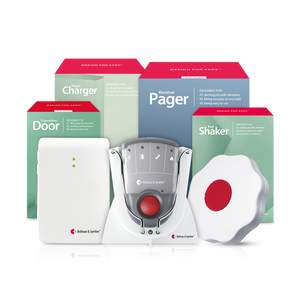
Doorbell System with Pager Receiver, Charger, and Bed Shaker
This is the most complete doorbell-specific bundle in the Bellman range, and the one we'd recommend as the default starting point for most users. The Doorbell Transmitter monitors your existing chime; the Pager Receiver delivers color-coded vibration alerts with LED indicator icons; the Pager Charger acts as a nighttime dock that connects to the Bed Shaker - so when the pager is charging bedside, pressing the doorbell also activates the bed shaker under your pillow. Day and night coverage in a single package, with no compromises for either situation.
- Works with existing doorbell chime - no door hardware changes
- Pager delivers vibration + color-coded LED icons - know it's the door, not the smoke alarm
- Bed Shaker via Pager Charger dock ensures overnight alerting while pager charges
- Pager is portable - carry it room to room throughout the day
- Expandable: add flash receivers, phone transmitters, or smoke detection at any time

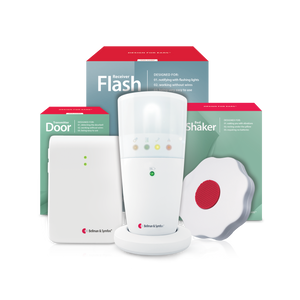
Doorbell System with Flash Receiver and Bed Shaker
For users who rely primarily on visual alerts, the Flash Receiver delivers high-intensity strobe flashes with color-coded LED indicators that are visible across a room - even in well-lit environments. Combined with the Bed Shaker for overnight use, this bundle covers the full day-to-night range with the most prominent visual signal in the Bellman receiver lineup. If you spend most of your waking hours in one main room (living room, home office, studio), a Flash Receiver in that space paired with a bed shaker in the bedroom is an extremely reliable coverage setup.
- Flash Receiver delivers room-filling strobe alerts - hard to miss even in bright conditions
- Color-coded LED indicators distinguish doorbell from other system alerts
- Bed Shaker provides reliable overnight coverage
- Battery backup on Flash Receiver for power outage resilience
- Fully expandable into broader Bellman Alerting System

Doorbell System with Standalone Pager Receiver
The simplest bundle in the doorbell range - a Doorbell Transmitter paired with just the Pager Receiver, with no additional accessories. It's the right starting point if you primarily need daytime coverage, live in a smaller home where one receiver covers most of your movement, or want to start with the minimum and add components over time. The pager is fully portable and rechargeable, delivers distinct vibration patterns with color-coded LED indicators, and can have a Bed Shaker added later by simply purchasing the Pager Charger accessory. Nothing is wasted when you expand.
- Most affordable entry point into the Bellman doorbell system
- Pager is compact, lightweight, rechargeable - carry it anywhere in the home
- Full week of battery life on a single charge under regular use
- Bed Shaker can be added later via Pager Charger - no need to replace anything
- Works as part of the full Bellman Alerting System if you expand

Doorbell System with Portable Receiver and Bed Shaker
The Portable Receiver is a different form factor from the Pager - louder, with adjustable sound output up to 93 dB (at 1 meter), individual sound signatures per alert type, and light indicators for visual confirmation. It's the right pick for users who still have some residual hearing and want sound as part of their alert delivery alongside visual cues, or for settings where a louder audible component genuinely helps. The included Bed Shaker extends coverage overnight. The Portable Receiver runs on batteries, making it easy to move between rooms without charging management.
- Adjustable volume up to 93 dB - useful for users with partial residual hearing
- Individual sound signatures distinguish doorbell from other alert types
- Light indicators provide simultaneous visual confirmation
- Battery-powered - no charging required, fully mobile
- Bed Shaker included for overnight alerting

Push Button System with Pager Receiver, Charger, and Bed Shaker
The Push Button equivalent of our top Doorbell pick - the same Pager + Charger + Bed Shaker configuration, but triggered by a physical button press rather than a doorbell chime detection. This is the right choice for apartments and rentals without existing doorbells, homes where the Doorbell Transmitter produces false triggers from ambient sounds, and any setup where you also want a wearable call-for-attention button inside the home. Mount the Push Button outside the door as a doorbell, or wear it on the included lanyard as a personal call button - or both simultaneously with a spare unit.
- No existing doorbell required - works anywhere a button can be mounted or carried
- Zero false triggers - button only fires when physically pressed
- Doubles as a personal call-for-help button when worn on the included lanyard
- Pager + Charger + Bed Shaker provides full day-and-night coverage
- Fully expandable across the Bellman Alerting System platform

Push Button System with Bluetooth Bridge and Watch Receiver
This is Bellman's most modern and discreet configuration - a Push Button Transmitter paired with a Bluetooth Bridge Transceiver and a Watch Receiver that delivers vibration alerts directly to the wrist. Unlike the RF-only bundles, this system uses the Bridge to connect the alerting network to the smartwatch and to the free Bellman Assistant app on iOS or Android. That means you can receive doorbell notifications on your wrist throughout the home, and even via your phone when the watch isn't nearby. The watch face is customizable, and icons clearly identify which alert type has triggered. Ideal for users who want the most unobtrusive, always-on-body alerting experience available.
- Watch Receiver delivers discreet wrist vibrations with clear event icons
- Bellman Assistant app extends alerts to smartphone (iOS and Android, free)
- Bluetooth Bridge connects the RF alerting system to modern wearable and app ecosystem
- Most discreet form factor in the Bellman range - no visible receivers in the home
- Push Button works as doorbell or wearable call button

Push Button System with Alarm Clock Receiver and Bed Shaker
The Alarm Clock Receiver is a particularly versatile unit because it serves double duty: it's both a doorbell alert receiver and a wake-up alarm clock with visual and vibration output, all in one bedside device. When someone presses the Push Button at the door, the Alarm Clock Receiver fires its light, sound (adjustable up to 100 dB), and bed shaker simultaneously. At the same time, it handles your morning alarm with the same multi-sensory outputs. For users who want a single bedside device that consolidates both functions without needing a separate alarm clock, this is the most space-efficient option in the range.
- Alarm Clock Receiver handles both doorbell alerts and morning wake-up in one device
- Up to 100 dB alarm output - one of the loudest in the Bellman receiver lineup
- Bed Shaker delivers strong physical vibration for deep-sleep wake-up
- Color-coded LED icons identify alert type at a glance
- Push Button doubles as a wearable call-for-attention button
Side-by-Side Comparison
All systems below use Bellman's RF wireless platform - no Wi-Fi, no app required (except the Watch system), pre-paired out of the box, with up to 260 feet of open-field wireless range.
The Nighttime Problem - and How Each System Handles It
Nighttime doorbell alerting is categorically harder than daytime alerting. Hearing aids are off. You're in a closed bedroom. Even a flash receiver in the hallway may not be visible from behind a closed door. A standard doorbell chime at full volume may not register at all.
The reliable answer is a bed shaker - a vibrating device placed under the pillow or mattress that delivers strong physical pulses directly to the sleeping body. At sufficient intensity, a bed shaker wakes most people reliably from sleep regardless of hearing status. All of the top-ranked systems above include a bed shaker for exactly this reason.
The specific path the alert takes matters too. In the Pager + Charger + Bed Shaker configuration, the pager is placed in its charging dock at night, and the dock connects to the bed shaker - so overnight doorbell alerts trigger both the pager's own vibration and the bed shaker simultaneously. In the Alarm Clock + Bed Shaker configuration, the receiver handles overnight alerting directly with combined flash, sound, and bed shaker output. Either approach provides the redundant delivery that makes nighttime alerting genuinely reliable rather than theoretical.
The question isn't whether a doorbell system will alert you during the day - almost any system will. The question is whether it will wake you from sleep at 11 p.m. when your hearing aids are out. That's where the bed shaker earns its place.
Bellman & Symfon - Alerting System Design NotesHow to Choose: A Decision Framework
Answer these questions before you buy
Work through these to narrow your options - each one eliminates configurations that won't serve your situation.
- Do you have an existing wired doorbell? → Doorbell Transmitter systems
- No doorbell or renting? → Push Button systems
- Need overnight alerting while sleeping? → Include a Bed Shaker
- Want the brightest possible visual alert? → Flash Receiver
- Prefer carrying an alert device on your person? → Pager Receiver
- Want alerts on your wrist / phone app? → Watch + Bridge system
- Need a combined alarm clock + doorbell receiver? → Alarm Clock Receiver
- Live in a large home needing multi-room coverage? → Add a second receiver
- Want to add phone / smoke alerts later? → Any Bellman bundle (all expandable)
- Have some residual hearing to work with? → Portable Receiver (up to 93 dB)
- Need to be completely discreet about the system? → Watch + Bridge
- Want the most complete starting bundle? → Pager + Charger + Bed Shaker
Beyond the Doorbell: Why the Platform Matters
The doorbell is typically the first alerting need people address - it's the most visible and immediately frustrating gap. But it's rarely the only one. Once a Bellman system is installed for the doorbell, expanding it to cover phone calls, smoke alarms, or baby monitoring requires adding a transmitter, not replacing anything. Every Bellman transmitter works with every Bellman receiver already in your home.
That means the decision you make about your doorbell system today is effectively also a decision about your whole-home alerting infrastructure. A Pager + Bed Shaker setup purchased for doorbell alerts will also notify you of phone calls the moment you add a Phone Transmitter, or smoke alarm events when you connect the smoke alarm adapter. You're not buying a doorbell device - you're buying into an alerting platform that grows with you.
- Buying a flash receiver without a bed shaker - leaves nighttime uncovered
- Choosing a Wi-Fi-dependent system - fails when internet or power is out
- Getting a standalone product that can't be expanded - locks you out of future additions
- Ignoring receiver placement - a single receiver in the living room won't cover a large home
- Skipping event identification features - not knowing if it's the doorbell or smoke alarm
- Overlooking the Push Button option for no-chime homes - Doorbell Tx needs a chime to detect
The Bottom Line
There's no single best doorbell alert system for every hearing-impaired user - but there is a best system for your situation, and the framework above should get you there. For most people starting from scratch, the Doorbell System with Pager, Charger, and Bed Shaker covers the most ground: it works with your existing chime, handles daytime and overnight alerting, delivers event-identified vibration alerts through the pager, and leaves every expansion path open for the future. If you don't have an existing doorbell, the Push Button equivalent gives you the same coverage without any chime dependency.
Whatever you choose, the most important thing is covering both daytime and nighttime use from the start. A system that reliably alerts you during the day but leaves you asleep through a nighttime ring isn't a solution - it's a partial solution that will frustrate you the first time it matters most. A bed shaker in the system resolves that completely.
To explore the complete range of door notification bundles, visit the Bellman door notification collection. For the full alerting picture, see the complete Bellman Alerting System.
Find the right system for your door.
Browse every Bellman doorbell alert bundle - pre-paired, Wi-Fi-free, and ready to expand whenever you are.
Sources and references: National Institute on Deafness and Other Communication Disorders (NIDCD) - Quick Statistics About Hearing; Age-Related Hearing Loss · World Health Organization (WHO) - Deafness and Hearing Loss Fact Sheet (updated March 2026) · Hearing Loss Association of America (HLAA) - Alerting and Assistive Technology · National Fire Protection Association (NFPA) - NFPA 72: National Fire Alarm and Signaling Code; guidance for alerting devices for the deaf and hard of hearing · Bellman & Symfon - Product specifications and technical documentation (us.bellman.com) · Federal Communications Commission (FCC) - Accessibility resources for people with hearing loss
This article is for informational purposes only. Product specifications, availability, and pricing are subject to change. For clinical guidance on hearing loss management, consult a licensed audiologist or qualified hearing health professional.
Best Doorbell Alert Systems for Hearing Impaired (2026)
This guide breaks down the practical choices, features, and considerations behind this topic. Use it to identify a setup that fits the listener, the environment, and the everyday moments that matter most.
The featured products below are current Bellman options discussed in the article or closely matched to its use case.