Best Alarm Clock for the Deaf: Tested and Ranked

A conventional alarm clock is a sound device. For a deaf or profoundly hard-of-hearing person, depending on one is not just unreliable - it is a setup for failure every single morning. This guide ranks the best alarm clocks built specifically for deaf adults, explains what features matter most, and cuts through the noise so you can find the right solution the first time.
Why Deaf Adults Need a Different Kind of Alarm Clock
The alarm clock market is enormous, but the vast majority of products in it are designed for one type of user: someone with functional hearing who is simply reluctant to wake up. Louder alarms, more aggressive melodies, vibrating wristbands synced to sleep apps - nearly all of it assumes sound is on the table. For deaf adults, it is not.
Profound hearing loss - whether congenital, acquired through illness, trauma, or age - removes the auditory channel from the morning routine entirely. Hearing aids and cochlear implants are typically removed for sleep, which means the user is functionally deaf during exactly the hours when their alarm needs to reach them. A person who sleeps without hearing devices cannot rely on any sound-based alarm, regardless of its decibel rating.
What replaces sound? Two things: vibration and light. A powerful bed shaker placed under the pillow or mattress delivers a physical wake-up signal through the body's mechanoreceptors, bypassing the auditory system entirely. High-intensity flashing LED lights add a second visual channel, giving the brain a redundant signal through a different sensory pathway. The best alarm clocks for deaf adults combine both and add battery backup for power-outage reliability. This guide ranks the Bellman lineup against those criteria, with practical guidance on which model fits which situation.
Each model was assessed against five criteria that matter specifically for deaf and hard-of-hearing users: vibration strength and placement flexibility; visual alert quality (LED intensity, number of flash points, daytime visibility); reliability features (battery backup, local alarm storage, no dependency on external networks); ease of use (control simplicity, display legibility, setup without audio feedback); and overnight safety coverage beyond the morning alarm. Rankings reflect how well each model addresses the full picture of morning independence for a deaf adult - not just raw loudness.
What a Deaf Person Actually Needs from an Alarm Clock
Before ranking models, it is worth being precise about what the task actually requires. "Loud" is irrelevant. The relevant question is: what physical signals can penetrate deep sleep without using the auditory pathway?
Powerful Bed Shaker Vibration
The bed shaker is the primary wake-up mechanism for deaf users. It must be strong enough to travel through a mattress and produce noticeable whole-body movement - not just perceptible vibration if you hold the pad in your hand. Motor quality, pad size, and placement depth all affect real-world performance. A weak motor on a thick foam mattress will fail where a strong one succeeds.
High-Intensity Flashing LED Lights
Visual alerts are the second independent channel. For deaf users, flashing lights serve two purposes: they provide a backup if the shaker alone doesn't break through, and they help the user orient quickly on waking, recognizing that the alarm is the source of the light rather than searching for what triggered. Lights need to be bright enough to be visible through closed eyelids in a darkened room.
Battery Backup - All Functions
Power outages are random. For a deaf user who cannot be woken by a neighbor shouting or a backup sound alarm, a power outage that disables the bed shaker and lights means a completely unprotected morning. Battery backup that keeps all alert functions - vibration, lights, and display - running through a power interruption is not optional for this user group.
Operable Without Sound Feedback
Many consumer alarm clocks give audio confirmation of button presses, spoken time readouts, or beep confirmation of alarm settings. For deaf users, these provide nothing, and a clock that is genuinely usable by a deaf person must provide all control feedback visually, through the display. Large dials and dedicated time/alarm controls (no shared-button menus) reduce the chance of misconfiguring the alarm at midnight.
Overnight Home Safety Awareness
For many deaf adults who live alone, the alarm clock's job extends beyond 6 AM. Overnight safety events - a smoke alarm, a CO detector, a doorbell at an unexpected hour - also need to reach the bedroom while they are sleeping without hearing devices. A standalone clock handles only the morning alarm; a system-connected receiver handles everything.
Independence from Smartphones and Networks
A deaf user whose morning alarm depends on a smartphone app, Bluetooth connection, or Wi-Fi network has introduced a failure mode that is unpredictable and invisible. Phone battery dies overnight, Bluetooth drops, app crashes - the alarm doesn't fire. For the primary morning alarm, a device that stores its own settings and operates independently of any connected device is the more dependable choice. Wireless options that store alarms locally (not streamed from the phone) address this partially.
The Rankings: Best Alarm Clocks for Deaf Adults in 2026
Four Bellman models cover the full range of use cases for deaf and hard-of-hearing users. The ranking below is ordered by how comprehensively each model addresses the specific needs of this group - starting with the most broadly capable and moving to more specialized tools for specific situations.

"The most comprehensive single-unit alarm clock for deaf users. Vibration, flashing lights, and 100dB sound all activate simultaneously - three independent channels at once - with battery backup that keeps all of them running through a power outage."
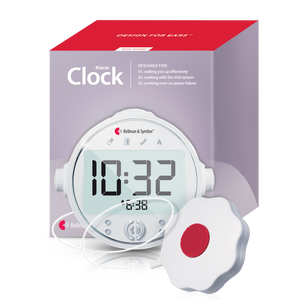
The Alarm Clock Pro ranks first because it addresses every core requirement for a deaf adult's morning alarm in one unit. The wired bed shaker places strong vibration directly under the pillow or mattress. Four high-intensity LEDs on the clock face flash at alarm time - bright enough to be visible with eyes closed in a darkened bedroom. The 100dB ascending alarm sweeps through multiple frequencies, which serves users with partial hearing loss or with residual hearing through cochlear implants. All three channels fire simultaneously, so there is no single point of failure.
The rechargeable NiMH batteries come pre-installed and power all functions - including the bed shaker and LED lights - during power outages, with no setup required. The Smart Snooze function reduces intervals from 9 minutes down to 2 minutes in two-minute steps, making it progressively harder to drift back into deep sleep after snoozing. The sound toggle on the back of the unit lets the user disable audio while keeping vibration and lights active - the right configuration for most profoundly deaf users in shared living situations.

"If the morning alarm is the only thing you need, the Pro is the better starting point. If you also need your bedroom to notify you of smoke, CO, a doorbell, or a phone call while you sleep without hearing devices - this is the product."
The Alarm Clock Receiver does everything the Pro does for the morning alarm - bed shaker, flashing lights, loud sound, battery backup, night light - and adds the ability to receive wireless signals from transmitters placed throughout the home. When a compatible smoke alarm transmitter fires, the receiver's bed shaker activates and its color-coded LEDs identify the alert type, so the user knows before they are fully awake whether it is their morning alarm or an emergency. The same applies to CO detector signals, doorbell events, and phone call notifications.
For a deaf adult living alone, this overnight awareness picture is genuinely safety-critical, not a bonus feature. The system is certified to UL217, UL2034, ULC-S531, and CSA 6.19 when used with compatible Bellman smoke and CO alarm transmitters. It is also expandable: additional transmitters can be added at any time without new pairing or Wi-Fi setup, because the Bellman Alerting System uses its own RF signal protocol. The receiver covers up to 260 ft in open field from any transmitter.

"The bed shaker and ascending alarm without the visual channel. The right choice for users who find the Pro's additional features unnecessary, or for those with partial hearing loss where sound remains a useful backup alongside vibration."
The Alarm Clock Classic delivers the two most important wake-up channels for deaf and hard-of-hearing users - powerful bed shaker vibration and a 100dB multi-frequency ascending alarm - with the simplest possible operating interface. Two dedicated push-rotate dials handle time and alarm setting independently, eliminating the shared-button menus that can lead to misconfiguration. The sound toggle disables audio entirely, leaving vibration-only wake-up for users who don't want to disturb others.
The Classic does not include flashing LED lights, which is the key distinction from the Pro and the main reason it ranks third for deaf users specifically. For someone with profound hearing loss where visual backup is important, the Pro is the better choice. For someone with moderate hearing loss, some residual hearing, or a cochlear implant with some environmental awareness, the Classic's simpler format may be preferable. Battery backup is supported, though batteries are not pre-installed. Smart Snooze is present here as well.

"The most portable and silent option for deaf users who travel, share a room, or want app-based alarm management. Ranks fourth for primary home use because of its smartphone dependency - but it is the right first choice in the right situation."
The Vibio is a different type of product from the bedside clock units. It is a rechargeable, Bluetooth-connected bed shaker pad paired to a free smartphone app (iOS and Android). It produces no sound - vibration only - and its compact size (roughly 3.7 × 3.7 × 1.1 inches) makes it genuinely travel-portable in a way that bedside clocks are not. For a deaf user who travels regularly, stays in hotels, or attends overnight events, the Vibio is the alarm clock that goes with them regardless of what the hotel room offers.
Its key reliability feature is local alarm storage: once alarms are configured in the app, the settings are saved on the device itself. The Vibio will fire its alarm even if the phone is off, out of range, or out of battery. Up to 10 separate alarm times can be stored with individual day patterns and adjustable vibration intensity across three settings. The Vibio also sends vibration notifications for incoming calls and texts - a meaningful additional alert for deaf users who keep the device nearby during the day. Battery life reaches up to 10 days per charge.
The reason it ranks fourth for home use as a primary alarm clock for deaf adults is the Bluetooth dependency for initial setup and any changes - and the absence of flashing LED lights as a visual backup channel. For the dedicated home bedside alarm, the Pro addresses both of those gaps. But as a secondary device, a travel companion, or a solution for users who share a bed with a light sleeper and cannot use sound or lights at all, the Vibio is the product that fills those specific needs.
Side-by-Side: How the Four Models Stack Up for Deaf Users
*Vibio stores alarms locally and fires without the phone connected - but initial setup and alarm changes require the app.
Decision Guide: Which Bellman Alarm Clock Is Right for You?
Profoundly Deaf, Living at Home Alone
Start with the Alarm Clock Receiver. The morning alarm function is equivalent to the Pro - vibration, lights, and battery backup - and the system integration means your bedroom is also covered for smoke, CO, and doorbell events overnight. The incremental investment is substantial compared to a standalone clock, but for a deaf adult living alone, the overnight safety coverage is not a secondary feature.
Profoundly Deaf, Living with Others or in a Shared Home
The Alarm Clock Pro is the right choice. Three simultaneous alert channels - vibration, lights, and sound - give you maximum redundancy. Sound can be disabled for nighttime use so it does not disturb others, leaving vibration and lights active. The pre-installed rechargeable battery backup eliminates the power-outage failure mode without any additional setup.
Moderate to Severe Hearing Loss, Wears Hearing Aids During the Day
The Alarm Clock Classic is worth considering if the simplest possible interface matters most. It lacks flashing lights, but the 100dB multi-frequency ascending alarm provides a meaningful auditory backup for users with residual hearing or cochlear implants, alongside the bed shaker. If visual alerts are important, step up to the Pro.
Deaf User Who Travels Regularly
The Vibio is the companion device for travel. It stores alarms locally, requires no wall power, and fits in any bag. Most deaf users who travel will use a Vibio on the road and an Alarm Clock Pro or Receiver at home - they solve different problems. Using only a Vibio as your home alarm clock is possible, but the absence of LED backup and the Bluetooth dependency make it a less complete solution for a primary home alarm than the bedside units.
Deaf User Who Shares a Bed with a Light Sleeper
The Vibio under the pillow is the right tool here. It produces no sound at all, its compact size contains the vibration closely, and its three intensity levels let you find the minimum vibration that wakes you reliably without transmitting movement to the other side of the bed. Vibration on the "soft" setting under a standard pillow is unlikely to disturb a partner.
Practical Setup Tips for Deaf Users
- Place shaker under the mattress near chest - not under a thick topper or near the feet
- Test in your actual sleeping position before relying on the alarm
- Disable sound on the Pro or Classic for bedroom-only vibration + lights
- Turn LED brightness to maximum - some models have a dimmer that defaults to low
- For the Receiver: pair at least one transmitter before your first night of use
- For the Vibio: sync alarms to the device before turning the phone off at night
- Pre-install batteries in the Classic (4x AAA rechargeable) before first use
- Place the clock or shaker close enough to require full waking to turn off
For a deaf adult, the alarm clock's job is not to be louder. It is to use a different sensory channel entirely - one the sleeping body can detect without any functional hearing involved.
Bellman & Symfon - Design PrinciplesFrequently Asked Questions
Can a Completely Deaf Person Use These Alarm Clocks?
Yes - the Alarm Clock Pro and Alarm Clock Receiver were both designed from the start for users with profound and total hearing loss. With sound disabled, both rely entirely on bed shaker vibration and flashing LED lights - two sensory channels that operate completely independently of hearing. The Vibio operates on vibration only and has no sound output at all.
Do Cochlear Implant Users Need a Different Product?
Cochlear implant users who remove their speech processors for sleep are functionally deaf during sleep and should select an alarm clock on the same basis as any profoundly deaf user - prioritizing vibration and visual alerts. Users who sometimes sleep with their processor in and have meaningful residual awareness may find the Classic's audio alarm a useful additional channel, but the bed shaker remains the primary wake-up mechanism for sleep.
Will the Flashing Lights Actually Wake a Sleeping Person?
The LED lights on the Alarm Clock Pro and Alarm Clock Receiver are specifically rated for daytime-visible intensity, which means they are bright enough to be effective in a room that is not completely dark. Whether they will wake a specific user from deep sleep on their own varies; they are most reliable as a second channel alongside vibration, not as the sole wake-up mechanism. Most deaf users find the combination of vibration-plus-lights significantly more reliable than either channel alone.
What Happens to the Alarm During a Power Outage?
The Alarm Clock Pro includes pre-installed rechargeable batteries that power all functions - bed shaker, LED lights, and display - through a power interruption. The Alarm Clock Classic supports battery backup but requires 4x AAA rechargeable batteries to be installed separately. The Alarm Clock Receiver also includes rechargeable battery backup. The Vibio runs on its own internal battery with no mains dependency at all.
Is There a Standalone Bed Shaker If I Already Have a Compatible Receiver?
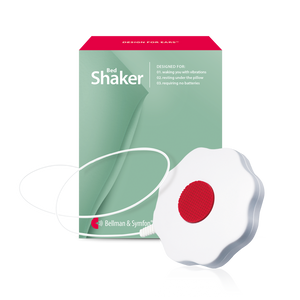
Yes. The Bellman Bed Shaker is available as a standalone accessory and connects to compatible Bellman receivers, including the Alarm Clock Receiver. It delivers the same wired vibration as the shakers bundled with the Pro and Classic, and is the replacement or expansion option for users already in the Bellman Alerting System.
Match your situation to the right product
The most checkmarks in one column point to your starting product.
- I need vibration + flashing lights both → Alarm Clock Pro or Receiver
- I live alone and need overnight home safety → Alarm Clock Receiver
- I want the simplest possible setup → Alarm Clock Classic
- I travel regularly and need a portable alarm → Vibio
- I share a bed - zero noise, zero light → Vibio (pillow placement)
- I need phone call alerts through vibration → Vibio
- I have a smoke or CO alarm to integrate → Alarm Clock Receiver
- I want a pre-installed battery backup, no setup → Alarm Clock Pro
- I have residual hearing / cochlear implant → Alarm Clock Classic or Pro
- I want a backup shaker for the existing Bellman system → Bed Shaker accessory
The Bottom Line
The best alarm clock for a deaf adult is one that does not ask them to rely on a sensory channel they do not have. Every Bellman alarm clock in this list - the Alarm Clock Pro, the Classic, the Alarm Clock Receiver, and the Vibio - was built around that premise. Sound, where present, is a supplement. Vibration and light are the primary signals.
For most deaf adults at home, the Alarm Clock Pro is the right starting point: three simultaneous alert channels, pre-installed battery backup, and a sound-off mode that leaves vibration and lights active. For those who need their alarm clock to be part of a broader overnight safety system, the Alarm Clock Receiver with at least one compatible transmitter covers the full picture. For travel, or for situations where complete silence is non-negotiable, the Vibio handles it. And for users who want the core function without additional complexity, the Classic delivers it reliably.
For a deeper look at how each product works - the motor mechanics, shaker placement, and the science behind vibration-based waking - see our full guide: How Does a Bed Shaker Alarm Clock Actually Work?
Find the alarm clock that works without sound.
Explore the full Bellman lineup - designed from the ground up for deaf adults and people living with hearing loss.
Sources and references: National Institute on Deafness and Other Communication Disorders (NIDCD) - Statistics on Hearing Loss (updated 2026); Age-Related Hearing Loss; Noise-Induced Hearing Loss fact sheets · World Health Organization (WHO) - Deafness and Hearing Loss Fact Sheet (March 2026) · Hearing Loss Association of America (HLAA) - Hearing Loss Facts and Statistics (updated 2026) · Bellman & Symfon - Alarm Clock Pro product specifications (us.bellman.com/products/heavy-sleeper-vibrating-alarm-clock-pro); Alarm Clock Receiver specifications (us.bellman.com/products/alerting-signaling-device-alarm-clock-receiver); Vibio specifications (us.bellman.com/products/vibio); Alarm Clock Classic specifications (us.bellman.com/collections/alarm-clocks); Bed Shaker specifications (us.bellman.com/products/bed-shaker) · UL Safety Certifications: UL217 (smoke alarms), UL2034 (CO alarms), ULC-S531, CSA 6.19 · National Fire Protection Association (NFPA) - Requirements for auxiliary alerting appliances for deaf and hard-of-hearing occupants · American Sleep Association - Sleep stages and sensory arousal thresholds.
This article is for informational purposes only. Product specifications are based on current published listings at us.bellman.com and may be updated; verify current specs on the product page before purchase. For clinical guidance on hearing loss or cochlear implant use, consult a licensed audiologist or qualified hearing health professional.
Best Alarm Clock for the Deaf: Tested and Ranked
This guide breaks down the practical choices, features, and considerations behind this topic. Use it to identify a setup that fits the listener, the environment, and the everyday moments that matter most.
The featured products below are current Bellman options discussed in the article or closely matched to its use case.