Alarm Clock for Hearing Impaired vs. Regular Alarm: Key Differences

A regular alarm clock and a hearing-impaired alarm clock may both sit on a nightstand. But everything else about how they work - the alert channels they use, the sensory pathways they target, and what happens when their primary mechanism fails - is fundamentally different. This guide breaks down every key difference, so you can understand exactly what you're missing with a standard clock and what a purpose-built alternative actually changes.
The Starting Point: What a Regular Alarm Clock Was Designed to Do
The modern alarm clock was designed for a person with typical hearing who is reluctant to wake up. The design brief was simple: produce a sound at a set time that is loud enough and annoying enough that the sleeper can't ignore it. Every standard alarm clock - digital bedside, clock radio, smartphone alarm, smart speaker - is a variation on that premise. They differ in tone, volume, snooze behavior, and convenience features, but they share one fundamental constraint: they depend entirely on the auditory system to work.
For the approximately 37.5 million American adults with some degree of hearing loss - and for the roughly 15 million with severe to profound loss - that constraint is not a minor limitation. It is a complete functional failure. An alarm that a person cannot physically detect will not wake them. And even for people with mild-to-moderate hearing loss who have some hearing, a standard alarm still creates an unreliable situation: sleeping without hearing aids means a narrowed frequency range, reduced sensitivity, and an increased chance of sleeping through an alarm that would otherwise be audible.
Alarm clocks designed for hearing-impaired users address this differently - not by making the sound louder, but by changing the sensory channels the alarm uses to reach the sleeper. This guide compares the two approaches across every dimension that matters for someone making this decision.
A regular alarm clock sends one type of signal - sound - through one channel - the auditory system. A hearing-impaired alarm clock sends multiple types of signals - vibration, light, and optionally sound - through multiple independent channels, so the wake-up does not depend on any single one working.
Side-by-Side: Every Key Difference at a Glance
| Feature | Regular Alarm Clock | Hearing Impaired Alarm Clock |
|---|---|---|
| Primary alert method | Sound only | Vibration + light + optional sound, simultaneously |
| Sensory channels used | Auditory only | Tactile, visual, and/or auditory |
| Works without functional hearing | No | Yes - vibration and light require no hearing |
| Works with hearing aids removed | Unreliable to non-functional | Yes - designed specifically for this scenario |
| Bed shaker / physical vibration | None | Yes - under pillow or mattress |
| Flashing LED visual alert | None | Yes - on models like the Alarm Clock Pro and Receiver |
| Sound alarm frequency range | Single frequency or narrow band - often high-frequency only | Multi-frequency ascending - spans low to high range |
| Maximum sound output | Typically 60–85dB | Up to 100dB+ (Bellman models) |
| Battery backup (all functions) | Rarely - display only, if at all | Yes - bed shaker and lights remain active during outages |
| Sound can be disabled independently | No - disabling sound disables the alarm entirely | Yes - vibration and lights remain active without sound |
| Home safety alert integration | None | Available - smoke, CO, doorbell (Alarm Clock Receiver) |
| Alert type identification | None - all alerts sound the same | Color-coded LEDs distinguish alarm types (Receiver) |
| Snooze design | Fixed interval - often 9 min | Smart Snooze - reduces from 9 to 2 min progressively |
| Control interface | Shared buttons, audio feedback common | Large dedicated dials, visual feedback only |
| Designed for deaf users | No | Yes - built from the ground up for this use case |
The Key Differences, Explained One by One
The comparison table shows what differs. This section explains why each difference matters in practice - and what it changes about the morning for a person with hearing loss.
Difference 1 - Alert Channels
One channel: sound. If the sound doesn't reach the auditory system effectively - because of hearing loss, sleep depth, background noise, or habituation - the alarm fails. There is no fallback. The only lever is volume, and volume alone cannot compensate for a degraded or absent auditory pathway.
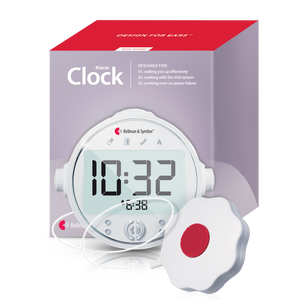
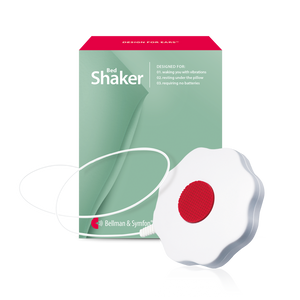
Multiple channels activated simultaneously: a bed shaker delivers physical vibration through the mattress or pillow, LED lights flash visually, and an audio alarm plays. The Bellman Alarm Clock Pro fires all three at once. Any single channel is enough to produce arousal - which means the alarm doesn't depend on all three working. It only needs one to break through.
Difference 2 - Sensory Pathways Targeted
Sound travels through air to the outer ear, through the ear canal, past the eardrum and ossicles, and into the cochlea, where hair cells convert vibration to electrical signals. Every step in that chain can fail: blocked ear canal, perforated eardrum, damaged cochlear hair cells (sensorineural loss), or auditory nerve dysfunction. For people with sensorineural hearing loss - the most common type - the hair cells that convert sound to nerve signals are damaged or absent in specific frequency ranges. Any alarm that produces sound in those frequencies is functionally inaudible, regardless of volume.
Vibration reaches the body through a completely separate pathway. Mechanoreceptors - particularly Pacinian corpuscles in the skin - detect physical movement and transmit signals to the brain through somatosensory nerves, not the auditory nerve. This pathway is unaffected by cochlear damage, hearing aid use, or sleep-related suppression of auditory input. Light reaches the visual cortex through the optic nerve. Both channels operate entirely outside the auditory system. When the Bellman Vibio or Alarm Clock Classic bed shaker activates, the body responds to the physical signal directly - no ears required.
Difference 3 - Performance with Hearing Aids Removed
This is where regular alarms fail most predictably. Most people with hearing aids remove them for sleep - audiologists consistently recommend it for skin health, device longevity, and comfort. A person sleeping without hearing aids has only their unaided hearing to work with, which may be severely limited. An alarm calibrated to be heard with hearing aids in place may be completely undetectable without them. The clock has no way to know the hearing aids are out; it just sounds at the set time and hopes for the best.
Hearing-impaired alarm clocks are designed specifically for the state users are in when they sleep: without hearing devices. The bed shaker in the Alarm Clock Pro and Classic doesn't care whether the user has hearing aids, cochlear implants, or no assistive devices at all. The vibration reaches the body regardless. This is the central design insight: the alarm must work during sleep, when the hearing aids are out, not during waking hours when they're in.
Difference 4 - Sound Frequency Range
Standard alarm clocks and phone ringtones typically produce tones in the 2,000-4,000 Hz range - high-frequency sounds that cut through background noise and catch the attention of people with typical hearing. This is exactly the frequency range most severely affected by both age-related hearing loss (presbycusis) and noise-induced hearing loss. For someone with high-frequency hearing loss, a standard alarm set to maximum volume may be producing a sound they are physiologically unable to detect at any intensity.
The Bellman Alarm Clock Pro and Classic both use ascending, multi-frequency alarm signals that sweep through a broad frequency range. Rather than targeting one pitch, the alarm produces tones at multiple frequencies in sequence, increasing the statistical chance that at least one frequency falls within the user's residual hearing range. For someone with partial high-frequency loss who retains lower-frequency sensitivity, this design change can make the auditory component of the alarm functional where a single-tone alarm would be inaudible. It's a meaningful engineering decision, not a marketing feature.
Difference 5 - Battery Backup Coverage
Most standard alarm clocks include battery backup - but it typically powers only the timekeeping display and, at best, a reduced-volume beep. The primary alarm tone at full volume often does not function on battery power. For a hearing person, a reduced-volume alarm might still work. For a hearing-impaired user whose strategy depends on the bed shaker and LED lights continuing to function through a power interruption, a display-only backup is not a backup at all.
The Alarm Clock Pro includes pre-installed rechargeable NiMH batteries that maintain all functions during a power outage - bed shaker, LED lights, and audio alarm. The Alarm Clock Classic supports full-function battery backup with 4x AAA rechargeable batteries. The Alarm Clock Receiver also includes a rechargeable backup. The Vibio runs entirely on its own internal battery with no mains dependency. None of these are partial backups - power continuity is treated as a reliability requirement, not a nice-to-have.
Difference 6 - Independent Sound Disable
On a standard alarm clock, turning off the sound turns off the alarm. There is nothing else - no other signal mode available. A person who needs to wake early without disturbing a sleeping partner either sets a quiet alarm that may not work, or wakes the partner. There is no middle ground because the product was designed around the assumption that sound is the only output available.
The Alarm Clock Pro and Classic both have a dedicated sound toggle that disables the audio alarm while leaving vibration - and, on the Pro, the LED flashing lights - fully active. Pressing the sound/flash button on the back of the Pro unit silences the auditory output without affecting any other alert channel. This is one of the most practical features for hearing-impaired users in shared living situations: they can set the alarm to vibration-only or vibration-plus-lights, wake up reliably, and not disturb anyone else in the room. The Vibio produces no sound by design - it is always vibration-only.
Difference 7 - Overnight Home Safety Coverage
A standard alarm clock handles one event: the set alarm time. Nothing else reaches the bedroom through it. A smoke alarm in the hallway, a doorbell at 2 AM, a CO detector activation - these are entirely separate, unconnected systems. For a person with typical hearing, the sound from those systems can reach the bedroom on its own. For someone sleeping without hearing aids, they likely cannot.
The Bellman Alarm Clock Receiver goes beyond morning alarms entirely. As part of the Bellman Alerting System, it receives wireless signals from transmitters placed throughout the home - smoke alarms, CO detectors, doorbells, phone ringers - and alerts the user through the bed shaker, LED lights, and color-coded indicators that distinguish each alert type. When a smoke alarm fires at 3 AM, the bed shaker activates and a specific colored LED tells the user what triggered it. For a deaf adult sleeping alone, this represents overnight safety awareness that no standard alarm clock can provide. The system is certified to UL217, UL2034, ULC-S531, and CSA 6.19 when used with compatible Bellman transmitters.
Difference 8 - Snooze Behavior
Standard alarm snooze functions offer a fixed interval - typically 9 minutes - that repeats indefinitely until dismissed. The design allows a user to repeatedly silence the alarm and return to sleep without ever fully waking. For a hearing-impaired user who already has a harder time achieving reliable initial arousal, a fixed-interval snooze that permits return to deep sleep between cycles compounds the problem.
The Smart Snooze function on the Alarm Clock Pro and Classic is behaviorally designed rather than just functionally present. It begins at 9 minutes and automatically reduces by 2 minutes with each successive snooze - 9, 7, 5, 3, 2 - making the intervals progressively shorter until the user is functionally unable to return to deep sleep between cycles. By the time the snooze interval reaches 2 minutes, the repeated physical jolts of bed shaker activation across a short window have usually produced full arousal even in deep sleepers. This is a feature that understands how sleep inertia works and is designed to overcome it systematically.
Who This Actually Affects - and How Significantly
The gap between regular and hearing-impaired alarm clocks is most obvious at the extreme end of hearing loss - a profoundly deaf person who removes their cochlear implant processor for sleep literally cannot be woken by any sound-based alarm, regardless of volume. But the impact is not limited to profound deafness. It shows up across a much wider population.
Age-Related Hearing Loss (Presbycusis)
Affects 1 in 3 adults over 65 and nearly half of those over 75. The high-frequency range most affected by presbycusis is exactly where standard alarms and phone ringtones are pitched. Many older adults have been sleeping through alarms for years without connecting the cause to their high-frequency hearing loss. The Alarm Clock Classic or Pro addresses both the frequency gap and the auditory reliability gap with one product change.
Noise-Induced Hearing Loss
The NIDCD estimates that around 17% of teens and 26% of adults have some noise-induced hearing loss - often high-frequency, often undiagnosed. Many of these individuals attribute missed alarms to being heavy sleepers without recognizing the hearing component. Multi-frequency ascending alarms like those in all Bellman models address this directly by not concentrating the signal in the range most likely to be affected.
Cochlear Implant and Hearing Aid Users
Users who remove processors or hearing aids for sleep are functionally in a much lower-sensitivity state during exactly the hours when their alarm needs to work. The cochlear implant community has long relied on vibrating alarm clocks for this reason. The Alarm Clock Pro's bed shaker and LED combination provides the two channels that do not depend on any hearing device being worn or functional.
Heavy Sleepers Without Diagnosed Hearing Loss
Deep NREM sleep involves active brain suppression of auditory input. Some people's brains suppress more thoroughly than others - and for them, even normal-hearing sleep produces functional deafness to sound-based alarms. For this group, the solution is the same as for someone with hearing loss: a signal that reaches the body through a non-auditory channel. The Vibio's silent vibration-only approach works for heavy sleepers for the same reason it works for deaf users - it bypasses the auditory suppression entirely.
People Living Alone with Hearing Loss
The gap between a regular alarm and a hearing-impaired alarm clock becomes a safety issue for people who live alone. There is no backup person to wake them for an emergency. The Alarm Clock Receiver addresses this by extending the alerting function beyond morning alarms to cover smoke, CO, and doorbell events - providing the overnight safety awareness that a standard alarm clock cannot offer at any price point.
Partners and Roommates
The sound-disable feature on hearing-impaired alarm clocks creates a different kind of value for shared living situations: vibration and light alerts that wake one person without disturbing another. A regular alarm can't be loud enough to reliably wake a hearing-impaired person and quiet enough not to wake their partner at the same time. The Alarm Clock Pro's independent sound toggle - or the Vibio's silence-by-design - solves this directly.
A regular alarm clock and a hearing-impaired alarm clock are not the same product at different volume levels. They are built on different assumptions about how a wake-up signal reaches a sleeping person - and for millions of Americans, only one of those assumptions is correct.
Bellman & Symfon - Design PrinciplesWhich Hearing-Impaired Alarm Clock Matches Your Situation
Not all hearing-impaired alarm clocks are identical, and the right Bellman model depends on the specific combination of hearing loss severity, living situation, and additional needs. Here is how to navigate the lineup.
Common Questions
Can a Hearing Impaired Alarm Clock Also Serve as a Regular Alarm?
Yes - completely. The Alarm Clock Pro and Classic both include the 100dB ascending audio alarm that a hearing person would use in exactly the same way as a standard clock. The additional channels (vibration, lights) are additive, not exclusive. A family where one person has hearing loss and another does not can both use the same Bellman clock effectively - the hearing person uses the sound, the hearing-impaired person relies on vibration and lights.
Is "Extra Loud" Enough - Or Is a Different Type of Alarm Actually Needed?
For high-frequency hearing loss specifically, "extra loud" at the wrong frequency helps less than expected. If the auditory hair cells that process 3,000 Hz are damaged, a 3,000 Hz alarm at 120dB may still be inaudible. The solution isn't just volume - it's frequency range coverage (which Bellman's multi-frequency ascending alarm addresses) and the addition of non-auditory channels that don't rely on cochlear function at all. "Extra loud" alone is a partial solution; multi-sensory design is the complete one.
My Hearing Loss Is Mild - Do I Really Need a Specialized Alarm Clock?
That depends on what you are currently experiencing. If you are occasionally sleeping through your regular alarm - or relying on a backup alarm, a partner, or a phone call to wake up - then yes, a specialized clock would likely solve a problem you've already noticed but may not have attributed to hearing. The Alarm Clock Classic is designed for exactly this profile: mild-to-moderate hearing loss, wants a reliable solution, doesn't need the full Pro feature set. The incremental investment is small relative to the cost of missing an appointment, a medical schedule, or a work commitment.
Do Regular Alarm Clock Apps on Smartphones Work for Hearing-Impaired Users?
Smartphone alarm apps share the same fundamental limitation as all sound-based alarms - they depend on the auditory system. Many also add failure modes that dedicated alarm clocks avoid: phone battery dies overnight, app permissions get reset, Do Not Disturb mode silences the alarm, or the phone is left in another room. For hearing-impaired users, the Bellman Vibio integrates with a smartphone via Bluetooth, but stores alarms locally and fires even with the phone off - removing the connectivity dependency while retaining the convenience of app-based alarm management.
The features a regular alarm doesn't have - and that actually matter
Use this as a checklist when evaluating any hearing-impaired alarm clock.
- Bed shaker under pillow or mattress - not just a vibrating motor in the clock body
- LED flashing lights - bright enough for daytime-lit rooms
- Multi-frequency ascending alarm - not a single fixed tone
- Independent sound disabled - vibration and lights work without sound
- Battery backup covers all channels - not just the display
- Smart Snooze - progressively shorter intervals, not fixed 9-min repeats
- Large dedicated controls - no audio feedback required to set correctly
- Option to expand to whole-home safety alerts if needed
- No dependency on Wi-Fi, apps, or smartphone connectivity for basic alarm
- 2-year warranty - reflects confidence in daily-use durability
The Bottom Line
The difference between a regular alarm clock and a hearing-impaired alarm clock is not a matter of volume or style. It is a matter of which sensory pathways the device uses to reach a sleeping person - and whether those pathways are functional for the specific user at the moment the alarm needs to work.
Regular alarm clocks were designed for people with typical hearing who are awake during the day when they set their alarms. Hearing-impaired alarm clocks were designed for people who are sleeping without hearing devices when the alarm needs to fire, who may have damaged high-frequency hearing that makes standard alarm tones functionally inaudible, and who need the wake-up to work on the one morning they cannot afford to miss. Those are different design problems with different design solutions - and the gap between them is large enough that "I'll just turn it up louder" is not a real answer.
For a full breakdown of which Bellman model is right for your specific situation, see our pillar guide: Best Vibrating Alarm Clocks for Heavy Sleepers & Hearing Impaired (2026). For the ranking of Bellman models specifically for deaf users, see Best Alarm Clock for the Deaf: Tested and Ranked.
Ready to replace your regular alarm with one that actually works?
Explore the full Bellman lineup - designed for people who need more than sound to start their day reliably.
Sources and references: National Institute on Deafness and Other Communication Disorders (NIDCD) - Quick Statistics About Hearing (2026); Age-Related Hearing Loss fact sheet; Noise-Induced Hearing Loss fact sheet · World Health Organization (WHO) - Deafness and Hearing Loss Fact Sheet (March 2026) · Hearing Loss Association of America (HLAA) - Hearing Loss Facts and Statistics (2026) · Bellman & Symfon - Alarm Clock Pro product specifications (us.bellman.com/products/heavy-sleeper-vibrating-alarm-clock-pro); Alarm Clock Classic specifications (us.bellman.com/collections/alarm-clocks); Alarm Clock Receiver specifications (us.bellman.com/products/alerting-signaling-device-alarm-clock-receiver); Vibio specifications (us.bellman.com/products/vibio); Bed Shaker specifications (us.bellman.com/products/bed-shaker) · UL Safety Certifications: UL217 (smoke alarms), UL2034 (CO alarms), ULC-S531, CSA 6.19 · Bolanowski SJ, et al. - Four channels mediate the mechanical aspects of touch. Journal of the Acoustical Society of America, 1988 (Pacinian corpuscle frequency sensitivity research) · Grutzmacher et al. - Characterization of sensorineural hearing loss and age-related frequency-specific threshold shifts. Audiology Research, 2022 · American Sleep Association - Sleep stages, NREM depth, and sensory arousal thresholds.
This article is for informational purposes only. Product specifications are based on current published listings at us.bellman.com; verify current specs on the product page before purchase. For clinical guidance on hearing loss, consult a licensed audiologist or qualified hearing health professional.
Alarm Clock for Hearing Impaired vs. Regular Alarm: Key Differences
This guide breaks down the practical choices, features, and considerations behind this topic. Use it to identify a setup that fits the listener, the environment, and the everyday moments that matter most.
The featured products below are current Bellman options discussed in the article or closely matched to its use case.