Hearing Loss in College: Complete Guide to Dorm Alerts, Campus Safety and Academic Tools (2026)

Starting college with hearing loss brings a unique set of challenges. This guide covers everything: waking up safely in a dorm, getting accommodations, hearing lectures more clearly, and staying alert on campus. Whether you are newly diagnosed or have managed hearing loss for years, this guide helps you plan ahead.
- How common is hearing loss among college students?
- Dorm room alerts: waking up and knowing your door
- Fire and CO alarms: what the law requires in dorms
- Staying alert on campus
- Academic accommodations: your legal rights
- Hearing lectures and seminars more clearly
- Device comparison: which tools fit which situations
- How to register with disability services
- Move-in packing checklist
- People also ask
College students with hearing loss face three main challenges: waking up and knowing what is happening in the dorm, following lectures in noisy classrooms, and navigating campus safely. The law gives you real rights. Section 504 of the Rehabilitation Act and the ADA require colleges to provide accommodations, including captioning, note-takers, and assistive listening devices. For the dorm, vibrating alarm clocks, bed shakers, and wireless alerting systems fill the gaps that campus infrastructure alone cannot cover. Personal sound amplification devices can help make speech clearer in one-on-one settings and small groups. See the sections below for details on each area. For the specific products that fit dorm life, see Best Dorm Room Alert Systems for Deaf & Hard of Hearing College Students.
How Common Is Hearing Loss Among College Students?
Hearing loss in college is more common than many people expect. A 2024 meta-analysis published in Frontiers in Neuroscience examined 8 studies covering 1,950 subjects. It found that approximately 19 percent of college students have some degree of hearing loss.
The same research found that noise-induced hearing loss is a major factor. Repeated exposure to loud noise at concerts, through headphones, and in music practice rooms can damage hearing over time. Student musicians showed especially high rates.
College is also when many students first manage hearing loss on their own. In high school, parents and IEP teams often handle accommodation requests. In college, that responsibility shifts to the student.
In college, you self-identify your disability and request your own accommodations. No one is required to seek you out. Students who register early get better access to note-takers, captioning, and assistive listening devices. Students who wait often find that requests take weeks to process. Register with disability services before your first week of classes.
Dorm Room Alerts: Waking Up and Knowing Your Door
A dorm room creates two daily problems for students with hearing loss. First: waking up without disturbing a roommate. Second: knowing when someone knocks or rings at the door.
Standard alarm clocks and phone ringtones are not reliable for people with moderate-to-profound hearing loss. Rooms are often small, and sound does not carry as well as it does in a house. A bed shaker or vibrating alarm is a much more dependable solution.
Vibrating alarm clocks and bed shakers

The Bellman Alarm Clock Pro produces a loud alarm up to approximately 100 dB. It also includes bright flashing lights and a bed shaker that goes under your pillow or mattress. All three alert types work together. The device runs on rechargeable batteries with a backup power supply, so it keeps working if you unplug it to charge nearby devices.
Three-mode alarm: sound, light, and bed shaker

For students who want something more compact, the Bellman Vibio Bed Shaker is a Bluetooth bed shaker that pairs with a free smartphone app (iOS and Android). You set multiple alarms from your phone and adjust the vibration strength. It charges via USB and is compact enough to pack easily for move-in day or travel home.
Wireless Bluetooth bed shaker controlled by smartphone app
The Alarm Clock Pro and Vibio are personal sound amplification products. They are not hearing aids and are not intended to treat, correct, or diagnose any medical condition.
Knowing when someone is at your door
Missing a knock or a resident advisor's visit is a common frustration. A wireless doorbell alert system solves this without any drilling or permanent installation.

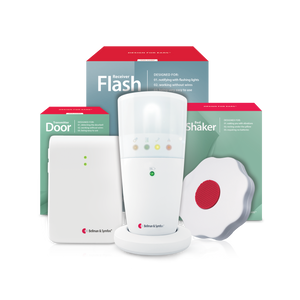
The Doorbell System with Flash Receiver and Bed Shaker includes a doorbell transmitter and a flash receiver. When someone presses the button or knocks near the transmitter, the flash receiver fires bright pulses with color-coded icons. You can place it anywhere in the room with clear line of sight.

If you want an alert you can wear on your wrist, the Doorbell System with Bridge and Watch Receiver sends a vibration and icon to a wristwatch. This works well if you use headphones or sleep in a position where the flash receiver is out of view. See the full breakdown in Best Dorm Room Alert Systems for Deaf & Hard of Hearing College Students.
Check with your RA before move-in. Many dorms have rules about installing transmitters on door frames. A push-button transmitter placed on a shelf near the door works just as well. No adhesive or drilling is needed for tabletop placement.
Fire and CO Alarms: What the Law Requires in Dorms
Campus fire safety is a genuine concern for students with hearing loss. A standard audible fire alarm may not wake a heavy sleeper with hearing loss.
The ADA and the Fair Housing Act both apply to college dormitories. The Fair Housing Act requires that dormitory-style sleeping accommodations for more than a set number of individuals be accessible to persons with disabilities. The Federal Register guidance from HUD specifically lists visual fire and carbon monoxide alarms as examples of required accessibility features for deaf and hard-of-hearing residents.
In practice, this means you can request a visual strobe alarm or a personal alerting device through your disability services office. Many campuses install strobe units in accessible rooms. Some states go further: Virginia law, for example, requires that dormitory buildings with more than 20 residents provide specialized smoke alarms upon request from deaf or hard-of-hearing occupants.
- Does my assigned room have a visual strobe fire alarm?
- Can I request a room with accessible alert equipment?
- What is the process for requesting a personal CO alarm?
- Who do I contact if the strobe unit in my room is broken?
- Does the building conduct accessible fire drills?
- Is there a campus emergency text or app notification system?

A personal wireless alerting system can add an extra layer of awareness, particularly for late-night study sessions or daytime naps when the dorm room door is closed. The Smoke/Fire Alarm System with Alarm Clock Receiver and Bed Shaker combines a smoke alarm transmitter with a bedside alarm clock receiver and bed shaker. When the transmitter detects smoke, it signals the receiver, which activates all three alert modes: sound, flashing lights, and vibration.
Personal alerting devices do not replace legally required building fire alarm systems. They are supplemental tools. Contact your campus disability services and housing offices to confirm which accessible equipment is available in your room before relying on personal devices alone.
Staying Alert on Campus
A college campus is a busy environment. Lectures, social events, and outdoor spaces all present different listening challenges. Staying aware of what is happening around you matters for both safety and participation.
Wearable alerting for on-the-go awareness
The Bellman Watch Receiver connects to compatible Bellman alerting transmitters via the Bridge Transceiver. It delivers discreet vibrations and color-coded icons on the wrist. This means you receive alerts from your dorm room setup even when you are in the hallway, a study lounge, or nearby common areas.
The Bridge Transceiver also connects to the free Bellman Assistant app on iOS and Android. When paired, you receive alerts from your home transmitters on your smartphone. This extends your awareness range significantly.
Staying safe in outdoor and transit spaces
Wearing hearing aids or personal amplifiers outdoors helps with conversations and directions. Some students use a directional microphone setting to focus on the person speaking in front of them. This reduces background noise from traffic and crowd noise.
Campus emergency notification systems are another layer of safety. Most universities send emergency alerts by text message and email. Register your phone number and student email in your school's emergency notification system on the first day of orientation.
Sign up for all campus alert channels. Most universities use multiple systems: text, email, app, and outdoor sirens. Students with hearing loss may not hear sirens. Text and app alerts are your reliable backup. Register for all of them at once during orientation week.
For a deeper look at on-campus alerting tools and wearable options, see How Deaf and Hard of Hearing Students Stay Alert on Campus.
Academic Accommodations: Your Legal Rights
The law gives college students with hearing loss clear rights. Two federal statutes apply.
Section 504 of the Rehabilitation Act of 1973 requires colleges and universities receiving federal financial assistance to provide qualified interpreters, captioning (now called CART), assistive listening devices, and other auxiliary aids and services to deaf and hard-of-hearing students. This applies to nearly every college that accepts federal student aid.
Title II and Title III of the ADA extend this requirement further. Title II covers public colleges. Title III covers private institutions. Together, they require effective communication access for deaf and hard-of-hearing students at essentially all postsecondary institutions, regardless of whether they receive federal funding.
Common accommodations for hearing loss
- CART (Communication Access Realtime Translation): A stenographer types speech in real time. Text appears on a screen in front of you or on a laptop. CART is highly accurate and works in any class size
- ASL interpreters: A qualified interpreter translates spoken content to American Sign Language for students who use ASL as their primary language
- Note-takers: A classmate or paid note-taker provides typed or written notes so you can focus on watching the interpreter or reading captions instead of looking down to write
- FM assistive listening systems: A transmitter microphone worn by the professor sends audio directly to a receiver you hold or clip to your clothing; reduces background noise in large lecture halls
- Priority seating: The right to sit in the front or side of the classroom closest to the speaker, or near the interpreter or captioning screen
- Extended test time: Additional time on exams and quizzes to account for the extra cognitive effort of reading captions or processing interpreted content while also reading test questions
- Captioned videos: All course videos, recordings, and online materials must be captioned or transcribed; this includes lecture recordings posted to course management systems
- Recording permission: The right to record lectures for personal review, even in courses where general recording is otherwise restricted
Colleges must provide auxiliary aids and services in a timely manner. The ADA requires that online course materials posted to course portals be in an accessible format. Videos must have closed captioning. Both Section 504 and the ADA require every postsecondary institution to have a staff person responsible for disability compliance. If you believe a required accommodation has been denied or delayed, you have the right to file a grievance through the institution's process, or a complaint with the U.S. Department of Education's Office for Civil Rights.
For a full accommodation checklist and how to prepare your documentation, see Disability Accommodations for Hearing Loss at University: A Student's Checklist.
Hearing Lectures and Seminars More Clearly
Even with accommodations in place, personal listening tools can help in everyday situations. Office hours, study groups, and campus social events are not always covered by formal accommodation plans.
Personal amplifiers for speech clarity
The Bellman Mino Personal Amplifier is a pocket-sized amplifier with two switchable microphone modes: omnidirectional and directional. In a seminar or office hours meeting, the directional mode focuses on sound in front of you and reduces noise from the sides. It also has a built-in telecoil, which picks up hearing-loop signals in venues with hearing loops. It runs up to approximately 29 hours per charge and fits easily in a backpack or pocket.
Pocket-sized amplifier with dual microphones and built-in telecoil
The Bellman Maxi Pro Personal Amplifier offers Bluetooth in addition to its omnidirectional microphone. It can stream audio from a paired smartphone or tablet, which is useful for following a lecture recorded via a course app. It runs up to approximately 70 hours per charge.
For settings where the speaker is further away, such as a large study group or a workshop, the Bellman Domino Pro Listening System is a two-piece wireless system. The transmitter is placed near the speaker or worn by them. The receiver delivers audio to you up to approximately 80 feet indoors and approximately 300 feet outdoors.
The Mino, Maxi Pro, and Domino Pro are personal sound amplification products. They are not hearing aids and are not intended to treat, correct, or diagnose any medical condition.
Related reading: For a full comparison of personal amplifiers in lecture and classroom settings, see Best Assistive Listening Devices for College Lectures & Classrooms (2026).
Device Comparison: Which Tools Fit Which Situations
Different situations call for different tools. The table below maps common college scenarios to the type of device that best addresses each.
| Situation | What You Need | Bellman Option |
|---|---|---|
| Waking up on time without a loud alarm | Vibrating bed shaker or multi-mode alarm clock | Vibio Bed Shaker or Alarm Clock Pro |
| Knowing when someone is at your dorm door | Wireless doorbell system with flash or wrist alert | Doorbell System with Flash Receiver and Bed Shaker or Doorbell System with Bridge and Watch Receiver |
| Receiving fire alarm alerts while sleeping | Smoke transmitter linked to a vibration or flash receiver | Smoke/Fire Alarm System with Alarm Clock Receiver and Bed Shaker |
| Following a professor in a small seminar or office hours | Pocket amplifier with directional microphone | Mino Personal Amplifier |
| Following a speaker across a large study room | Two-piece wireless listening system | Domino Pro Listening System |
| Streaming lecture audio from a course app or TV | Bluetooth personal amplifier | Maxi Pro Personal Amplifier |
| Getting wrist alerts from your dorm transmitters on campus | Watch receiver plus Bridge Transceiver | Watch Receiver + Bridge Transceiver |
How to Register with Disability Services
Disability services offices at colleges are typically called the Office of Disability Services, Student Accessibility Services, or the Center for Students with Disabilities. The name varies by school. The process is broadly similar everywhere.
Steps to register before your first week
- Find the office: Search your university's website for "disability services" or "accessibility services." Most schools list the office under Student Affairs or Student Support
- Gather documentation: Audiologist reports, audiograms, IEP or 504 plan records from high school, and any notes from an ENT or hearing specialist. Documentation should be current and describe the nature and degree of your hearing loss
- Submit your application: Most schools use an online intake form. List every accommodation you think you will need. It is easier to remove an accommodation you do not use than to add one mid-semester
- Meet with your coordinator: After submitting your application, you will typically have a meeting with a disability services coordinator to discuss your needs and finalize your accommodation letter
- Distribute your letter: You are responsible for sharing it with each professor at the start of every semester. Do this within the first week of classes
- Follow up if accommodations are not provided: If a professor does not implement your accommodation, contact disability services. You do not need to resolve it alone
Most disability offices accept audiograms and audiologist reports as primary documentation. If your last audiogram is more than three years old, schedule an updated test before you start college. Some schools require documentation from the most recent 12 to 36 months. Contact your disability services office before your first semester begins to confirm their specific documentation requirements.
Move-In Packing Checklist for Students with Hearing Loss
Hearing assistive tech for your first day on campus
Pack these before move-in day. Replace or charge everything the week before you leave.
- Vibrating alarm clock or Bluetooth bed shaker
- Wireless doorbell alert transmitter and receiver
- Personal amplifier for seminars and office hours
- Extra batteries or charging cables for all devices
- Disability services documentation and accommodation letter
- Copy of your audiogram and audiologist contact info
- Hearing aid batteries or charger (if applicable)
- Drying kit or dehumidifier for hearing aids
- Neck loop (if your hearing aids have a T-coil)
- Watch receiver if you use a Bellman alerting system
- Bellman Assistant app installed and paired before arrival
- Campus emergency alert system registration completed
- Disability services office contact number saved in phone
- Note-taking supplies if CART or interpreter is not available week one
For the full annotated packing guide with specific product recommendations, see Deaf College Student Packing List: Essential Hearing Assistive Tech for Move-In.
Build your dorm setup before move-in day
Vibrating alarms, wireless door alerts, and personal amplifiers ship ready to use. Browse the full range of Bellman alerting and listening devices.
People Also Ask
What accommodations can a deaf or hard of hearing college student request?
Under Section 504 of the Rehabilitation Act and the ADA, colleges must provide equal access for students with hearing loss. Common accommodations include CART captioning, note-takers, ASL interpreters, assistive listening devices, extended test time, priority seating, and captioned videos. Students register with the campus disability services office to request these. The process starts with documentation from an audiologist or hearing specialist.
What is the best alarm clock for a deaf college student in a dorm?
A vibrating alarm clock or bed shaker is the most reliable option. The Bellman Alarm Clock Pro produces a loud alarm up to approximately 100 dB and includes a bed shaker and bright flashing lights. The Bellman Vibio is a compact Bluetooth bed shaker controlled by a free smartphone app. Both are suitable for dorm use. These are personal sound amplification products. They are not hearing aids and are not intended to treat, correct, or diagnose any medical condition.
How can a hard-of-hearing student know when someone is at their dorm room door?
A wireless doorbell alerting system solves this without drilling or permanent installation. The Bellman Doorbell System with Flash Receiver and Bed Shaker lights up when someone presses the transmitter button. The Doorbell System with Bridge and Watch Receiver sends a vibration alert to a wrist-worn watch. Both options are portable and roommate-friendly. See the full comparison at Best Dorm Room Alert Systems for Deaf & Hard of Hearing College Students.
Can a hard of hearing student hear lectures more clearly without a hearing aid?
Yes. A personal sound amplifier, such as the Bellman Mino Personal Amplifier or the Bellman Maxi Pro Personal Amplifier, can make speech easier to follow in seminars, office hours, and study groups. In large lecture halls, an FM assistive listening device provided through disability services is another option. These personal amplifiers are not hearing aids and are not intended to treat, correct, or diagnose any medical condition.
Are dorms required to provide accessible fire alarms for deaf students?
Yes. The ADA and the Fair Housing Act apply to campus dormitories. Federal guidance from HUD specifically lists visual fire and carbon monoxide alarms as required accessibility features for deaf and hard-of-hearing residents. Students may request accessible room assignment or accessible alarm equipment through their housing and disability services offices. Personal supplemental alerting devices can add an extra layer of awareness but do not replace building alarm systems.
What is the prevalence of hearing loss among college students?
A 2024 meta-analysis published in Frontiers in Neuroscience (Kornisch et al.) found that approximately 19 percent of college students have some degree of hearing loss. Noise-induced hearing loss from repeated exposure to loud sound is a significant factor. Student musicians showed especially high rates of hearing loss at certain frequencies.
What should a deaf college student pack for move-in day?
Essential items include a vibrating alarm clock or bed shaker, a wireless doorbell alert system, a personal amplifier for seminar and office-hours settings, hearing aid batteries or a charger, disability services documentation, and any neck loops or accessories compatible with your hearing aids. Register for campus emergency text alerts before you arrive. See the full list at Deaf College Student Packing List: Essential Hearing Assistive Tech for Move-In.

Sources used in this article:
- Kornisch M, Barton A, Park H, Lowe R, Ikuta T (2024) Prevalence of hearing loss in college students: a meta-analysis. Frontiers in Neuroscience 17:1282829 -- frontiersin.org/journals/neuroscience/articles/10.3389/fnins.2023.1282829/full
- National Association of the Deaf -- Private Colleges and Post-Secondary Institutions -- nad.org/knowledge-hub/education/higher-education/private-colleges-and-other-post-secondary-institutions
- ADA National Network -- Postsecondary Institutions and Students with Disabilities -- adata.org/factsheet/postsecondary
- Federal Register -- HUD Section 504 ANPRM: Nondiscrimination on the Basis of Disability (April 2023) -- federalregister.gov/documents/2023/04/25/2023-08464
- National Association of the Deaf -- Housing Discrimination and Fair Housing Act Resources -- nad.org/resources/civil-rights-laws/fair-housing-act/housing-discrimination
This article is for informational purposes only and does not constitute medical or legal advice. Consult a licensed audiologist for guidance on your specific hearing needs. Contact your college's disability services office for guidance on your specific accommodation rights.
More in This Series
Best Dorm Room Alert Systems for Deaf & Hard of Hearing College Students
A focused comparison of wireless doorbell, flash, and wrist-alert systems for dorm use.
Vibrating Alarm Clock for College Students: Never Sleep Through Class Again
How vibrating alarms and bed shakers help deaf and hard of hearing students wake up on time.
Disability Accommodations for Hearing Loss at University: A Student's Checklist
How to register with disability services, what to document, and what to request.
How Deaf and Hard of Hearing Students Stay Alert on Campus
Wearable alerting tools and campus safety strategies for daily life on campus.
Portable Bed Shaker for Dorm Rooms: Sleep Safely Without a Loud Alarm
Compact, travel-ready vibrating alarms that work quietly so your roommate can sleep.
Best Assistive Listening Devices for College Lectures & Classrooms (2026)
Personal amplifiers and FM systems compared for lecture halls and seminar rooms.
Deaf College Student Packing List: Essential Hearing Assistive Tech for Move-In
Everything to pack on move-in day, from bed shakers to Bluetooth bridges.
What Is a Telecoil (T-coil) and How Does It Help in Public?
How T-coil hearing aids connect to loop systems in campus theaters, lecture halls, and public venues.