Best Vibrating Alarm Clocks for Heavy Sleepers & Hearing Impaired (2026)

If a standard alarm clock has ever failed you - or someone you care for - you already understand why vibration matters. This guide covers how vibrating alarm clocks work, who needs them, and which Bellman models are built for people who need a wake-up signal they can actually feel.
Why a Standard Alarm Clock Is Not Enough for Everyone
A regular alarm clock does one thing: it makes a sound and hopes you hear it. For the roughly 37.5 million American adults with some degree of hearing loss - and for millions more who simply sleep through conventional alarms - that single-channel approach fails more often than most people admit. The phone on the nightstand. The clock radio turned up. The partner who ends up doing the waking. These are workarounds for a tool that wasn't designed with all sleepers in mind.
Vibrating alarm clocks address that gap directly. Instead of relying on sound reaching your ears, they deliver a physical signal to your body - through a bed shaker placed under your pillow or mattress - that bypasses hearing entirely. The result is a wake-up method that works regardless of hearing ability, regardless of how deeply you sleep, and regardless of whether anyone else in the room needs to be disturbed.
This guide is for anyone who has ever slept through an alarm, anyone living with hearing loss who wants a reliable morning routine, and anyone supporting a family member who needs a dependable wake-up solution. We cover the science, the options, and the right Bellman product for each situation.
Heavy sleepers who regularly miss or sleep through conventional sound alarms, regardless of volume. Deaf and hard-of-hearing adults who need a wake-up signal that does not depend on auditory input. People with high-frequency hearing loss who may miss the high-pitched tones most alarm clocks use. Couples and roommates where one person needs to wake earlier without disturbing others. Travelers who want a reliable alarm that works away from home. And caregivers and family members are helping someone else find the right solution.
Why Vibration Wakes You When Sound Doesn't
Understanding why vibrating alarms work better for certain people requires a brief look at how the body processes different types of sensory input during sleep.
Sound and the Sleeping Brain
During sleep - particularly in the deeper stages of NREM sleep and during REM, the brain actively suppresses sensory input to prevent disturbance. Sound signals travel from the ear through the auditory cortex, but how much of that signal crosses the arousal threshold depends on a combination of factors: sleep stage, background noise masking, the frequency range of the sound, individual hearing sensitivity, and how habituated the brain has become to a repeated stimulus. A person who sets the same alarm tone every day for years may literally stop responding to it - the brain has learned to classify it as non-threatening background noise.
For people with sensorineural hearing loss - the most common type, caused by damage to the cochlear hair cells - the problem is compounded. Most standard alarm clocks emit tones in the higher frequency ranges (2,000-4,000 Hz), precisely the range most commonly affected by age-related hearing loss (presbycusis) and noise-induced hearing loss. The NIDCD notes that high-frequency hearing loss is the earliest and most consistent manifestation of both conditions. An alarm that a person cannot physiologically detect will not wake them, regardless of its volume rating.
How Vibration Bypasses the Hearing System Entirely
Vibration signals are processed through an entirely different sensory pathway. Mechanoreceptors in the skin - Pacinian corpuscles in particular - are highly sensitive to vibration and respond independently of the auditory system. When a bed shaker activates under a pillow or mattress, the resulting physical movement simultaneously stimulates these receptors across a large area of the body simultaneously. The brain processes this as an immediate, high-priority physical signal. There is no frequency to miss and no auditory threshold to cross. The body simply responds to being physically moved.
Research on tactile alerting systems consistently shows that whole-body vibration - the kind produced by a bed shaker placed under the mattress rather than a small device under the pillow alone - produces the fastest and most reliable arousal from sleep. This is why proper bed shaker placement matters and why the power of the vibration motor in the device is not a secondary consideration.
What to Look for in a Vibrating Alarm Clock
Not all vibrating alarms are equal. The market includes everything from basic pillow-pad vibrators to full multi-sensory systems with battery backup and visual alerts. Here is what actually matters when evaluating a model for heavy sleepers or hearing-impaired users.
Vibration Strength and Motor Quality
This is the most overlooked spec. A weak vibration motor may wake a light sleeper, but it will fail a deep sleeper or someone who uses a thick mattress topper. Look for devices that specify motor output, describe vibration as "powerful" with concrete placement guidance, and have a track record with hearing-impaired users.
Placement: Pillow vs. Mattress
Under-mattress placement near the torso produces a stronger, more distributed vibration than under-pillow placement, though both have their use cases. A clock that ships with a shaker designed for both positions - and a cord long enough to reach either - gives you more flexibility.
Visual Alerts (Flashing Lights)
For deaf and hard-of-hearing users, visual reinforcement of the alarm signal adds a second independent channel. High-intensity LED flashing lights that are bright enough to penetrate closed eyelids - or to be seen across a room - add meaningful backup, particularly if vibration alone hasn't always worked.
Battery Backup
Power outages happen. For heavy sleepers or deaf users who depend on their alarm clock for appointments, medical schedules, or work, a model without battery backup introduces an unnecessary single point of failure. A battery backup that powers not just the clock display but also the bed shaker and lights is the standard to look for.
Control Simplicity
An alarm clock you can set correctly when you're half-asleep is worth more than one loaded with features you misconfigure at midnight. Large dials, clear displays, and intuitive snooze controls matter in practice. Look for designs with dedicated alarm and time controls that don't share buttons.
Multi-Frequency Sound (If Used)
For users with partial hearing - not profoundly deaf - an ascending alarm that sweeps through multiple frequencies rather than a single tone increases the chance of the auditory signal being detected. This is especially relevant for high-frequency hearing loss, where a single-pitch alarm in the affected range may be functionally inaudible.
Bellman Vibrating Alarm Clocks: The Full Lineup
Bellman & Symfon has been designing assistive listening and alerting products since 1989. The US lineup currently includes three alarm clock models - the Alarm Clock Pro, the Alarm Clock Classic, and the Vibio - plus the Alarm Clock Receiver for users integrating into the broader Bellman Alerting System. Each is designed around the premise that a wake-up alarm must work - not just on average, but every morning.
Most Popular
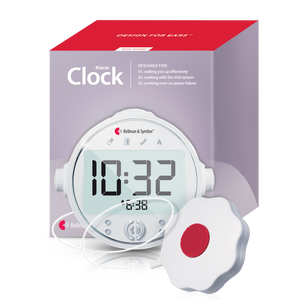
The Alarm Clock Pro is Bellman's flagship bedside alarm and the most comprehensive single-unit solution for heavy sleepers and hearing-impaired users. It combines three independent alert channels - an ascending 100dB sound alarm, four high-intensity LED flashing lights, and a powerful wired bed shaker - that activate simultaneously. For users who have missed alarms before despite having audio alerts, the addition of both vibration and bright visual flashes creates a redundant system where at least one channel is likely to break through.
The bed shaker slides under the pillow or mattress and produces a strong, noticeable vibration when the alarm triggers. The LED lights are bright enough to be effective in daylight conditions. Battery backup - with rechargeable NiMH batteries pre-installed - ensures full functionality, including bed shaker and lights during power outages. The "Smart Snooze" function automatically reduces snooze intervals from 9 down to 2 minutes in two-minute steps, making it progressively harder to keep hitting snooze without actually waking up.
- Up to 100dB ascending, multi-frequency sound alarm
- 4x high-intensity LED flashing lights
- Powerful wired bed shaker (pillow or mattress)
- Rechargeable battery backup (pre-installed)
- Smart Snooze: reduces from 9 to 2 minutes
- Large illuminated LCD display
- Night light beacon for dark-room navigation
- 2-year warranty
The Alarm Clock Classic delivers the core of what a vibrating alarm needs to do - a powerful bed shaker plus a loud ascending audio alarm - in a straightforward, easy-to-operate package. Two separate push-rotate dials for time and alarm setting mean there is no confusing shared-button menu to navigate. The 100dB ascending alarm spans multiple frequencies, improving audibility for users with partial high-frequency hearing loss. The optional sound disable lets users wake from vibration alone when they need to avoid disturbing others.
It is the right choice for users who want a dependable alarm without extra features, for older adults who prefer a simpler interface, or for anyone who found the Pro's additional settings more than they needed. Battery backup is included, and the Smart Snooze function is present here as well. The Classic doesn't include flashing lights - if visual alerts are a priority, the Pro is the better fit.
- Up to 100dB ascending, multi-frequency sound alarm
- Powerful wired bed shaker (pillow or mattress)
- Battery backup (powers all functions)
- Smart Snooze: 9 to 2-minute intervals
- Large LCD display with adjustable backlight
- Two separate dials for simple time/alarm setting
- Sound-off mode for vibration-only wake-up
- 2-year warranty
The Vibio is a fundamentally different product from the Classic and Pro. It is a Bluetooth-connected, app-controlled portable bed shaker - rechargeable, compact, and completely silent. Instead of a bedside clock unit, it pairs with your smartphone via the free Vibio app (iOS and Android) and delivers vibration-only alerts: alarms, phone call notifications, and incoming text message alerts. It is the ideal solution for users who share a room and need a wake-up signal that disturbs no one else, for travelers who want a reliable alarm that doesn't depend on a hotel alarm clock, and for couples where one partner needs to wake significantly earlier.
The app allows up to 10 separate alarms with adjustable vibration intensity across three settings (soft, medium, strong). Once alarms are configured, Vibio stores them locally and operates without the phone nearby. A single charge lasts up to 10 days of use. Critically, the alarm activates even if the mobile phone is turned off. For users who prefer not to sleep with their phone active, this removes a common point of failure for app-based alarms.
- Bluetooth 5 connection with free iOS/Android app
- Silent, strong vibration - zero sound output
- Up to 10 alarms with adjustable vibration intensity
- Phone call and text message alert notifications
- Works with the phone off or out of range
- Up to 10 days of battery life per charge
- Compact and travel-friendly design
- USB charging cable included
The Alarm Clock Receiver is for users who need more than a standalone alarm - those who want a single bedside unit that wakes them and also notifies them of doorbell rings, smoke alarms, CO detector alerts, and phone calls throughout their home. It functions as part of the Bellman Alerting System, requiring at least one compatible transmitter to receive external notifications. When triggered, it uses color-coded LED indicators to distinguish between different alert types, alongside sound, bright flashing lights, and a wired bed shaker - giving the user immediate visual information about what the alert is before they're fully awake.
For deaf and hard-of-hearing adults who live alone, or for those who want a safety net around fire and carbon monoxide events overnight, this is the most comprehensive bedroom unit in the Bellman lineup. The system is expandable: additional transmitters can be added at any time without rewiring or complex setup.
- Works as part of the Bellman Alerting System
- Color-coded LED indicators for alert type
- Bright flashing lights, loud alarm, bed shaker
- Covers up to 260 ft (open field) from transmitters
- Compatible with smoke alarm and CO transmitters
- Rechargeable battery backup included
- Large controls and built-in night light
- Safety certified: UL217, UL2034, ULC-S531, CSA 6.19
Choosing the Right Bellman Alarm Clock: A Practical Comparison
The right model depends on three things: how you sleep, how much hearing loss you have (if any), and what else you need the device to do. The table below maps the key differentiators.
The Decision Logic in Plain Language
If you are a heavy sleeper without significant hearing loss but who consistently misses standard alarms, start with the Alarm Clock Pro. The combination of vibration, flashing lights, and loud ascending sound gives you multiple simultaneous channels - one of them will break through.
If you have moderate to profound hearing loss and want the simplest possible bedside clock with vibration and loud sound, the Alarm Clock Classic is the right fit. Fewer features to configure means fewer things to get wrong at 5 AM.
If you travel, share a room with a light sleeper, or want completely silent alerts, the Vibio is the correct choice. It is uniquely suited to situations where no noise can be made during the wake-up process.
If you live alone with significant hearing loss and need overnight safety coverage - smoke, CO, doorbell, phone - alongside your alarm, the Alarm Clock Receiver, combined with compatible transmitters, gives you the most comprehensive system available.
Getting the Most from Your Vibrating Alarm Clock
A well-designed vibrating alarm clock can still underperform if the setup isn't right. These are the practical details that most guides skip over.
Bed Shaker Placement
The single most impactful variable in vibrating alarm effectiveness is where you put the shaker. Placement under the mattress near the torso - not under the pillow, and not near the feet - produces the strongest and most consistent physical signal for most sleepers. The shaker vibrates the mattress surface you're lying on rather than just one small pillow near your head. If the Alarm Clock Pro or Classic isn't waking you reliably, try moving the shaker from under the pillow to directly under your mattress near your shoulder or chest area before concluding the device isn't powerful enough.
Thick Mattress Toppers
Memory foam mattress toppers can significantly dampen vibration. If you use one, place the shaker between the topper and the main mattress surface rather than under the mattress itself. This keeps the vibration-generating surface in direct contact with where you sleep.
Sound Frequency and Partial Hearing Loss
If you have high-frequency hearing loss and are relying on the audio alarm as a backup, ensure the volume is set to maximum, and the alarm frequency is enabled. The Bellman alarms use ascending multi-frequency signals specifically to cover more of the audible spectrum - this design decision directly addresses the reality that most environmental sounds and consumer alarm tones cluster in the high-frequency range most affected by age-related and noise-induced hearing loss.
Using the Smart Snooze Intentionally
The Smart Snooze feature on the Pro and Classic - which reduces snooze intervals from 9 to 2 minutes progressively - is not just a gimmick. It is a behavioral design: by the time a user has hit snooze enough times to reach the 2-minute interval, the repeated physical alerts have typically achieved full arousal. Use it. Disabling it and setting a long snooze interval defeats part of the alarm's purpose.
Vibration does not depend on hearing at all. When the bed shaker is powerful enough and placed correctly, it wakes the body directly - through the skin, through mechanoreceptors, independently of any auditory pathway.
Bellman & Symfon - Product Design RationaleSpecific Use Cases: Matching the Right Solution
Older Adults with Age-Related Hearing Loss
Presbycusis - the gradual high-frequency hearing loss that affects roughly 1 in 3 adults over 65 and nearly half of those over 75 - is the most common reason standard alarm clocks fail older sleepers. The Alarm Clock Pro, with its multi-frequency ascending alarm and bed shaker operating simultaneously, is built for this demographic specifically. The large display, simple controls, and battery backup remove common friction points for this user group.
Students and Young Heavy Sleepers
Deep sleep architecture in young adults - particularly teens and people in their 20s - makes sleeping through standard alarms genuinely common, not a character flaw. For students in dorms or shared housing, the Vibio's completely silent vibration-only alerts let one person wake up without disturbing roommates. For those with their own room, the Alarm Clock Pro is the most reliable single-device solution.
Frequent Travelers
Hotel alarm clocks are notoriously unreliable. The Vibio is compact, rechargeable, holds a 10-day charge, and TSA-compatible - a self-contained alarm system that operates on your settings, not whatever someone else left the hotel clock set to. It also alerts you to incoming calls and texts through vibration, making it a useful communication tool during travel.
Couples with Different Wake Times
One of the most common and least-discussed alarm clock problems: one person needs to be up at 5 AM, the other at 7:30 AM. Sound-based alarms make this a source of daily friction. The Vibio solves it cleanly - completely silent to anyone not sleeping directly on the shaker, and strong enough to wake reliably. No negotiation about alarm volume necessary.
Deaf Adults Living Alone
For profoundly deaf adults, an alarm clock is only part of the morning safety equation. Overnight safety events - a smoke alarm, a CO detector, a doorbell at an unexpected hour - also need to reach the bedroom. The Alarm Clock Receiver, as part of the Bellman Alerting System, provides that complete overnight awareness picture, with color-coded visual indicators distinguishing alarm types so the user knows immediately what they're waking up to.
Medical Schedules and Critical Wake-Ups
For people who need to wake at a specific time for medication, dialysis, shift work, or any other schedule where missing the alarm has real consequences, reliability is not optional. Battery backup - standard on the Alarm Clock Pro and Classic - ensures the alarm functions even during power outages. The multi-channel alert approach means there is no single point of failure in the wake-up system.
Common Mistakes When Choosing or Using a Vibrating Alarm Clock
- Placing the shaker under a thick mattress topper without adjustment
- Setting it near the feet rather than under the torso
- Choosing vibration-only when hearing loss is severe, and visual backup would help
- Not testing the alarm before the first morning you actually need it
- Setting a long snooze interval that allows returning to deep sleep
- Using a cheap consumer device with a weak motor on a heavy-foam mattress
- Not charging the Vibio regularly - catching it at 5% at midnight
- Placing the bedside unit too far away to reach without fully waking up
The Bellman Bed Shaker: When You Need Just the Vibration Component
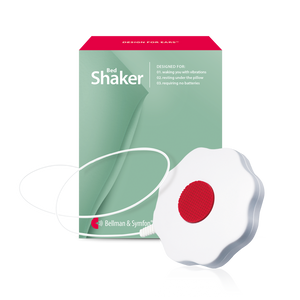
For users who already have a compatible Bellman receiver - or who want to add powerful vibration alerts to an existing Bellman Alerting System setup - the Bellman Bed Shaker is available as a standalone accessory. It connects directly to compatible receivers (including the Alarm Clock Receiver and Flash Receiver) and delivers the same powerful vibration as the integrated shakers included with the Pro and Classic.
The bed shaker operates at 2.0-4.0V DC, requires no batteries of its own, and features an anti-slip surface to prevent shifting during the night. It is the component that makes vibration-based alerting possible across the broader Bellman Alerting System - adding overnight tactile awareness for doorbell, phone, smoke, and CO alerts beyond the morning alarm function.
Match your situation to the right product
Review the scenarios below - the most checkmarks in a category tells you where to start.
- I need vibration + flashing lights + loud sound all at once → Alarm Clock Pro
- I want battery backup in case power goes out → Alarm Clock Pro or Classic
- I sleep with a partner who can't be disturbed → Vibio
- I travel regularly and need a portable alarm → Vibio
- I want the simplest possible setup, no extra features → Alarm Clock Classic
- I live alone and need overnight home safety alerts too → Alarm Clock Receiver
- I have profound or total deafness → Alarm Clock Pro or Receiver
- I have mild-to-moderate hearing loss → Alarm Clock Classic or Pro
- I have high-frequency hearing loss and need multi-frequency tones → Any Bellman Clock
- I want phone call and text alerts through vibration → Vibio
The Bottom Line on Vibrating Alarm Clocks in 2026
The market for vibrating alarm clocks has matured significantly. What was once a niche assistive technology category - associated almost exclusively with profound deafness - has expanded to serve heavy sleepers of all ages and hearing levels, couples with different schedules, students, travelers, and anyone who has simply accepted missed alarms as an inevitability of their sleep style.
The fundamental insight that Bellman & Symfon has built its alarm clock line around remains as accurate in 2026 as it was when the company started in 1989: a single-channel alert system - sound alone - leaves too much to chance for too many people. Vibration doesn't ask your ears to cooperate. Flashing lights don't depend on sleep stage. Battery backup doesn't care about the power grid. These aren't premium extras. They are the features that determine whether the alarm actually does its job.
For anyone making this decision for the first time, the Alarm Clock Pro is the place to start. For travelers, the Vibio. For those who need their morning alarm to be part of a whole-home safety system, the Alarm Clock Receiver. And for anyone who knows exactly what they need - a loud, simple, reliable bedside clock with vibration and battery backup - the Alarm Clock Classic delivers it without distraction.
Find the alarm clock that will actually wake you up.
Explore the full Bellman alarm clock range - designed from the ground up for heavy sleepers and people with hearing loss.
Sources and references: National Institute on Deafness and Other Communication Disorders (NIDCD) - Quick Statistics About Hearing; Age-Related Hearing Loss; Noise-Induced Hearing Loss fact sheets · World Health Organization (WHO) - Deafness and Hearing Loss Fact Sheet (updated March 2026) · Bellman & Symfon - Alarm Clock Pro product specifications (us.bellman.com/products/heavy-sleeper-vibrating-alarm-clock-pro); Vibio product specifications (us.bellman.com/products/vibio); Alarm Clock Receiver product specifications (us.bellman.com/products/alerting-signaling-device-alarm-clock-receiver); Alarm Clock Classic specifications; Bed Shaker specifications (us.bellman.com/products/bed-shaker) · American Sleep Association - Sleep stages and arousal thresholds during NREM and REM sleep · Hearing Loss Association of America (HLAA) - Hearing Loss by the Numbers (updated February 2026) · Tonndorf, J. - Bone conduction and tactile hearing: sensorineural pathways in tactile alerting. Annals of Otology, Rhinology & Laryngology · General research on Pacinian corpuscles and mechanoreceptor response to vibration.
This article is for informational purposes only. Product specifications are based on current published listings at us.bellman.com and may be updated; verify current specs on the product page before purchase. For clinical guidance on hearing loss, consult a licensed audiologist or qualified hearing health professional.
Best Vibrating Alarm Clocks for Heavy Sleepers & Hearing Impaired (2026)
This guide breaks down the practical choices, features, and considerations behind this topic. Use it to identify a setup that fits the listener, the environment, and the everyday moments that matter most.
The featured products below are current Bellman options discussed in the article or closely matched to its use case.