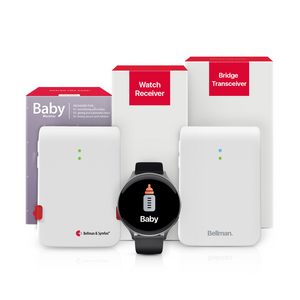
Baby Monitor for Deaf and Hard of Hearing: More Than a Baby Monitor - Smoke & CO Safety, Day and Night

When you are deaf or hard of hearing, a baby monitor is only one part of what keeps your family safe. A smoke alarm you cannot hear and a CO detector that sounds an audible alert while you sleep without hearing devices are just as urgent a gap - and the same system that alerts you to your baby can cover both, around the clock.
Deaf parents should combine a vibrating baby monitor system with a smoke and CO alert transmitter on the same Bellman Bluetooth Bridge - ensuring they receive both infant and household safety alerts through the same Watch Receiver and app. The Bellman smoke and CO transmitter connects to the existing Bridge alongside the baby monitor transmitter, delivering a distinct wrist alert the moment a detector activates - day or night, hearing devices on or off.
The Gap That Baby Monitors Alone Don't Fill
When a new baby arrives, parenting instincts drive a familiar sequence: get a baby monitor, set it up in the nursery, make sure you can hear - or, for deaf and hard-of-hearing parents, feel - every cry and stir. The baby monitor becomes the central safety tool of the household, and for those early weeks, it often feels like the most important piece of technology in the home.
But there is a safety gap that baby monitors alone do not fill. While you are focused on monitoring the nursery, the rest of the home continues to carry its own risks. A smoke alarm activates in the kitchen. Carbon monoxide begins to accumulate from a faulty furnace. A fire starts while you are asleep. These are the emergencies that are most deadly when they go undetected - and for deaf and hard-of-hearing parents, the standard response to all of them - an audible alarm - is precisely the alert mechanism that does not work.
The NFPA reports that roughly three out of five home fire deaths occur in homes with no working smoke alarms, or where alarms fail to alert sleeping occupants. For deaf and hard-of-hearing individuals sleeping without hearing devices, an audible smoke alarm offers the same protection as no alarm at all. This is not a minor gap. It is a life-safety issue that requires the same intentional, technology-driven solution that baby monitoring does.
The good news - and the core point of this guide - is that if you already have or are planning to set up a Bellman baby monitor system, you are already most of the way to solving this problem. The same Bridge that routes your baby alerts to your Watch Receiver can do the same for smoke and CO emergencies. One system, one Watch, complete coverage.
Why Standard Smoke and CO Alarms Are Inadequate for Deaf Parents
Standard residential smoke alarms produce an audible tone - typically 85 decibels at ten feet - designed to wake sleeping occupants and give them time to evacuate. For hearing individuals sleeping lightly, this works reasonably well. For deaf and hard-of-hearing individuals sleeping without hearing devices, and for those who are deep sleepers regardless of hearing level, it fails in the most critical moments: in the middle of the night, when the fire starts, when response time is measured in seconds.
Most deaf and hard-of-hearing individuals remove their hearing aids or cochlear processor at night. This is not optional - extended wear causes discomfort, skin irritation, and battery depletion. It is simply part of living with hearing loss. The result is that the hours when you are most vulnerable - asleep, in a quiet room, without any audio input - are precisely the hours when audible alarms are least likely to reach you.
A smoke alarm, however loud, that you cannot hear while you sleep does not protect you. For this reason, the NFPA and the National Association of the Deaf both recommend that deaf and hard-of-hearing individuals supplement audible alarms with visual and tactile alerting systems specifically designed for their needs.
What Standard Alarms Get Right - and Where They Fall Short
Standard smoke and CO alarms are effective at detection. The sensor technology in modern residential detectors - photoelectric and ionisation for smoke, electrochemical sensors for CO - is reliable and well-validated. The gap is entirely in the alert delivery mechanism: sound. For deaf and hard-of-hearing parents, the detection is happening correctly, but the signal telling them to act never arrives.
Strobe light alarms - standalone visual alert devices - are one common solution. They flash a bright light when activated and can be effective at waking some people, particularly lighter sleepers or those with moderate hearing loss. But strobe lights have limitations: they require line-of-sight, they do not work if the bedroom door is closed, and they provide no tactile alert for those who sleep facing away from the unit or who are heavy sleepers. They are better than nothing, but they are not a complete solution.
The complete solution pairs detection with a tactile alert that arrives directly on your body - a wrist vibration from the Watch Receiver - regardless of where you are in the home, how deeply you are sleeping, or whether the bedroom door is open or closed.
How the Bellman System Adds Smoke and CO Alerting to Your Baby Monitor Setup
If you already have the Bellman Baby Monitor System - or you are planning to set one up - adding smoke and CO alerting is a single additional step: connect a Bellman smoke and CO transmitter to the same Bridge. That is it. The Bridge already knows how to relay alerts to your Watch Receiver. The smoke transmitter simply adds another input, with its own distinct icon, to the same output device you are already wearing.
How the Signal Chain Works
Like all Bellman Bridge alerts, the smoke and CO alert path - transmitter to Bridge to Watch Receiver - operates entirely over local Bluetooth and does not require an internet connection. A fire that starts during a storm that also knocks out your internet does not interrupt the alert. Your Watch Receiver vibrates regardless of what is happening with your Wi-Fi or ISP. For a full explanation of why offline reliability matters for deaf parents, see our guide: Baby monitor without Wi-Fi for deaf parents: why offline is safer.
Day and Night: Two Different Alert Challenges, One System
Smoke and CO alerting for deaf and hard-of-hearing parents operates differently during the day than during the night - not because the risks are different, but because your state of awareness and the alert channels available to you are different. The Bellman system handles both scenarios, but it is worth understanding each clearly.
Daytime Alerting
During the day, you are typically awake, mobile, and moving through different parts of the home. The Watch Receiver on your wrist is the primary alert channel. Wherever you are - in the kitchen, working at your desk, in the garden, tending to the baby - if a smoke or CO transmitter activates, you feel the vibration and see the flame icon immediately. The Bridge also sends a simultaneous alert to the Bellman smartphone app, which functions as an additional layer for caregivers or other household members who have the app installed.
Daytime CO alerting deserves special mention because CO has no smell, no visible presence, and causes impairment that can affect your ability to recognise something is wrong before you collapse. The wrist alert - immediate, forceful, and distinctly identifiable - gives you the signal to act before symptoms progress to dangerous levels.
Nighttime Alerting
Nighttime is the highest-risk period for both fire and CO emergencies. The majority of residential fire fatalities occur overnight. CO poisoning is most dangerous during sleep, when the gas accumulates gradually and victims may lose consciousness without ever becoming fully alert. For deaf and hard-of-hearing parents sleeping without hearing devices, the nighttime window is when audible alarms are completely ineffective.
The Watch Receiver worn to bed is the core nighttime solution. Its vibration is intentionally strong - designed to wake a sleeping adult reliably - and the flame icon on the Watch face makes the nature of the emergency immediately clear even when you are groggy. The alert arrives within seconds of the transmitter detecting the alarm sound.
For the most complete overnight coverage, pairing the baby monitor and smoke alerting with a vibrating alarm clock completes the picture. The Bridge + Smoke/CO + Alarm Clock bundle gives you wrist vibration for emergency alerts throughout the night and a silent vibrating alarm clock for morning wake-up - both through the same Bridge, no audible sound required for any function. You can add a Watch Receiver separately to this bundle for daytime wrist notifications if you prefer not to rely on the smartphone app during the day.
Alarm activates at 85 dB. Hearing devices are off. The sound reaches the bedroom but not the sleeping person. No wrist vibration. No visual signal (unless a standalone strobe is present and line-of-sight conditions are met). Alert is not received. Response time is zero until the parent wakes for another reason.
Smoke alarm activates. Transmitter detects the alarm sound and sends a 433 MHz signal to the Bridge in under two seconds. Bridge relays a Bluetooth alert to the Watch Receiver worn on the parent's wrist. Strong vibration + flame icon. Parent wakes. Internet connection not required. Response time: seconds.
One Bridge, Two Critical Alerts: Baby Monitor and Smoke/CO Together
Here is the full picture of what a combined baby monitor and smoke/CO setup looks like through the Bellman Bridge system - and why keeping both on a single Bridge is the most reliable configuration.
Every one of these alerts arrives on the same Watch Receiver, identified by its own distinct icon, with no audible sound produced anywhere in the home. The baby stays asleep. The household stays quiet. You receive exactly the right information on your wrist - immediately, reliably, at any hour.
This is the core idea behind the cluster note that informed this blog: a baby monitor for deaf parents is not just about the baby. It is about being the informed, aware parent your whole household needs - without making noise that disrupts the environment you are trying to protect.
Why Running Baby Monitor and Smoke/CO on the Same Bridge Is the Right Approach
Some parents consider maintaining separate systems - a standalone baby monitor and a standalone visual or tactile smoke alert device, as independent solutions. This approach can work, but it has practical disadvantages that a single Bridge setup avoids entirely.
One Watch covers everything
With a separate smoke alert system, you may need to wear or carry a second receiver, or manage a second vibrating device alongside the baby monitor Watch. With the combined Bridge approach, one Watch on your wrist covers every alert type. One charging routine. One device to track. One pairing to maintain.
Icon-based identification prevents confusion
In a separate-systems approach, two devices vibrating simultaneously or in sequence can create confusion - which vibration means what? With the Bridge system, every alert type has a distinct icon on the Watch face. A flame icon means emergency. A baby icon means check the nursery. The distinction is immediate and unambiguous, even at 3 a.m.
No internet required for either alert type
Separate standalone systems often rely on different connectivity methods - some use Wi-Fi, some use proprietary radio frequencies. A fire that starts during an internet outage might interrupt one system but not the other. With the Bellman Bridge, both baby and smoke alerts travel over the same local Bluetooth path - neither depends on internet connectivity.
Scales as your family and home needs grow
As you add children, change homes, or expand coverage - adding a doorbell transmitter, a second baby monitor for twins, a push button for caregiver communication - every addition connects to the same Bridge and appears on the same Watch. A separate smoke system does not grow with you; it simply becomes another parallel device to manage alongside everything else.
Setting Up Smoke and CO Alerting: What It Actually Looks Like
Adding the Bellman smoke and CO transmitter to an existing Bridge setup is designed to be straightforward - no electrician, no rewiring, no replacing your existing detectors. Here is the complete setup sequence.
-
Confirm your existing smoke/CO detectors are working The Bellman smoke transmitter works by detecting the sound of your existing alarm. Before setup, test each detector in your home - press the test button and confirm the alarm sounds. Replace any detectors that do not test correctly. The Bellman transmitter amplifies and relays a working alarm; it cannot compensate for a failed detector.
-
Position the smoke transmitter near your detector Place the Bellman smoke transmitter within close range of your most critical smoke or CO detector - typically the hallway detector nearest the bedrooms, or the kitchen detector if that is your highest-risk location. The transmitter should be within clear acoustic range of the alarm. No wiring to the detector is required; the transmitter listens for the alarm sound.
-
Pair the transmitter to your existing Bridge. Use the Bellman app to add the smoke transmitter as a new device on your existing Bridge. The pairing process follows the same steps as adding any other transmitter - the Bridge simply adds a new transmitter ID and maps it to the appropriate alert icon.
-
Test the full alert chain Use the detector's test button to trigger the alarm while wearing your Watch Receiver. Confirm the Watch vibrates and displays the flame icon within a few seconds. Walk to your bedroom, close the door to simulate overnight conditions, and repeat the test. Confirm the Watch vibrates reliably from your sleeping position.
-
Add additional transmitters for multi-room coverage. For homes with detectors on multiple floors or in multiple areas, adding additional smoke transmitters - one per critical detector location - ensures complete coverage. Each transmitter pairs to the same Bridge and sends the same flame icon to the Watch, regardless of which detector triggered.
The most important placement is near the detector closest to where you sleep. In a typical home, this is the hallway smoke detector between the bedrooms. A fire starting anywhere in the home will eventually trigger the detector closest to its origin - but the signal reaching you fastest overnight is the one from the bedroom hallway.
For CO specifically, place a transmitter near the detector in the sleeping area or adjacent hallway. CO tends to accumulate silently throughout a structure, and nighttime exposure is most dangerous because you cannot respond to symptoms while unconscious. The wrist alert from the Watch is the only mechanism that can reliably alert a sleeping deaf parent to a CO emergency in progress.
The Silent Household: Every Alert Reaches You Without Waking the Baby
One of the most practical benefits of the Bellman system that often goes unappreciated until you are living it: when all your household alerts are routed to a Watch Receiver rather than audible devices, your home becomes measurably quieter. And when you have a baby - or twins, or young children - quiet is not a preference. It is a daily operational requirement.
Consider the scenario without a Bellman system. A smoke alarm activates. It sounds at 85 decibels - a sound level designed to penetrate sleep, penetrate walls, penetrate the noise of a burning building. Every child in the home wakes instantly. An already urgent situation - a fire emergency - now includes panicked children, a household in chaos, and a parent trying to respond while managing multiple frightened children simultaneously.
With the Bellman system, the alert to the parent is silent to everyone else in the house. The Watch vibrates. The parent wakes. The children remain asleep. The response is immediate and calm - not because the emergency is less urgent, but because the alert reached exactly the person who needed it, without creating secondary disruption. In the seconds that matter most, that calm can be meaningful.
The same logic applies to every alert type in the system:
- Doorbell: No chime sounds through the house. You feel the doorbell icon on your wrist. The baby's nap is not interrupted. You go to the door. The visitor is attended to. See our guide on doorbell alerting for deaf parents.
- Phone call: Your phone rings silently in the next room. The Bridge sends a phone icon to your Watch. You feel it and go to answer - no ring piercing the house, no baby startled. This was highlighted in the cluster note as one of the core "more than just baby awareness" benefits.
- Push button: A push button transmitter lets a co-parent or caregiver signal you without calling out across the house. Silent communication, no disrupted naps. See how this fits into a whole-home setup in our guide: Deaf parenting: how to stay safe and connected at home with the right tech.
- Smoke and CO: Emergency alerting arrives on your wrist with no sound produced by the Bridge or Watch - only the original detector alarm sounds, which is outside the sleeping area and does not reach you if you are deaf. You respond. Your children continue sleeping until it is necessary to wake them as part of evacuation.
Full Home Safety Setup: With and Without Combined Smoke Alerting
| Safety Scenario | Baby Monitor Only (No Smoke Alert) | Baby Monitor + Smoke/CO on Bellman Bridge |
|---|---|---|
| Baby cries - nighttime | Watch vibrates - baby icon | Watch vibrates - baby icon |
| Smoke alarm activates - daytime | No alert - deaf parent must be near the alarm or see strobe (if present) | Watch vibrates - flame icon within seconds |
| Smoke alarm activates - nighttime (hearing devices off) | No alert - audible alarm cannot reach sleeping deaf parent | Watch worn to bed vibrates - flame icon - parent wakes immediately |
| CO accumulation - nighttime | No alert - CO is odourless, invisible, audible alarm ineffective while sleeping without hearing devices | CO transmitter detects alarm - Watch vibrates - alert arrives before dangerous exposure levels |
| Internet outage during emergency | Baby alerts unaffected (Bluetooth) - smoke alerts depend on system used | Both baby and smoke/CO alerts via local Bluetooth - no internet required |
| Alert differentiation | Baby icon only | Baby icon / Flame icon / CO icon - immediately distinguishable on Watch face |
| Silent delivery - baby stays asleep | Baby alerts: silent to household | All alerts: silent to household - Watch vibrates only |
The Overnight Setup: Complete Coverage While You Sleep
The overnight hours - when hearing devices are off, children are asleep, and the household is at its quietest - are the most important hours for both baby monitoring and fire/CO safety. Here is how to build a complete overnight setup through the Bellman Bridge system.
The foundation is the Watch Receiver worn to bed. Every alert - baby, smoke, CO, doorbell - vibrates directly against your wrist and displays the relevant icon. You wake, identify the alert type, and respond appropriately. For most deaf parents, the Watch is sufficient as the primary overnight alert device on its own.
For additional confidence - particularly for deep sleepers or those who want a redundant backup alert channel alongside the Watch - pairing the Bridge with a bed shaker alarm clock adds a second physical alert channel. The Bridge + Smoke/CO + Alarm Clock bundle is purpose-built for exactly this: it combines a vibrating alarm clock (including a bed shaker for under-mattress placement) with the Bluetooth Bridge and smoke/CO transmitter - giving you wrist vibration, bed shaker vibration, and visual flash from the alarm clock unit simultaneously when a smoke or CO alarm activates. You can add a Watch Receiver separately for daytime wrist alerts without relying on the smartphone app.
If you also want baby monitoring covered through the same overnight bundle, the Bridge + Baby Monitor + Alarm Clock bundle gives you the Bridge, baby transmitter, and vibrating alarm clock in one package - and you can add the smoke/CO transmitter to that same Bridge as a separate accessory to cover both alert types overnight.
- Smoke transmitter placed near bedroom hallway detector
- CO transmitter placed near sleeping area detector
- Baby transmitter within 3–5 ft of infant's sleep spot
- Watch Receiver charged above 20% before bed
- Test smoke alert chain from sleeping position - door closed
- Test baby alert from sleeping position - Watch vibrated
- Existing detectors tested monthly - replace if not working
- Bridge on same floor as bedrooms for shortest signal path
- Alarm Clock bundle configured for silent morning wake-up
- App paired as secondary alert for co-parent or second caregiver
The Complete Picture: What a Fully Equipped Bellman Home Looks Like
Every component covered in this guide - and in the cluster of guides it belongs to - points toward the same destination: a home where a deaf or hard of hearing parent can be the fully informed, immediately responsive parent their family needs, without depending on sound, without waking sleeping children, and without relying on internet infrastructure that can fail at the worst moment.
Here is what that home looks like, component by component.
Everything on one Bridge, everything on one Watch
The complete Bellman setup for a deaf or hard of hearing parent's home - every alert type covered, no sound required.
- Bluetooth Bridge - centrally placed on bedroom floor
- Baby Monitor Transmitter - near infant's sleep spot
- Smoke Transmitter - near bedroom hallway detector
- CO Transmitter - near sleeping area detector
- Doorbell Transmitter - silent visitor alerts
- Push Button Transmitter - caregiver communication
- Watch Receiver - worn day and night on wrist
- Alarm Clock bundle - silent morning wake-up + bed shaker
- Bellman App - secondary alerts for co-parent or caregiver
- All transmitters tested from sleeping position
Baby monitor and smoke/CO alerting - on one Watch, one Bridge.
Add a Bellman smoke and CO transmitter to your existing Bridge setup, or start with the Bridge + Smoke/CO + Alarm Clock bundle for complete overnight safety coverage - no internet required, no sound produced, no baby woken.
Sources and references: National Fire Protection Association (NFPA) - Fire Loss in the United States 2023; Home Structure Fires report; Smoke Alarm Requirements · Centers for Disease Control and Prevention (CDC) - Carbon Monoxide Poisoning: Prevention; Unintentional Non-Fire-Related CO Poisoning · National Institute on Deafness and Other Communication Disorders (NIDCD) - Hearing loss in adults statistics · National Association of the Deaf (NAD) - Fire Safety and Alerting Technology for Deaf and Hard of Hearing Individuals · Hearing Loss Association of America (HLAA) - Assistive Alerting Technology: Home Safety Guidance · Gallaudet University Research Institute - Deaf and hard of hearing household safety data · Bellman & Symfon - Baby Monitor System with Bluetooth Bridge and Watch Receiver product specifications; Smoke Alert Transmitter specifications; Bluetooth Bridge Transceiver BE1521 documentation (us.bellman.com) · IEEE 802.15 - Bluetooth 5 specification: peer-to-peer local operation · FCC - 433 MHz ISM band specification · U.S. Fire Administration (USFA) - Residential Fire Death and Injury Statistics; Nighttime Fire Fatalities.
This article is for informational purposes only and does not constitute fire safety, medical, or legal advice. Ensure all smoke and CO detectors in your home comply with local building codes and are tested regularly. For personalised hearing health guidance, consult a licensed audiologist or appropriate professional. Product specifications subject to change - refer to current listings at us.bellman.com.

Baby Monitor for Deaf and Hard of Hearing: More Than a Baby Monitor - Smoke & CO Safety, Day and Night
This guide breaks down the practical choices, features, and considerations behind this topic. Use it to identify a setup that fits the listener, the environment, and the everyday moments that matter most.
The featured products below are current Bellman options discussed in the article or closely matched to its use case.