Vibrating Alarm Clock for College Students: Never Sleep Through Class Again

A standard alarm gives you one shot to wake up: sound. If you are a heavy sleeper, that is often not enough. A vibrating alarm adds a second channel your brain cannot ignore as easily. This guide explains why vibrating alarms work, which situations call for which type, and what to look for in a dorm setting.
- Why so many students sleep through their alarms
- How a vibrating alarm actually wakes you up
- Vibrating alarms and hearing loss: a different problem
- Alarm Clock Pro: sound, light, and vibration together
- Vibio Bed Shaker: silent and app-controlled
- Alarm Clock Classic: loud and straightforward
- Comparing your options side by side
- Choosing the right alarm when you share a room
- Getting your alarm setup right from day one
- People also ask
A vibrating bed shaker works by delivering an alert through touch rather than sound. It bypasses the brain's deep-sleep filtering, which can cause heavy sleepers to miss audio alarms. For most college students, the best setup is a multi-mode alarm that combines a loud ascending sound, bright flashing lights, and a bed shaker all at once. The Bellman Alarm Clock Pro does exactly that. For students sharing a room who need silence, the Bellman Vibio Bed Shaker is a Bluetooth shaker that produces no sound and is controlled through a free smartphone app. For the full picture of dorm alerting tools, see the pillar guide: Hearing Loss in College: Complete Guide to Dorm Alerts, Campus Safety & Academic Tools (2026).
Why So Many Students Sleep Through Their Alarms
Sleeping through an alarm is not a willpower problem. It is a biology problem. And college makes it worse.
A 2025 study by the American College Health Association found that 74.3 percent of college students were classified as poor sleepers based on standardized sleep quality indices. Poor sleep quality typically means more time spent in the deepest stages of sleep, which is exactly where audio alarms struggle most.
Sleep researchers describe something called the arousal threshold: the strength of stimulus needed to pull a person out of sleep. During slow-wave deep sleep, that threshold rises sharply. A sound that would wake a light sleeper in a moment may not register at all for someone in deep sleep. The brain actively suppresses incoming sensory signals during deep sleep stages. This is not a failure of the alarm. It is the brain doing its job.
First-year college students face an additional challenge. Research published in peer-reviewed sleep literature shows that younger adults naturally spend more time in deep slow-wave sleep. They also tend to have later circadian rhythms. This means early-morning alarms hit at the exact moment when arousal thresholds are highest and sleep is deepest.
Sleep researchers have identified a process called habituation. The brain learns to filter out familiar, repetitive sounds during sleep. This is why an alarm that jolted you awake on day one of the semester barely registers by week six. The brain has cataloged it as non-threatening and learned to suppress it. Varying alarm tones helps slow down habituation. Adding a physical sensory channel such as vibration helps most because touch is processed differently from sound during sleep.
For students with hearing loss, the picture is still different. The problem is not a high arousal threshold. It is that the alarm signal never reaches the brain clearly in the first place. An audio alarm set to 60 to 80 dB, the typical range for a standard bedside clock or phone, may not be audible enough to register, regardless of sleep stage. This group needs a fundamentally different approach, not a louder version of the same thing.
How a Vibrating Alarm Actually Wakes You Up

A bed shaker is a small disc-shaped device that goes under your pillow or mattress. When the alarm fires, it vibrates strongly. That vibration reaches your body directly through touch.
Touch is processed by a different sensory pathway than sound. The brain does not filter tactile signals during sleep in the same way it filters auditory ones. Physical sensation is harder to habituate to and harder to ignore during deep sleep stages. This is the core reason vibrating alarms work when loud ones do not.
A study of sleep arousal found that wrist vibration woke adults from deep sleep in a high percentage of trials with a short median response time. The bed shaker operates on the same principle, delivering stronger physical sensation directly to the sleeping surface.
The most effective wake-up systems combine multiple alert types at once. Sound, light, and vibration firing simultaneously give the brain multiple pathways to register the alarm. Missing one is much harder when all three are active simultaneously.
- Phone alarms produce 60 to 80 dB, often insufficient in deep sleep
- The brain habituates to familiar alarm sounds over days and weeks
- Do Not Disturb settings, flat batteries, and OS updates all create failure points
- A phone on vibrate slides off a mattress or gets muffled under sheets
- Students with hearing loss may not hear the alarm regardless of volume
- A dedicated bed shaker stays in place and delivers vibration to the body directly
- Multi-mode alarms add light and sound that cannot all be filtered at once
- Backup battery in the alarm clock keeps it running through power outages
Vibrating Alarms and Hearing Loss: A Different Problem
Students with hearing loss face a distinct version of the waking problem. For a heavy sleeper, the issue is arousal threshold during deep sleep. For a student with hearing loss, the issue is signal reception. An alarm that is not loud enough to be heard does not reach the brain at all, regardless of sleep stage.
A 2024 meta-analysis in Frontiers in Neuroscience found that approximately 19 percent of college students have some degree of hearing loss. For many of them, a standard phone alarm or bedside clock produces a sound that falls below the threshold of comfortable hearing, even when the room is quiet and they are awake. During sleep, the gap widens further.
A multi-mode alarm that adds bright flashing lights and a bed shaker changes the equation entirely. The alarm no longer depends on the ears alone. The flashing light is visible even without hearing aids. The bed shaker delivers vibration that no ear can miss.
Students who are deaf or have profound hearing loss often find that the bed shaker alone is sufficient. Those with moderate-to-severe hearing loss may find that combining the shaker with a bright visual alert is the most reliable setup. The light catches the eye if you happen to open it. The shaker catches you if you do not.
Related reading: For a full overview of dorm alerting tools including door knock alerts, fire awareness systems, and wrist receivers, see Best Dorm Room Alert Systems for Deaf & Hard of Hearing College Students.
Alarm Clock Pro: Sound, Light, and Vibration Together

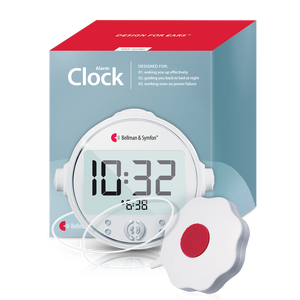
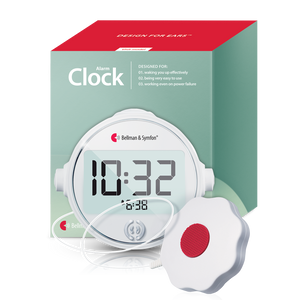
The Bellman Alarm Clock Pro is a digital alarm clock that fires three alert types simultaneously: an ascending multi-tone alarm up to approximately 100 dB, bright flashing lights, and a wired bed shaker. All three activate the moment the alarm goes off. They do not stagger or escalate one at a time. All three hit at once.
The ascending tone matters. The alarm starts at a lower volume and gets louder over time. This makes the first few seconds of the alarm less jarring for anyone nearby while still building to a level that crosses deep-sleep arousal thresholds. By the time the alarm has been sounding for a minute, it is loud enough to be genuinely hard to ignore.
The bed shaker included with the Alarm Clock Pro connects via a cable and goes under a pillow or mattress. It vibrates strongly. For students who routinely sleep through phone alarms, the combination of all three alert modes is a meaningful upgrade.
Ascending sound alarm, flashing lights, and wired bed shaker in one unit
The Alarm Clock Pro does not require a phone, an app, or a Bluetooth connection. It works on its own. This removes a whole category of failure points. There is no Do Not Disturb to misfire. There is no battery running low. The alarm is set on the clock, and the clock rings.
The backup battery is worth noting specifically for dorm use. Dorm rooms share circuits, and power can dip or trip unexpectedly. The backup battery keeps the alarm set and the time accurate even if someone on your floor blows a fuse at 2 a.m.
Best for: Heavy sleepers who need all three alert modes firing at once. Students with moderate-to-profound hearing loss who need a visual alert alongside vibration. Any student who has missed class by sleeping through a phone alarm.
Vibio Bed Shaker: Silent and App-Controlled

The Bellman Vibio Bed Shaker solves a different version of the same problem. It produces no sound at all. It is a Bluetooth shaker that pairs with the free Vibio app on iOS and Android. You set your alarms from your phone. At the set time, the shaker vibrates under your pillow. Your roommate hears nothing.
The Vibio is compact and USB-rechargeable. It is portable enough to bring home on weekends or pack for travel without taking up meaningful space. This makes it a good choice for students who split time between campus and home, or who move frequently between terms.
The app lets you set multiple alarms and adjust the vibration strength. It also sends vibration alerts for incoming calls and text messages. For students who need to stay reachable overnight without turning on sound, this covers both wake-ups and notifications on a single device.
Silent Bluetooth bed shaker controlled by free smartphone app
One trade-off to be aware of: the Vibio depends on the app and Bluetooth connection. Keep your phone charged and within Bluetooth range. The phone also needs to be running the app in the background. For most students, this is automatic, but it is worth knowing up front so it does not catch you off guard when your phone hits 0% at midnight.
Best for: Students sharing a room with a lighter sleeper who cannot tolerate alarm noise. Students with hearing loss who need vibration without sound. Students who travel frequently and want one compact device that works everywhere.
Alarm Clock Classic: Loud and Straightforward

The Bellman Alarm Clock Classic is the original extra-loud vibrating alarm clock. It produces an ascending multi-tone alarm up to approximately 100 dB and includes a wired bed shaker. It also has a Smart Snooze feature that gradually reduces the snooze interval, so the alarm fires more frequently if you keep hitting snooze.
There are no flashing lights on the Alarm Clock Classic. This makes it a simpler device than the Alarm Clock Pro. For students who mainly need a loud alarm and bed shaker and do not require a visual alert, it covers the core need well.
Extra-loud ascending alarm with Smart Snooze and wired bed shaker
Best for: Students who are heavy sleepers, do not have hearing loss, and do not need a visual alert. A reliable, no-frills option for anyone who needs loud sound and vibration without extra features.
Comparing Your Options Side by Side
The three Bellman alarm options cover different combinations of alert types and use cases. The table below maps each product to the situations it fits best.
| Feature | Alarm Clock Pro | Vibio Bed Shaker | Alarm Clock Classic |
|---|---|---|---|
| Loud sound alarm | Yes, up to ~100 dB | No sound | Yes, up to ~100 dB |
| Flashing lights | Yes | No | No |
| Bed shaker | Yes, wired, included | Yes, Bluetooth | Yes, wired, included |
| Requires phone or app | No | Yes (free Vibio app) | No |
| Backup battery | Yes, included | USB-rechargeable | Power cord |
| Smart Snooze | No | Managed via app | Yes |
| Call and text notifications | No | Yes, via app | No |
| Portable for travel | Less so; power cord setup | Yes, USB-rechargeable | Less so; power cord setup |
| Best for | Heavy sleepers and students with hearing loss who need all three alert types | Students sharing a room; students who travel; hearing loss without a sound requirement | Heavy sleepers who need loud alarm and vibration without extra features |
Choosing the Right Alarm When You Share a Room
Sharing a dorm room means your alarm affects someone else. A 100 dB alarm going off at 7 a.m. when your roommate does not have class until noon is a reliable source of tension.
The good news is that the vibration channel of a bed shaker is mostly contained to your sleeping surface. A shaker under your pillow does not transmit meaningful vibration to the other bed. The sound and light channels do affect the room.
If your roommate is a heavy sleeper too
The Alarm Clock Pro is a reasonable choice. The sound is loud but ascending, meaning it builds from a lower level rather than slamming in at full volume. If your roommate also sleeps through alarms, this is unlikely to cause friction.
If your roommate is a light sleeper
The Vibio is the right answer. It produces no sound at all. Set it through the app, and it handles wake-up without affecting anyone else in the room. Talk to your roommate about the setup on move-in day so they understand what the device is.
If your schedules are very different
The Vibio handles early starts without disturbing a late sleeper. If you find that vibration alone is not quite enough to consistently pull you out of deep sleep, consider pairing the Vibio with the Alarm Clock Pro: use the Vibio as the first alert and the Alarm Clock Pro as the failsafe if you do not wake in time. Set the Alarm Clock Pro 10 minutes after the Vibio.
Talk to your roommate about alarm setups before the semester starts, ideally over email or message before you arrive. Find out what time each of you typically wakes up, how sensitive they are to light and sound, and what they are comfortable with. This conversation takes five minutes and prevents weeks of low-level irritation. If one of you has hearing loss, explaining the alerting setup at this point also means no confusion when a flash receiver lights up the room at 3 a.m. during a test.
Getting Your Alarm Setup Right from Day One
Most alarm failures happen in the first two weeks of a new semester. Students are still adjusting to a new schedule, a new environment, and new sleep rhythms. A setup that works reliably from the first night is worth the five minutes it takes to get right.
Before your first early class of the semester
Run through this on the night before classes start. Do not leave it to the morning.
- Place the bed shaker under your pillow or between the mattress and fitted sheet
- Route the cable neatly so it does not get pulled out during sleep
- Test the alarm while awake to confirm the shaker fires and the sound level is right
- Set a backup alarm on your phone at least ten minutes after the primary alarm
- If using the Vibio, pair it to the app and test vibration before your first night
- Keep your phone charged overnight to at least 30 percent if using Vibio
- Keep the Alarm Clock Pro plugged in and note the location of the backup battery slot
- Position the flash unit where you can see it from bed if you are using the Alarm Clock Pro
- Set your alarm 15 minutes earlier than you need to for the first week
- Tell your roommate what each device does and which days it will go off early
For students with hearing loss, the alarm setup is just one part of the dorm picture. Door knock alerts, fire awareness systems, and wearable receivers all work together to fill the gaps that a campus building's infrastructure may leave. See the full dorm alert guide at Best Dorm Room Alert Systems for Deaf & Hard of Hearing College Students for details on each.
Stop sleeping through alarms.
The Alarm Clock Pro fires sound, light, and vibration all at once. The Vibio is silent, Bluetooth, and completely roommate-friendly. Both ship ready to use.
People Also Ask
Do vibrating alarm clocks actually work for heavy sleepers?
Yes. Vibration wakes you through touch rather than through the auditory system. The brain processes tactile signals differently from auditory signals during sleep, and it is harder to habituate to physical sensations. A bed shaker placed under a pillow delivers vibration directly to the body. Multi-mode alarms that combine vibration with loud sound and bright flashing lights give heavy sleepers the best chance of waking on time because all three sensory channels fire simultaneously.
What is the best vibrating alarm clock for a college dorm?
For heavy sleepers who need maximum alert coverage, the Bellman Alarm Clock Pro combines an ascending alarm up to approximately 100 dB, bright flashing lights, and a wired bed shaker. It requires no phone or app. For students sharing a room who need a silent option, the Bellman Vibio Bed Shaker pairs with a free app and produces no sound. For a loud alarm and vibration without added features, the Bellman Alarm Clock Classic is straightforward and reliable.
Will a vibrating alarm clock wake up my roommate?
A bed shaker placed under your pillow or mattress is mostly contained to your sleeping surface. The Bellman Vibio produces no sound and will not wake a sleeping roommate. The Bellman Alarm Clock Pro produces sound up to approximately 100 dB and includes flashing lights, which can affect a shared room. The right choice depends on your roommate's schedule and how sensitive they are to noise and light during sleep.
Can I use a vibrating alarm clock if I have hearing loss?
Yes. Vibrating bed shakers and multi-mode alarm clocks are well-suited to students with hearing loss. They do not rely on audio alone. The Alarm Clock Pro adds bright flashing lights so you can see the alert even without hearing aids in. The Vibio works entirely through touch. Both are alerting devices, not medical products. They do not treat, correct, or diagnose any hearing condition.
How does a bed shaker work with an alarm clock?
A bed shaker is a disc-shaped vibrating unit. Some shakers, like those included with the Alarm Clock Pro and Alarm Clock Classic, connect to the clock via a cable. When the alarm fires, the clock sends a signal through the cable and the shaker vibrates. The Vibio works differently: it pairs via Bluetooth with the free Vibio app. When the alarm set in the app fires, it wirelessly signals the shaker. Both approaches deliver vibration to the body through a pillow or mattress.
Is there a vibrating alarm clock that also alerts for calls and texts?
Yes. The Bellman Vibio Bed Shaker pairs with a free smartphone app on iOS and Android. The app sends vibration alerts for incoming phone calls and text messages in addition to alarms set within the app. This is useful for students who need to stay reachable overnight without turning on the phone's ringer and disturbing a roommate.
Why do I sleep through every alarm I set?
The most common reasons are a high arousal threshold during deep sleep, habituation to a familiar alarm tone, and sleep debt, which pushes you into deeper sleep stages when the alarm fires. The American College Health Association found that 74.3 percent of college students are classified as poor sleepers, which means more time in the deep stages where audio alarms struggle to wake them. Switching to a multi-mode alarm that adds vibration and light alongside sound is the most reliable fix. Varying alarm tones also slows down habituation.

Sources used in this article:
- American College Health Association -- National College Health Assessment (2025): Sleep quality data showing 74.3% of college students classified as poor sleepers -- acha.org/NCHA/Data
- Kornisch M et al. (2024) -- Prevalence of hearing loss in college students: a meta-analysis -- Frontiers in Neuroscience 17:1282829 -- frontiersin.org/journals/neuroscience/articles/10.3389/fnins.2023.1282829/full
- Sleep Foundation -- Sleep Stages, Arousal Thresholds, and the Science of Waking -- sleepfoundation.org/how-sleep-works/stages-of-sleep
- Lund HG, Reider BD, Whiting AB, Prichard JR (2010) -- Sleep patterns and predictors of disturbed sleep in a large population of college students -- Journal of Adolescent Health 46(2):124-132 -- medicalnewstoday.com/releases/160265
- Sleep Cycle -- Heavy Sleeping: Arousal Thresholds and Sleep Spindles -- sleepcycle.com/sleep-talk/heavy-sleeping
This article is for informational purposes only and does not constitute medical advice. If you experience excessive daytime sleepiness or believe you have a sleep disorder, consult a qualified healthcare provider.
More in This Series
Hearing Loss in College: Complete Guide (2026)
The full pillar guide covering dorm alerts, campus safety, academic accommodations, and personal listening tools for college students.
Portable Bed Shaker for Dorm Rooms: Sleep Safely Without a Loud Alarm
A focused look at compact, travel-ready bed shakers that let you wake up without disturbing your roommate.
Best Dorm Room Alert Systems for Deaf & Hard of Hearing College Students
Door knock alerts, flash receivers, wrist alerts, and smoke systems compared for dorm use.
How Deaf and Hard of Hearing Students Stay Alert on Campus
Wearable alerting tools and campus safety strategies for life beyond the dorm room.
Disability Accommodations for Hearing Loss at University: A Student's Checklist
How to register with disability services, what documentation to bring, and what to request before classes start.
Best Assistive Listening Devices for College Lectures & Classrooms (2026)
Personal amplifiers and FM systems compared for lecture halls and seminar rooms.
Deaf College Student Packing List: Essential Hearing Assistive Tech for Move-In
Everything to bring on move-in day, from bed shakers to Bluetooth bridges and disability documentation.
Hearing Loss in College: Campus Safety & Academic Tools
How to stay safe and succeed academically as a student with hearing loss on campus.