Smoke Alarm for Deaf People: Visual vs. Vibrating Options

A standard smoke alarm is nearly useless if you can't hear it. This guide explains how visual and vibrating smoke alarms for deaf and hard-of-hearing people actually work, how they compare, and what a reliable home fire safety system looks like in 2026.
Why Standard Smoke Alarms Fail Deaf People - Especially at Night
Residential smoke alarms are one of the most important safety devices in any home. In a fire, every second matters. The NFPA estimates that working smoke alarms cut the risk of dying in a home fire by more than half. And yet the standard residential smoke alarm is built entirely around a single sensory channel - a loud, high-pitched audio siren - that a large portion of the population cannot reliably perceive.
Standard residential smoke alarms emit tones in the 3,000-4,000 Hz frequency range. This is precisely the range most commonly affected by age-related and noise-induced hearing loss. For someone who is profoundly deaf, that siren might as well not exist. For someone with moderate to severe hearing loss - particularly a person who has removed their hearing aids before bed - it may not register even at full volume through a closed bedroom door.
The nighttime problem is the most serious dimension of this. Nearly half of all residential fire fatalities occur while people are sleeping. A deaf or hard-of-hearing person asleep in a closed bedroom, hearing aids removed, with only a standard audio smoke alarm on the ceiling, is genuinely at elevated risk. This is not a hypothetical - it's a documented disparity in fire mortality data, and it's why fire safety organizations, including the NFPA, specifically recommend supplementary visual and vibrating alerting for people with hearing loss.
The solution exists, is accessible, and works. This guide covers the full landscape: how visual and vibrating smoke alarm options work, how they compare against each other, what the standards require, and how systems like the Bellman smoke and fire notification systems bring these together into a complete, reliable whole-home safety setup.
This article covers supplementary alerting systems designed to extend smoke alarm awareness for people with hearing loss. These systems work alongside certified smoke detectors - they do not replace the requirement to have working, code-compliant smoke alarms installed in your home. Always ensure your primary smoke detectors meet local fire code requirements, regardless of what supplementary alerting system you use.
The Numbers Behind the Risk
Why "Just Turn It Up" Doesn't Solve the Problem
A common instinct is that louder smoke alarms would address the gap. This misunderstands the nature of hearing loss. Sensorineural hearing loss - the most common form, caused by damage to the inner ear - isn't simply a reduction in volume sensitivity across all frequencies. It's a loss of sensitivity at specific frequency ranges, often with the high-frequency range (2,000-8,000 Hz) disproportionately affected. A smoke alarm at twice the volume still emits the same 3,000-4,000 Hz tone that falls in the impaired range for many people with hearing loss. Making it louder doesn't move it into the frequency range they can still hear.
For people who are profoundly deaf, volume is irrelevant entirely. No audio signal, regardless of decibel level, will wake someone with no usable hearing from sleep in a closed room. The physical reality of sound propagation through walls and doors compounds this further - even for people with moderate hearing loss, an 85 dB alarm in the hallway may produce only 65 dB at the far end of a bedroom with the door closed, depending on home construction.
This is why effective fire safety for deaf and hard-of-hearing people requires a different approach entirely: delivering the alert through a sensory channel other than hearing - light, physical vibration, or both.
The National Fire Alarm and Signaling Code (NFPA 72) specifically addresses alerting for people with hearing loss. It requires supplementary notification appliances - including visible notification (strobe lights) and tactile notification (vibrating devices) - in certain residential and commercial settings to serve occupants who cannot reliably perceive audio alarms. Many state and local building codes incorporate these requirements. For people living independently with hearing loss, meeting the spirit of these standards isn't just regulatory - it's the practical baseline for genuine fire safety.
Visual vs. Vibrating Alerts: How Each One Works and When It's Effective
There are two primary non-audio alert channels used in deaf smoke alarm systems: visual (flashing lights/strobes) and vibrating (bed shakers and body-worn devices). Understanding what each does well - and where each falls short - is essential to building a system that actually works in the situations that matter most.
- Excellent daytime awareness - catches peripheral vision across a room
- Color-coded LEDs distinguish smoke/fire from carbon monoxide at a glance
- Battery backup keeps receivers functional during power outages
- Effective in any room where the user is likely to be facing or near the receiver
- Some strobe outputs (like Xenon flash receivers) are bright enough to register through partial doorway openings
- No physical contact with the user required
- The only reliable method for waking a deaf sleeper with hearing aids removed
- Bed shaker delivers vibration directly into the body - impossible to miss physically
- Wrist-worn receivers provide always-on-body alerting throughout the day
- Works regardless of room orientation, lighting, or whether eyes are open
- Strong bed shakers proven to wake deep sleepers who wouldn't respond to audio
- Pager receivers vibrate on the body during the day for mobile coverage
The critical insight is that neither channel is sufficient on its own for full day-and-night protection. During waking hours, a flash receiver in the main living area provides effective visual alerting - but only when you're in or near that room with your eyes open. A vibrating pager covers mobility through the house. Neither of these wakes you reliably from deep sleep. The bed shaker is the essential nighttime component: it operates when your eyes are closed, your hearing aids are out, and the flash receiver across the room may as well not exist.
The most effective systems combine all three channels - visual, vibration on the body, and bed shaker at night - so no alert scenario is left uncovered. This is exactly how the Bellman smoke and fire notification systems are configured: multi-sensory delivery through a single integrated platform, with the bed shaker as the non-negotiable nighttime layer.
Don't Overlook Carbon Monoxide - It's the Silent Threat
Every discussion of smoke detection for deaf people needs to include carbon monoxide, and yet CO detection is often treated as an afterthought. This is a meaningful oversight. Carbon monoxide is colorless, odorless, and tasteless - there is no sensory way to detect its presence without a device. It's produced by fuel-burning appliances (furnaces, water heaters, gas ranges, fireplaces), attached garages, and generators. At dangerous concentrations, CO causes cognitive impairment before it causes unconsciousness, which means a person may not respond effectively even if they receive an alert.
For deaf and hard-of-hearing people, the parallel to smoke alarms is exact: a standard CO alarm emits an audio signal that may not be perceived, especially during sleep. A supplementary visual and vibrating CO alert addresses the same gap. The Bellman combined Smoke/Fire and Carbon Monoxide systems include a dedicated CO transmitter alongside the smoke transmitter, with color-coded LED differentiation on receivers - red flashing for smoke/fire, alternating red and orange for carbon monoxide - so there's never ambiguity about what type of emergency is occurring.
- CO is odorless and colorless - zero sensory presence without a detector
- Standard CO alarms use audio-only alerts - same problem as standard smoke alarms
- CO causes cognitive impairment before unconsciousness - impairs response even if awake
- Many CO incidents occur at night when heating systems are running and people are asleep
- Attached garages and basement furnaces are common CO sources in US homes
- A deaf sleeper with only a standard CO alarm has no effective early warning system
How the Bellman Smoke Alarm System Works
The Bellman approach to smoke and fire alerting follows the same transmitter-and-receiver architecture as every other component in the Bellman Alerting System. The Smoke Alarm Transmitter is a self-contained smoke and heat detector that mounts to the ceiling like any standard smoke alarm. When it detects smoke or heat, rather than (or in addition to) sounding a local siren, it immediately broadcasts a wireless RF signal to all paired receivers throughout the home.
The Transmitter: Early Detection by Design
The Bellman Smoke Alarm Transmitter uses advanced early detection technology designed to trigger at the first signs of danger - giving occupants the maximum possible time to react and evacuate. Its wireless range extends up to 500 feet in an open field, meaning it reliably reaches receivers anywhere in a typical home. Battery life is up to 10 years, reducing the maintenance burden significantly. It mounts using standard ceiling hardware with a mounting kit included in all bundles, and requires no Wi-Fi, no app, and no pairing process — everything arrives factory-linked and ready to work out of the box.
The separate Carbon Monoxide Alarm Transmitter operates on the same platform with up to 5 years of battery life, also wirelessly reaching all paired receivers with a distinct signal that the receivers identify and communicate as a different event type from smoke.
The Receivers: Multi-Sensory Alert Delivery
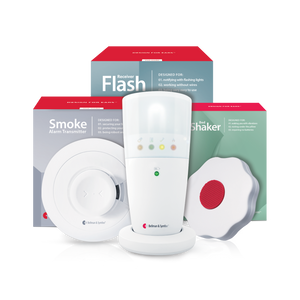
When the smoke transmitter fires, every paired receiver in the home activates simultaneously. The Flash Receiver - plugged into a wall outlet in any room - produces a Xenon-based strobe flash of approximately 30 candela intensity with color-coded LED indicators for event identification. The Alarm Clock Receiver at the bedside fires its combined sound, flash, and bed shaker outputs simultaneously. The bed shaker under the pillow or mattress delivers strong physical vibration directly to the sleeping body. In systems that include the Watch Receiver and Bluetooth Bridge, a dedicated smoke/fire icon appears on the wrist display as well.
All Bellman receivers include battery backup that maintains full function during power outages - critically important given that electrical fires can disrupt household power at the moment they begin. The combined effect of multiple simultaneous alert channels across the home is the redundancy that makes the system genuinely reliable: if one channel fails to register in a particular situation, the others don't.
Bellman Smoke Alarm System Bundles: Every Configuration Explained
All bundles below use the same Bellman RF platform - no Wi-Fi, no app required, pre-paired from the factory, and fully expandable. The Smoke Alarm Transmitter in every bundle carries UL217 certification. CO Alarm Transmitters carry UL2034 / CSA 6.19 certification.
Smoke/Fire and Carbon Monoxide Alarm System with Alarm Clock Receiver and Bed Shaker
The most comprehensive smoke alerting bundle in the Bellman range, and the one we'd recommend for almost every deaf or hard of hearing household. It includes both a Smoke and Fire Alarm Transmitter and a Carbon Monoxide Alarm Transmitter - covering both threats from a single system. The Alarm Clock Receiver at the bedside delivers up to 100 dB sound, a bright flash, and bed shaker vibration simultaneously when either transmitter fires, and color-coded LEDs clearly distinguish a smoke event (red) from a CO event (alternating red and orange). During a power outage, the battery backup keeps the receiver fully operational. The same Alarm Clock Receiver also handles your morning wake-up alarm with identical multi-sensory output, making it a genuinely useful bedside device beyond emergency use.
- Smoke AND carbon monoxide detection in one fully integrated system
- Alarm Clock Receiver delivers up to 100 dB + bright flash + bed shaker - simultaneous
- Color-coded LED icons distinguish smoke/fire (red) from CO (alternating red/orange)
- Battery backup maintains full receiver function during power outages
- Built-in night light and intuitive controls on Alarm Clock Receiver
- Expands into full Bellman Alerting System - add doorbell, phone, baby monitor transmitters
Smoke/Fire and Carbon Monoxide Alarm System with Flash Receiver and Bed Shaker
For users who want the most powerful visual alert alongside their bed shaker - or who prefer a Flash Receiver over a combined alarm clock device - this bundle provides the same dual smoke and CO coverage with the Xenon-based Flash Receiver delivering room-filling strobe output. The Flash Receiver (approximately 30 candela) is specifically engineered to produce alerts visible across a room in normal lighting, including in a direct sightline from a sleeping position. The Bed Shaker provides nighttime reliability. Battery backup on the Flash Receiver ensures continuous function during power outages, and color-coded LEDs distinguish event types clearly.
- Xenon Flash Receiver (~30 candela) - powerful strobe visible in normal room lighting
- Smoke AND carbon monoxide detection in one integrated system
- Color-coded LEDs: red for smoke/fire, alternating red/orange for CO
- Bed Shaker under pillow or mattress for reliable overnight waking
- Battery backup on Flash Receiver for power-outage resilience
- Certified to UL217 / UL2034 / ULC S531 / CSA 6.19 standards
Smoke/Fire Alarm System with Flash Receiver and Bed Shaker
For homes where a separate standalone CO detector is already installed, or for users who want a focused smoke-and-fire alerting system without the CO component, this bundle provides the same Flash Receiver and Bed Shaker configuration paired with just the Smoke Alarm Transmitter. It carries the same UL217 / ULC S531 certification and 500-foot wireless range. The Flash Receiver delivers room-filling strobe flash with color-coded LED event indicator; the Bed Shaker handles overnight coverage. Fully expandable - if you later want to add CO monitoring, adding a Carbon Monoxide Alarm Transmitter requires no changes to the existing receiver setup.
- Focused smoke and fire detection - right for homes with existing CO monitoring
- Flash Receiver provides strong visual strobe alerts during waking hours
- Bed Shaker delivers physical overnight waking with no audio required
- Battery backup on Flash Receiver for power-outage operation
- CO Alarm Transmitter can be added later - no receiver changes needed
- Certified to UL217 / ULC S531 standards
Smoke/Fire Alarm System with Alarm Clock Receiver and Bed Shaker
A focused smoke-only equivalent of our top pick - the Smoke Alarm Transmitter paired with the Alarm Clock Receiver and Bed Shaker, without the CO component. This is the right configuration for users who have standalone CO detection elsewhere and want a comprehensive bedside smoke alert system that also consolidates their morning alarm. The Alarm Clock Receiver combines clock functions with multi-sensory emergency alerting: loud sound, flash, and bed shaker activate simultaneously when the smoke transmitter fires. Its high-contrast digital display, built-in night light, and battery backup make it a practical daily-use device rather than a purely emergency appliance.
- Alarm Clock Receiver combines morning alarm and smoke alert in one bedside unit
- Up to 100 dB alarm output with simultaneous flash and bed shaker
- Built-in night light and high-contrast digital display
- Battery backup for continuous operation during power outages
- CO Alarm Transmitter can be added at any time without changing receiver setup
- Part of the full Bellman Alerting System - expandable to any other alert category
Smoke/Fire Alarm System with Flash Receiver, Bed Shaker, Bridge, and Watch Receiver
Bellman's most advanced smoke alerting configuration - the Smoke Alarm Transmitter paired with a Flash Receiver, Bed Shaker, Bluetooth Bridge Transceiver, and Watch Receiver. When smoke or fire is detected, the Flash Receiver fires its strobe, the Bed Shaker activates under the pillow, and the Watch Receiver simultaneously vibrates on the wrist with a dedicated smoke/fire event icon on its display. The free Bellman Assistant app for iOS and Android extends alerts to the smartphone, providing an additional notification layer including when you're in parts of the home beyond the Flash Receiver's direct visual range. This bundle is certified to UL217 / ULC S531 standards and works as part of the full Bellman Alerting System.
- Triple-layer alert: Flash Receiver strobe + Bed Shaker + Watch vibration simultaneously
- Watch Receiver displays dedicated smoke/fire icon for immediate event identification
- Free Bellman Assistant app adds smartphone notifications for extended coverage
- Most comprehensive detection-to-alert coverage in the Bellman smoke range
- Customizable Watch face - wearable daily as a regular smartwatch
- Certified to UL217 / ULC S531 standards
Carbon Monoxide Alarm System with Flash Receiver and Bed Shaker
A dedicated CO-only alerting system - the right choice for homes where smoke detection is already covered by existing certified smoke alarms and the gap is specifically carbon monoxide. The Carbon Monoxide Alarm Transmitter detects CO at early concentrations, well before levels reach immediately dangerous thresholds, giving maximum time to respond and ventilate. When triggered, the Flash Receiver delivers bright strobe alerts and the Bed Shaker activates for nighttime coverage. Battery backup maintains Flash Receiver operation during power outages. Certified to UL2034 / CSA 6.19 standards. Fully compatible with all Bellman receivers - if you later want to add smoke detection, the Smoke Alarm Transmitter pairs with the same receivers already in place.
- Early CO detection - triggers at low concentrations before levels become critical
- Flash Receiver and Bed Shaker cover both day and night alerting scenarios
- Battery backup on Flash Receiver for power-outage operation
- CO Alarm Transmitter has up to 5 years of battery life
- Smoke Alarm Transmitter can be added at any time - same receivers respond
- Certified to UL2034 / CSA 6.19 standards
Smoke & Fire ADA Compliance Kit with Flash Receiver and Bed Shaker
Designed specifically for public housing, university residential facilities, assisted living settings, shelters, and community safety programs that require documented ADA-aligned fire alerting for deaf and hard-of-hearing occupants. This kit includes the Smoke Alarm Transmitter, Flash Receiver, and Bed Shaker preconfigured for rapid deployment without Wi-Fi, apps, or manual pairing - reducing installation complexity across multi-unit environments. The system is certified to UL217 and ULC S531 standards and supports government procurement, ADA readiness programs, and housing authorities. Flash Receiver delivers high-intensity strobe output with color-coded event indicators; Bed Shaker provides tactile nighttime coverage.
- ADA-aligned configuration designed for multi-unit and institutional deployment
- Certified to UL217 / ULC S531 - supports government procurement requirements
- Pre-configured for rapid deployment - no Wi-Fi, apps, or manual pairing
- Flash Receiver provides a high-intensity strobe with color-coded event indicators
- Bed Shaker delivers tactile nighttime alerting for sleeping occupants
- Suitable for public housing, university housing, assisted living, and shelters
Bundle Comparison at a Glance
How to Choose: Matching the System to Your Situation
Answer these before you buy
Each question narrows your options - most people will have a clear answer within the first three.
- Need both smoke AND CO coverage? → Dual smoke+CO bundles (#1 or #2)
- Already have CO detection installed? → Smoke-only bundles (#3, #4, or #5)
- Need only CO coverage? → CO-only bundle (#6)
- Want a single bedside unit for alarms + clock? → Alarm Clock Receiver bundles
- Want the most powerful visual strobe? → Flash Receiver bundles
- Want wrist-based and smartphone alerts too? → Watch + Bridge + Flash bundle (#5)
- Installing in a multi-unit / institutional setting? → ADA Compliance Kit (#7)
- Primary concern is nighttime waking? → Any bundle with Bed Shaker (all above)
- Want to also cover doorbell, phone, baby monitor? → Any bundle (all same platform)
- Power outages a concern in your area? → All Bellman receivers include battery backup
- Large home — need multi-room coverage? → Add a second Flash Receiver to any bundle
- Most comprehensive single purchase? → Smoke + CO + Alarm Clock + Bed Shaker (#1)
Fire Safety as Part of a Complete Alerting Platform
One of the most practical advantages of building your smoke alerting on the Bellman platform is that smoke detection is just one of the things the system handles. The same Flash Receiver or Alarm Clock Receiver that fires when smoke is detected also responds to your doorbell, phone calls, and baby monitor - each with distinct color-coded indicators so you always know what's happening. Adding a doorbell alerting system or a baby monitor to an existing smoke alert setup requires only adding the corresponding transmitter. No new receivers, no new setup, no system replacement.
This is the architectural advantage of the modular platform: fire safety and daily convenience alerting share the same infrastructure. The receiver by your bed that wakes you for a smoke alarm at 3 a.m. is the same device that wakes you when your baby cries at 2 a.m. - and each event is instantly identifiable by icon color, so you know exactly what you're responding to before you're fully awake.
We bought a few devices for my mom after she had a scare with a missed smoke alarm. I can't explain the relief of knowing she'll be alerted now. It's not flashy, it's just very solid.
Verified Customer - Bellman Alerting SystemThe Bottom Line
The fire safety gap for deaf and hard-of-hearing people is real, measurable, and entirely addressable with the right equipment. Standard smoke alarms emit tones in the frequency range most affected by hearing loss, offer no non-audio alerting channel, and provide no reliable method for waking a deaf sleeper from a closed bedroom at night. These are not minor limitations - they are life-safety gaps that affect nearly 40 million Americans with hearing difficulty.
Visual alerting (strobe flash receivers) and vibrating alerting (bed shakers and wearable devices) together close that gap comprehensively. They cover different situations - visual works when you're awake and in the room; vibration wakes you from sleep regardless of what room you're in. The most effective systems combine both, delivered simultaneously across multiple channels, so no scenario is left unaddressed.
For most households, the Smoke/Fire and Carbon Monoxide System with Alarm Clock Receiver and Bed Shaker is the right starting point — it covers both detection threats, delivers the most complete multi-sensory overnight alert, and forms the foundation of a whole-home alerting setup that can expand to cover every other event in the home. To explore the full range, visit the Bellman smoke and fire detection collection.
Don't leave fire safety to chance.
Explore Bellman's complete range of smoke and CO alerting systems - pre-paired, Wi-Fi-free, and certified to UL standards. Every second of early warning matters.
Sources and references: National Fire Protection Association (NFPA) - NFPA 72: National Fire Alarm and Signaling Code; Fire Loss in the United States (annual report); Home Smoke Alarms research · U.S. Fire Administration (USFA) - Home Fire Alarms for People with Hearing Loss; Residential Fire Statistics · National Institute on Deafness and Other Communication Disorders (NIDCD) - Quick Statistics About Hearing · Americans with Disabilities Act (ADA) - Title III requirements for accessible fire alarm systems in public accommodations · Underwriters Laboratories (UL) - UL217: Single and Multiple Station Smoke Alarms; UL2034: Single and Multiple Station Carbon Monoxide Alarms · CSA Group - CAN/ULC S531: Standard for Smoke Alarms (Canada) · World Health Organization (WHO) - Deafness and Hearing Loss Fact Sheet (updated March 2026) · Centers for Disease Control and Prevention (CDC) - Hearing Loss in Adults · Bellman & Symfon - Smoke and fire notification system product specifications and documentation (us.bellman.com)
This article is for informational purposes only. Product specifications, certifications, and availability are subject to change. This article does not constitute fire safety, building code, or ADA compliance advice. Always consult local fire codes and a qualified professional for fire safety system installation requirements in your specific jurisdiction.
Smoke Alarm for Deaf People: Visual vs. Vibrating Options
This guide breaks down the practical choices, features, and considerations behind this topic. Use it to identify a setup that fits the listener, the environment, and the everyday moments that matter most.
The featured products below are current Bellman options discussed in the article or closely matched to its use case.