Bluetooth Smoke Alarm for Hearing Impaired: Visual & Vibrating Safety Explained

A standard smoke alarm is a sound-based device. For the 48 million Americans with hearing loss - and for anyone who removes hearing aids at night - that sound may not be enough. This guide explains how a Bluetooth smoke alarm system for hearing-impaired people works, why visual and vibrating alerts are a life-safety requirement, and exactly how to configure day and night coverage so no moment is unprotected.
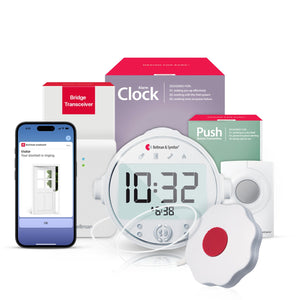
A Bluetooth smoke alarm system for hearing-impaired people connects a Smoke Alarm Transmitter to the Bellman Bluetooth Bridge, which sends instant wrist vibrations and visual alerts to the Watch Receiver and smartphone app when smoke or fire is detected - ensuring safety during the day. At night, when hearing aids are removed, and the Watch is charging, the Bridge + Smoke + Alarm Clock bundle adds an Alarm Clock Receiver with bright flashing lights and a bed shaker that delivers physical vibration strong enough to wake a deep sleeper - no Wi-Fi or subscription required.
Research on residential fire fatalities consistently shows that nearly half of fire deaths occur at night. The combination of darkness, sleep, and the absence of hearing aids creates a window where a standard smoke alarm - even a loud one - may not wake a deaf or hard-of-hearing person in time to escape. A multi-sensory alerting system that uses vibration, flashing lights, and a bed shaker is not a convenience upgrade. It is the difference between waking and not waking.
Why a Standard Smoke Alarm Is Not Enough
The National Fire Protection Association estimates that three out of five home fire deaths occur in homes with no working smoke alarm, or with an alarm that failed to alert occupants. For hearing-impaired people, the risk profile is different: the alarm is often present and working perfectly, but the warning it produces is inaccessible.
Standard smoke alarms produce a high-frequency alarm tone in the 3,000–4,000 Hz range. This frequency range is specifically chosen because it falls within the range of maximum human hearing sensitivity. For people with high-frequency hearing loss - the most common pattern of age-related and noise-induced hearing loss - this is precisely the range that is most compromised. A 3,500 Hz tone that a person with normal hearing finds piercing may register as a faint background sound, or nothing at all, for someone with even moderate hearing loss at that frequency. Add a closed door, a sleeping position away from the alarm, and the absence of hearing aids, and the standard smoke alarm becomes effectively silent.
This is not a hypothetical. It is a documented, recurring cause of preventable fire fatalities. The solution is a system that does not depend on hearing the alarm - one that delivers the warning through channels that remain accessible regardless of hearing status, time of day, or sleep state.
How the Bellman Bluetooth Smoke Alarm System Works
The Bellman smoke alerting system replaces the single-channel audio warning of a standard alarm with a multi-sensory, whole-home notification chain. Here is how the signal travels from the moment smoke is detected to the moment you are alerted.
The Smoke Alarm Transmitter
The Bellman Smoke Alarm Transmitter uses advanced multi-criteria optical and heat sensing technology to detect smoke and fire. It is placed in the home either as a standalone smoke detector or alongside your existing smoke alarms - it can detect the sound of a standard alarm's horn and relay that signal wirelessly, so you do not necessarily need to replace existing alarms to gain the alerting capability. When smoke or elevated heat triggers the transmitter, it sends a wireless signal on the 433 MHz radio frequency band, which travels through walls, ceilings, and floors without requiring line-of-sight to any receiver.
The Bluetooth Bridge
The Bellman Bluetooth Bridge receives the 433 MHz signal from the Smoke Alarm Transmitter and converts it into a Bluetooth signal - instantly and without Wi-Fi. The Bridge identifies the alert as a smoke alarm event specifically and relays the correct icon and notification to both the Watch Receiver and the Bellman Assistant app simultaneously. For a full technical explanation of how the Bridge handles this signal conversion, see our plain-English guide to how the Bellman Bluetooth Bridge works.
The Watch Receiver and Smartphone App
During the day, the Bellman Watch Receiver vibrates with a distinct, urgent pattern and displays a smoke alarm icon on its screen. At the same time, the free Bellman Assistant app on your iOS or Android smartphone shows a high-priority smoke alarm notification. You receive the alert on your wrist and your phone simultaneously - two independent channels confirming the same emergency. At night, a dedicated Alarm Clock Receiver with flashing lights and a bed shaker takes over. More on nighttime coverage in its own section below.
Bright flashes, strong vibrations, and wrist-based alerts give you peace of mind, knowing you will always be ready in case of an emergency.
Bellman & Symfon - Smoke/Fire Alarm System Product DescriptionDaytime vs. Nighttime: Why You Need Both Configurations
This is the section most guides on smoke alarms for hearing impaired people skip - and it is the most important one. Daytime smoke detection and nighttime smoke detection require fundamentally different alert channels. A system optimized for one time period provides incomplete coverage during the other. Complete fire safety means covering both shifts, with the right device for each.
Watch + Smartphone App
During waking hours, you wear the Watch Receiver on your wrist and carry your smartphone. Both receive the smoke alarm alert the moment the Bridge relays it.
- Watch vibrates urgently with smoke alarm icon
- Bellman Assistant app (iOS & Android) shows simultaneous notification
- Coverage extends to the yard, garage, and all rooms within 650 ft of the Bridge
- Alert is private - no audio disrupts others in the home
- Dual-channel: missing one means catching the other
Alarm Clock Receiver + Bed Shaker
At night, the Watch charges on the bedside table and hearing aids are removed. The Alarm Clock Receiver and bed shaker take over primary alerting - without depending on the Watch or smartphone.
- Alarm Clock Receiver produces 100 dB alarm and bright flashing lights
- Bed shaker placed under mattress delivers strong physical vibration
- Wakes deep sleepers through multiple physical channels simultaneously
- Operates independently - no Watch, no phone, no Bluetooth pairing needed at night
- Works during internet outages and power fluctuations
The Bridge + Smoke + Alarm Clock bundle is built precisely for this two-shift approach. It includes the Smoke Alarm Transmitter, Bluetooth Bridge, Alarm Clock Receiver, and Bed Shaker - covering overnight safety from the moment you set it up. The Watch Receiver can be added separately to complete the daytime layer, giving you continuous whole-home coverage around the clock from one unified system and one transmitter.
Wearing the Watch to sleep is not a reliable nighttime safety strategy. Wrist vibration during deep sleep may not be strong enough to wake someone reliably - the same reason vibrating phone alerts are often missed overnight. The bed shaker delivers vibration through the entire mattress, which is a significantly stronger physical signal than a wrist vibration. For a life-safety alert during sleep, the Alarm Clock Receiver and bed shaker combination is the appropriate configuration - not the Watch alone.
The Three Alert Channels: What Each One Does
The Bellman smoke alerting system uses up to three distinct notification channels, depending on configuration. Understanding what each one does - and when each one matters most - makes it easier to choose the right setup for your household.
Wrist Vibration - Watch Receiver
The Bellman Watch Receiver delivers an urgent vibration pattern and displays a smoke alarm icon on its screen. This is the primary daytime alert channel - it reaches you wherever you are in the home and yard, requires no line-of-sight, and works with up to one week of battery life per charge. The Watch distinguishes smoke alarm alerts from doorbell or phone alerts through distinct vibration patterns and dedicated icons, so you always know immediately what type of alert has fired.
Smartphone Notification - Bellman Assistant App
The free Bellman Assistant app (iOS 15+ and Android 8.0+) receives the same smoke alarm notification from the Bridge via Bluetooth and displays it on your phone screen with sound and vibration settings you control. This channel runs simultaneously with the Watch during the day, providing an independent backup. If you put the Watch on to charge mid-afternoon, your phone catches any alerts in the meantime. The app requires no Wi-Fi to receive alerts from the Bridge - it communicates directly over Bluetooth.
Flashing Lights - Flash Receiver or Alarm Clock Receiver
The Alarm Clock Receiver and the optional Flash Receiver both produce bright, rapid flashing lights when an alert fires. Visual alerts are particularly effective when the wrist Watch is not being worn - during sleep, during a shower, or during any activity where the Watch has been set aside. The Alarm Clock Receiver's flash output can be directed toward the sleeping area so the flashing light enters the sleeper's visual field, adding a second physical channel alongside the bed shaker. The flash output is also effective during the daytime for anyone in the same room as the receiver.
Bed Shaker - Physical Vibration Through the Mattress
The bed shaker is a flat vibrating disc placed under the mattress or pillow. When an alert fires, it produces strong vibrations that travel through the mattress and into the sleeping person's body. This is the most reliable method for waking a deaf or hard of hearing person from deep sleep - significantly more reliable than a wrist vibration or a loud sound alone. The bed shaker is included in the Bridge + Smoke + Alarm Clock bundle and works with the Alarm Clock Receiver via the standard Bellman Visit RF connection.
Carbon Monoxide: The Alert You Cannot See, Hear, or Smell
Carbon monoxide is produced by incomplete combustion - from gas furnaces, fireplaces, water heaters, generators, and attached garages. It is colorless, odorless, and accumulates silently. The only way to detect it is with a CO sensor. For hearing-impaired people, the stakes are even higher than for smoke: there is no visual cue of any kind - no smoke, no visible flame - before incapacitation begins.
The Bellman alerting system supports CO detection through a Carbon Monoxide Alarm Transmitter that works exactly like the Smoke Alarm Transmitter - detecting elevated CO levels and sending an immediate signal to the Bridge, which relays the alert to the Watch, the app, and the Alarm Clock Receiver. The CO alert uses a distinct icon on the Watch so you know immediately whether the emergency involves smoke/fire or carbon monoxide - a critical distinction that affects the appropriate response.
For households that want combined smoke and CO coverage, Bellman offers a full ADA-aligned bundle with both the Smoke Alarm Transmitter and the Carbon Monoxide Alarm Transmitter included, alongside the Alarm Clock Receiver and bed shaker - providing complete fire and CO safety coverage for hearing impaired individuals in a single preconfigured kit.
Smoke/Fire: Optical and heat sensing detect combustion products. The Smoke Alarm Transmitter can detect your existing smoke alarm's horn or operate as a standalone detector. Alert relayed to Watch (smoke icon), app notification, Alarm Clock Receiver, and bed shaker.
Carbon Monoxide: Electrochemical sensing detects CO concentration in air. The CO Transmitter fires when CO rises above safe thresholds. Alert relayed through the same Bridge to the same Watch (CO icon), app notification, Alarm Clock Receiver, and bed shaker - a distinct icon ensures you know which hazard has been detected.
Standard Smoke Alarm vs. Bellman Multi-Sensory System: A Direct Comparison
| Feature | Standard Smoke Alarm Only | Bellman Bluetooth Smoke System |
|---|---|---|
| Alert channels | Audio only - one channel, inaccessible with hearing loss | Wrist vibration, smartphone app, flashing lights, bed shaker - four independent channels |
| Overnight alerting | Audio alarm only - may not wake a deaf sleeper without hearing aids | Bed shaker through mattress + 100 dB Alarm Clock + flashing lights - wakes deep sleepers reliably |
| Daytime wrist alert | Not available - no wearable channel | Watch Receiver vibrates with smoke icon wherever you are in the home |
| Smartphone notification | Not available on standard alarms | Bellman Assistant app (iOS & Android) receives simultaneous alert via Bluetooth |
| Wi-Fi required | No | No - 433 MHz RF + Bluetooth; no internet dependency at any point |
| Works during power outage | Battery backup on some models | RF transmitters and receivers operate on battery; Bridge has battery backup; system maintains alerting through outages |
| CO detection option | Requires separate CO alarm | CO Transmitter available - integrates into same Bridge, Watch, and Alarm Clock Receiver |
| Whole-home alert coverage | Fixed location only - audible range limited | Watch covers full home and yard (650 ft); additional receivers can be placed in multiple rooms |
Where to Place the Smoke Alarm Transmitter: Getting Detection Right
The Smoke Alarm Transmitter can be deployed in two ways - and choosing the right method for your home makes a significant difference in detection reliability.
Method 1: Alongside Your Existing Smoke Alarm
The transmitter's internal microphone can detect the horn of an existing smoke alarm and relay the signal wirelessly. Place the transmitter within a few feet of your existing alarm - ceiling or wall-mounted near the alarm unit. When the standard alarm fires, the transmitter detects the horn sound and immediately signals the Bridge. This method means you keep your existing smoke detection infrastructure and simply add the Bellman alerting layer on top.
Method 2: As a Standalone Smoke Detector
The Smoke Alarm Transmitter can also function as a standalone detector using its own optical and heat sensing elements. In this configuration, it mounts directly to the ceiling like a standard smoke alarm and detects smoke and fire independently - no existing alarm required. This is the preferred method for new installations, vacation homes, or any room where you want dedicated Bellman-system detection rather than relying on the acoustic detection of an adjacent alarm.
- Install on ceiling or high on walls - smoke rises, so ceiling placement maximizes early detection
- At least one alarm on every level of the home - basement, main floor, upper floors
- Inside each bedroom and in the hallway outside sleeping areas
- Away from cooking areas - install at least 10 feet from stoves to reduce false triggers
- Away from air vents, fans, and windows that can dilute or redirect smoke before detection
- Test the complete signal chain monthly - press the test button and confirm Watch and app both alert
- Replace transmitter batteries per manufacturer schedule - do not wait for low-battery notifications
- Replace smoke detection elements every 10 years - optical sensors degrade over time
No Wi-Fi: Why That Matters Specifically for Fire Safety
Many modern smart smoke alarms - including popular Wi-Fi connected models - route their alerts through the internet. When smoke is detected, the alarm sends a signal to a cloud server, which sends a push notification to your phone. This works reliably in normal conditions. It fails silently in the scenarios where you most need it to work.
If your internet goes down - whether from a utility outage, a router failure, or a fire that disrupts your power before the alarm triggers - the cloud notification chain breaks. Your alarm may be sounding at full volume while your phone shows nothing. In a house fire, the power failure often precedes or accompanies the alarm event itself. An internet-dependent alerting system is most likely to fail precisely when a fire makes it most critical.
The Bellman system uses 433 MHz RF between the transmitter and Bridge, and Bluetooth between the Bridge and Watch - neither of which routes through the internet or depends on your router. The transmitters and receivers operate on battery backup. The system continues to function during power outages, internet outages, and router failures. For a life-safety alert, this is not a minor technical preference - it is a fundamental reliability requirement. See our full guide on no-Wi-Fi hearing alert systems for more.
Smoke Safety as Part of a Whole-Home Alerting System
The Bridge + Smoke + Alarm Clock bundle provides complete two-shift smoke and fire coverage. But the same Bridge and Watch Receiver that handles fire safety also handles every other alert type in the home - and that expandability is one of the most practical aspects of the Bellman system for hearing-impaired households.
Rather than buying a separate doorbell alert device, a separate baby monitor, and a separate phone alert system - each with its own receiver, its own setup, and its own notification style - the Bellman system routes all of them through one Bridge and one Watch. You learn one notification style, manage one receiver on your wrist, and know exactly what each distinct vibration pattern and icon means without having to check multiple devices.
- Doorbell coverage: A Door Transmitter plus the Doorbell System with Bridge and Watch Receiver uses the same Bridge to alert your wrist when a visitor arrives. For overnight doorbell coverage, the Bridge + Door + Alarm Clock bundle uses the same Alarm Clock Receiver that already covers your smoke alerts.
- Baby monitoring: Parents who also need baby monitoring can add a Baby Monitor Transmitter. The same Watch vibrates with a baby icon - and for overnight monitoring, the same Alarm Clock Receiver handles baby alerts alongside smoke alerts. See our guide on baby monitors for deaf parents for full coverage.
- Landline phone alerts: The Phone System with Bridge and Watch Receiver connects a Telephone Transmitter to the landline - the Watch vibrates with a phone icon for incoming calls, using the same Bridge already in place.
- Push button: A Push Button Transmitter lets a family member or caregiver send a direct wrist alert. The Bridge + Push + Alarm Clock bundle extends this to overnight coverage.
For a complete overview of how the smoke alarm fits into a full whole-home alerting setup, see The Complete Guide to Bluetooth Alerting Systems for Deaf & Hard of Hearing People.
Confirm Every Layer Before Calling It Done
A gap in any of these items is a gap in your fire safety coverage. Work through all of them after setup.
- Smoke Alarm Transmitter placed on ceiling - or mounted beside existing alarm
- Bridge plugged in centrally - signal chain from transmitter to Watch confirmed
- Watch Receiver paired - smoke alarm icon confirmed on test signal
- Bellman Assistant app installed - smoke notification confirmed on phone
- Alarm Clock Receiver placed in bedroom - alert confirmed on test signal
- Bed shaker placed under mattress or pillow - vibration confirmed on test signal
- Overnight test performed with hearing aids removed - bed shaker wakes reliably
- At least one transmitter per floor of the home
- CO Transmitter added if gas appliances, garage, or fireplace are present
- Monthly test scheduled - calendar reminder set
Day and night smoke and fire coverage - one unified system.
The Bridge + Smoke + Alarm Clock bundle covers overnight alerting with a bed shaker and flashing lights. Add the Watch Receiver separately for daytime wrist alerts wherever you are at home.
Sources and references: Bellman & Symfon - Smoke/Fire Alarm System with Bluetooth Bridge and Alarm Clock product specifications (us.bellman.com/products/smoke-fire-monitoring-system-with-bluetooth-bridge-and-alarm-clock) · Bellman & Symfon - Smoke Alarm Transmitter: advanced multi-criteria optical and heat sensing technology, 433 MHz wireless transmission, standalone detection or acoustic detection of existing alarm horn · Bellman & Symfon - Alarm Clock Receiver: 100 dB audio output, bright flashing light, bed shaker connection, battery backup · Bellman & Symfon - Bluetooth Watch Receiver: up to 1 week battery life, 650 ft Bluetooth range (open field), distinct smoke alarm icon and vibration pattern · Bellman & Symfon - Bluetooth Bridge Transceiver: 433 MHz RF input, Bluetooth 5 output, no Wi-Fi required · Bellman & Symfon - ADA Smoke, Fire, and CO Alarm Notification Bundle: Smoke Alarm Transmitter + Carbon Monoxide Alarm Transmitter + Alarm Clock Receiver + Bed Shaker (us.bellman.com) · Bellman & Symfon - Smoke and CO detector collection overview (us.bellman.com/collections/alerting-devices-safe-smoke-carbon-monoxide-detector-for-deaf) · National Fire Protection Association - residential fire death statistics; NFPA finding that nearly half of residential fire deaths occur during sleeping hours · Audiological research on high-frequency hearing loss (3,000–4,000 Hz) as the most common pattern in age-related and noise-induced hearing loss, and its implications for standard smoke alarm audibility.
This article is for informational purposes only. Product specifications are subject to change; refer to current product pages at us.bellman.com for the most up-to-date technical details.
Bluetooth Smoke Alarm for Hearing Impaired: Visual & Vibrating Safety Explained
This guide breaks down the practical choices, features, and considerations behind this topic. Use it to identify a setup that fits the listener, the environment, and the everyday moments that matter most.
The featured products below are current Bellman options discussed in the article or closely matched to its use case.