ADA Hotel Room Accommodations for Hearing Loss

ADA Hotel Guide
Hotels have duties under the ADA. Many guests do not know what to ask for. This guide explains the rules in plain words. It also shows how to make a clear request.
- What Does the ADA Require From Hotels for Guests With Hearing Loss?
- Which Communication Features Must Hotel Rooms Have?
- How Many Rooms Must Have Communication Features?
- What Can Hotels Provide on Request?
- How Do You Call a Hotel With a TTY or Relay?
- How Do You Request a Room With Communication Features?
- What Should You Check After You Arrive?
- Can a Hotel Say No?
- What Can You Bring to Add to Hotel Features?
- What Is a Simple Hotel Request Checklist?
- People Also Ask
Hotels must communicate effectively with guests who are deaf or hard of hearing. Many rooms must have visual alarms. They must also have visual alerts for calls and door knocks. Hotels must provide a TTY and caption decoders on request. Ask for these when you book, and get your request in writing.
What Does the ADA Require From Hotels for Guests With Hearing Loss?
The Department of Justice (DOJ) publishes a business brief for hotels. It says hotels and motels must provide effective communication. Guests who are deaf must get equal access. So must guests who are hard of hearing.
The right aid depends on the guest and the task. Short chats may work with written notes. Long or complex talks may need more help.
- A hotel must provide a TTY on request for guest rooms.
- Where rooms have TVs, caption decoders must be provided on request.
- Guests may bring service animals, including hearing dogs, into guest areas.
- Long or complex talks may need an interpreter or real-time captioning.
These are rules for hotels, not favors. You can ask for them plainly.
Note: This guide gives general information. It is not legal advice. The DOJ brief is guidance, not a binding rule.
Which Communication Features Must Hotel Rooms Have?
Hotels must also build certain features into a share of guest rooms. The DOJ lists three.
| Feature | What It Does | What to Ask |
|---|---|---|
| Visual alarm | Shows a light signal. It connects to the building emergency alarm system. | Does my room have a visual alarm? |
| Visual notification devices | Alert you to phone calls and door knocks or bells. | How does the room signal a knock? |
| Electrical outlets | Help you use a text telephone. | Where are the TTY outlets? |
The 2010 ADA Standards call these rooms guest rooms with communication features. They must include a fire alarm system with both audible and visible alarms.
How Many Rooms Must Have Communication Features?
The DOJ says a certain percentage of rooms must have these features. The 2010 Standards set the minimum by total room count. Larger hotels must have more.
The Standards also say these rooms must be spread among room types. Guests should have comparable choices, such as bed types.
Timing matters. Hotels built or altered after the ADA took effect must have the features. Older hotels must remove barriers when it is not too difficult or costly.
Hotels may also use portable visual alarms and communication devices. Ask which option your hotel uses.
What Can Hotels Provide on Request?
- TTY: The hotel must provide one on request for your room.
- Front desk TTY: The hotel also needs one at the front desk.
- Caption decoders: Provided on request where rooms have TVs.
- Built-in captions: New TVs of 13 inches or more have decoders built in.
- Written notes: These work for short, simple talks.
How Do You Call a Hotel With a TTY or Relay?
The ADA created a free nationwide relay network. A relay operator types and speaks messages between you and the hotel.
The hotel must be ready to take relay calls. These calls may take a little longer. To call a TTY user, dial 7-1-1.
How Do You Request a Room With Communication Features?
- Book directly with the hotel by email or online chat.
- Say you are deaf or hard of hearing.
- Name each item you need, such as a visual alarm or a TTY.
- Ask the hotel to confirm your request in writing.
- Save the confirmation and bring a printed copy.
- Write again a few days before you arrive.
Related reading: Hotel Safety for Deaf Guests: What to Ask & Bring
What Should You Check After You Arrive?
- Ask staff to show you the visual alarm and alerts.
- Test the phone and door alerts, if the hotel allows it.
- Find the outlets for a text telephone.
- Ask for the TTY and caption decoder, if you need them.
- Learn how staff will reach you in an emergency.
If something is missing, tell the front desk right away. Ask for a fix or a portable device. Note the date, time, and staff name.
You can also call the DOJ ADA Information Line at 800-514-0301. The TTY line is 833-610-1264. The ADA.gov site has a page to file a complaint.
Can a Hotel Say No?
Sometimes. The DOJ says a hotel need not provide an aid in two cases. One is when it would fundamentally change the service. The other is when it would cause an undue burden.
If a hotel says no, ask what else it can offer. Keep every answer in writing.
What Can You Bring to Add to Hotel Features?
Hotel features are the base. Your own tools add a backup layer.

The Vibio Bed Shaker wakes you with strong, silent vibration. You can set up to 10 alarms. The free app works on iOS and Android. It runs on saved settings if your phone is off or disconnected.
Portable Bluetooth Bed Shaker Controlled by a Mobile App

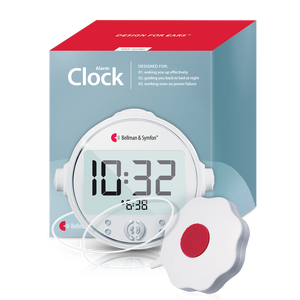
The Alarm Clock Pro is a bedside clock. It adds bright flashing lights to sound and vibration. It uses a wall plug power adapter. See more in the alarm clocks collection.
Important: These alarms are wake-up aids. They do not detect fire. They do not replace hotel alarms or the features hotels must provide.
Related reading: Best Portable Travel Alarm Clocks for Deaf & Heavy Sleepers
Related reading: Portable Bed Shakers for Travel: Never Oversleep on the Road
What Is a Simple Hotel Request Checklist?
Your Hotel Request Checklist
Use it for every booking.
- Say you are deaf or hard of hearing when you book
- Ask for a room with communication features
- Ask for a TTY and a caption decoder, if needed
- Ask for written confirmation of every request
- Bring a printed copy of the confirmation
- Test the visual alarm and alerts at check-in
- Check the outlets for text telephones
- Report any missing item to the front desk right away
- Note the date, time, and staff name
- Pack a portable alarm and a phone backup alarm
Planning a full trip? Read The Complete Travel Guide for Deaf & Hard of Hearing People (2026).
Need a Portable Wake-Up Aid?
The Vibio Bed Shaker is silent, rechargeable, and controlled by a free app.
People Also Ask
Do Hotels Have to Provide Visual Alarms for Deaf Guests?
Many hotels must provide built-in visual alarms in a share of rooms. They connect to the building alarm system.
What Is a Hotel Room With Communication Features?
It is a guest room with visual alarms. It has visual alerts for calls and door knocks. It also has outlets for text telephones.
Must Hotels Provide a TTY?
Yes, on request, for use in guest rooms. The hotel also needs a TTY at the front desk.
Do Hotels Have to Provide Caption Decoders?
Where rooms have TVs, hotels must provide caption decoders on request. New TVs of 13 inches or more have them built in.
How Many Hotel Rooms Must Have Communication Features?
The number depends on the total rooms in the hotel. The ADA sets a minimum in its 2010 Standards.
Can Hotels Use Portable Visual Alarms Instead?
Yes. Hotels may use portable visual alarms and communication devices to meet the requirements.
Can a Hotel Refuse Because of Cost?
Not always. A hotel need not provide an aid that is an undue burden. Ask for another option.
Where Can I Get Help With ADA Questions?
Call the DOJ ADA Information Line at 800-514-0301. The TTY line is 833-610-1264.
Does a Bed Shaker Replace Hotel Alarms?
No. A bed shaker is a wake-up aid. It does not detect fire or replace hotel alarms.

Sources used in this article:
- Department of Justice, ADA Business Brief for hotels and motels, ada.gov/resources/business-brief-hotels
- ADA.gov, 2010 ADA Standards for Accessible Design, ada.gov/law-and-regs/design-standards/2010-stds
- ADA.gov, ADA Information Line, ada.gov/infoline
- ADA.gov, File a Complaint, ada.gov/file-a-complaint
This article is for general information only. It is not legal advice. DOJ business briefs are guidance and may change. Alarm products do not replace required fire alarms. Confirm details with your hotel and ADA.gov.
Read Next in This Series
The Complete Travel Guide for Deaf & Hard of Hearing People (2026)
Our full guide to flights, hotels, devices, and safety.
Best Portable Travel Alarm Clocks for Deaf & Heavy Sleepers
Compare portable ways to wake up on time in any room.
Hotel Safety for Deaf Guests: What to Ask & Bring
Questions to ask the hotel and items to pack.
Flying With Hearing Loss: Airport & Airplane Tips
Simple steps for security, gates, and the flight itself.
Portable Bed Shakers for Travel: Never Oversleep on the Road
How a portable bed shaker works and how to pack one.
Travel Amplifiers & TV Listening for Hotel Rooms
Ways to hear conversations and TV in hotel rooms.
Emergency Alerts on the Go: Staying Safe in Unfamiliar Places
How to get alerts when you are far from home.
Cruise Travel for Deaf & Hard of Hearing Passengers
Plan for ship life, drills, shows, and shore trips.
Camping & Outdoor Safety for People With Hearing Loss
Plan and pack for trips without hotel alerts.
Travel Packing Checklist for Hearing Loss (Printable)
A printable list to help you pack with confidence.